- 한국어
- English
- 日本語
- 中文
- العربية
- Español
- Français
- Deutsch
- Pусский
- Tiếng Việt
- Indonesian
By Yoon Sojung and Yoon Seungjin
Photos = Kim Sunjoo
Video = Kim Sunjoo and Lee Jun Young
"President Yoon's U.K. state visit will be the crowning moment to highlight the 140-year-old bilateral relations," British Deputy Ambassador Gareth Weir says.
In an interview with Korea.net, he called the trip significant for both countries as President Yoon is the first foreign head of state to receive such an invitation from King Charles III since the monarch's coronation, predicting an occasion packed with iconic and special moments to mark bilateral ties.
The diplomat wore a red poppy badge on his jacket collar according to the British custom of doing so on Remembrance Day (Nov. 11), or the U.K.'s equivalent to Memorial Day in Korea, to honor British soldiers who sacrificed their lives in wars like World War I, II and the Korean War. Since this year marks the 70th anniversary of the Armistice Agreement that ended the Korean War, another event was added to the annual commemoration ceremony held in London that day.
The following are excerpts from the Nov. 13 interview held the British ambassador's official residence in Seoul's Jung-gu District.
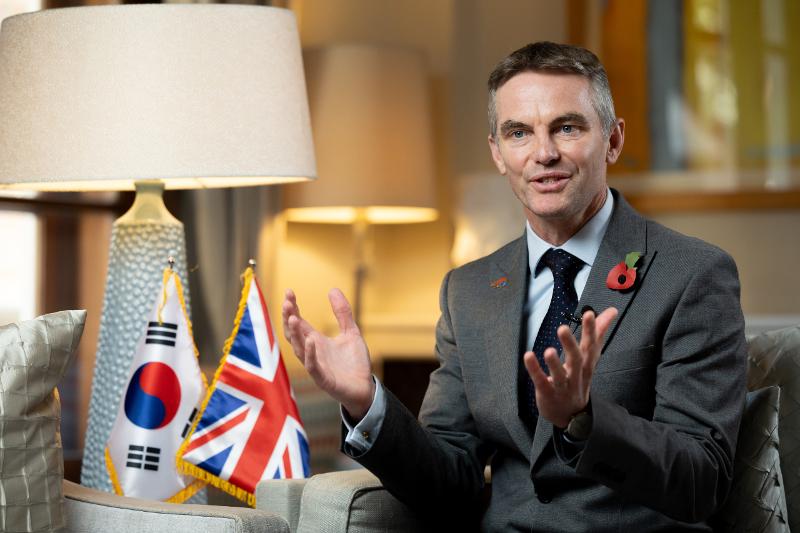
British Deputy Ambassador to Korea Gareth Weir on Nov. 13 explains the significance of President Yoon Suk Yeol’s state visit to the U.K. in an interview with Korea.net at the British ambassador's official residence in Seoul.
Korea and the U.K. this year mark the 140th anniversary of diplomatic relations. How has the embassy marked this anniversary and what is your evaluation of bilateral ties?
Looking all the way back when we signed the treaty of navigation, commerce and friendship in 1883 with the Joseon Dynasty, it's incredible to see what has happened in our partnership over the 140 years. Although we have very different cultures, food and we are different people and speak different languages, our shared history taught us that we are very close when it comes to our values. Among many events the embassy hosted to mark the diplomatic milestone, I want to highlight the king's coronation party we held at the embassy compound, which has the same history of the 140-year-old bilateral relations. Another impressive event in my view is the British minister of state for Indo-Pacific's visit to Korea this May. Minister Anne-Marie Trevelyan launched a program called "Empower," designed to empower female leaders in Korea as part of celebrating the 140 years. And the cherry on top, the crowning moment, will be President Yoon Suk Yeol's first state visit to the U.K.
King Charles III invited President Yoon to pay a state visit to the U.K. slated for later this month. Please explain the significance of this visit.
The state visit is the highest way of inviting a head of state to the U.K. Since this is the king's first foreign invite since his coronation, it will be very significant for both the U.K. and Korea. We hope the president and the first lady will get to see some iconic and very special moments through the state visit such as a ceremonial welcome by the Highnesses, state banquet at Buckingham Palace, speaking at both houses of Parliament and a visit to Churchill War Rooms, where British Prime Minister Winston Churchill led his country during World War II. These will be part of the special moments where we can celebrate our shared history together.
President Yoon's visit is not just a ceremonial event but also an opportunity to boost bilateral cooperation. What sectors does the British government led by Prime Minister Rishi Sunak wish to boost cooperation with Korea?
Thanks to the state visit, leaders of both countries can set out a new future vision for bilateral ties. Even though both sides have already been working actively together in many sectors, I want to highlight the five areas for huge cooperation potential: defense, trade, science technology, international development, and energy and climate. In defense, the Indo-Pacific security and that of Europe Atlantic are intertwined in the contested world we live today. The defense is a big sector to work together such as cybersecurity, defense industry and interoperability.
Regarding trade, both countries are top 10 economies in the world. We are about to renegotiate the Korea-U.K. free trade agreement and we have big opportunities to modernize and upgrade our trade relationship. In science and technology, as both countries are innovators in this area, we have high potential to work together in technologies of the future such as artificial intelligence and semiconductors.
In international development, Korea, which transformed itself from a destitute, poor country into an OECD member country, has been doing incredibly well to become one of the global top 10 donors. Both the U.K. and Korea can boost investment and cooperation in order to achieve (the United Nations') Sustainable Development Goals. In the area of energy and climate, the two countries are committed to the goal of "2050 Net Zero" by achieving carbon neutrality by 2050. To this aim, we must successfully carry out energy transformation. We have a high potential to work together in the areas of renewable energy and nuclear energy for our carbon commitment.
Many Koreans love British culture such as Shakespearean plays and music of the Beatles, while many Britons are big fans of K-pop and Korean films. Why do you think the people of both sides love each other's culture?
It is amazing to see how peoples of both countries deeply enjoy each other's culture. For example, an exhibition at Victoria & Albert Museum on Hallyu, the Korean Wave, attracted thousands of people, and equally, an exhibition "Masterpieces from the National Gallery, London" at Seoul's National Museum of Korea, also was very successful. Whether it's music or film, it is amazing to see the cultural links. Some Korean footballers now play in the English Premier League, becoming global mega stars.
This cultural link is growing because I believe the U.K. and Korea produce some of the world's best content. I think we are both cultural superpowers in terms of the quality of music, TV or films we produce. It is understandable that both countries have a mutual appreciation of each other, transcending barriers like language. In the U.K., the popularity of K-pop and K-Culture seems to be growing. Tickets for major music festivals in the U.K. where Korean bands headline are all sold out. Korean food is on sale in Koreatown in London. More British people study the Korean language. So I think the integration of Korean culture in the U.K. keeps growing.
How does London view Seoul's efforts to improve peace on the Korean Peninsula and the denuclearization of North Korea?
The U.K. is absolutely committed to the denuclearization of the Korean Peninsula, peace of the region and dismantlement of the weapons program in North Korea. We are very active in working with all parties of the world. We also look forward to (South) Korea's membership in the United Nations Security Council starting next year.
We look forward to working with Seoul in a whole range of issues and challenges, including the issue of how we get North Korea come back to the table and back to dialogue for denuclearization talks.
You assumed your post in July last year. What plans do you have while serving in Korea?
I live with my family here and we all enjoy our lives in Korea. I wish to explore this country especially through trying sports in different seasons such as skiing in winter and surfing in summer. Recently, I traveled from Busan to Seoul by cycle more than 600 km to meet many Korean people along the way. With an ambition to get to know better about this country, I wish to do my job better.
What is your concluding message to Korea.net readers?
Personally, I hope to continue my adventure in Korea more and would love to get any recommendations from Korea.net readers. Second, watch the state visit; there will be a lot of highlights, fun and significant moments during the course. Stay tuned for the social media of the British Embassy in Korea, Korea.net and the latest news. I will be delighted to come back to Korea.net to discuss the significance of the bilateral relationship after the state visit.
arete@korea.kr
<grammarly-desktop-integration data-grammarly-shadow-root="true"></grammarly-desktop-integration>