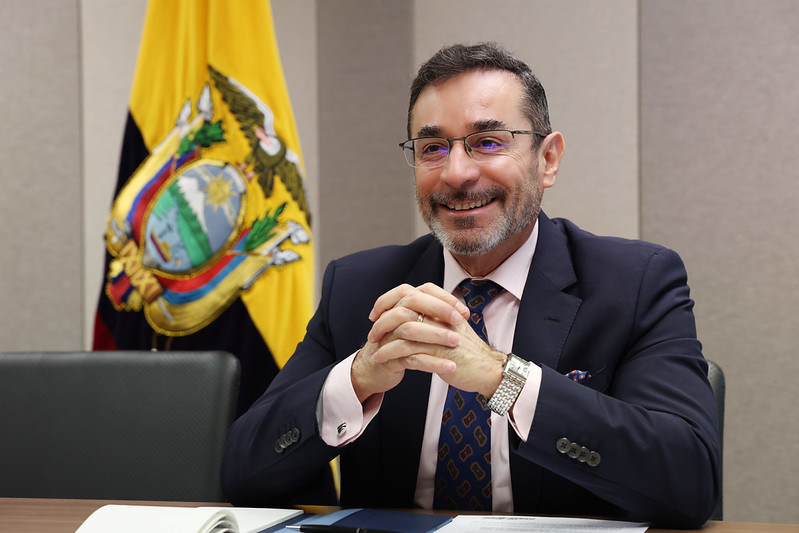
Ecuadorian Ambassador to Korea Patricio Esteban Troya Suarez on March 11 gives an interview to Korea.net at his embassy in Seoul's Jongno-gu District.(Lee Jeongwoo)
By Kim Hyelin
In July 1976, five models of the Pony by Hyundai Motor were exported to an overseas market for the first time. The destination? Ecuador.
At the time, the transaction was done through a barter system for Ecuadorian bananas. The following year, Daewoo Engineering and Construction secured its first infrastructure contract in Latin America by winning a project to pave a major road in Quito.
Fifty years later, ties between both countries have marked a new turning point: the Strategic Economic Cooperation Agreement (SECA) signed in September last year.
Ecuadorian Ambassador to Korea Patricio Esteban Troya Suarez on March 11 spoke of the past, present and the future of bilateral ties in an interview with Korea.net at his embassy in Seoul's Jongno-gu District.
As a veteran diplomat with decades of expertise accumulated through previous postings in Germany, the U.S., Qatar and Italy, he assumed his assignment in Seoul in October 2024. With sharp insights based on his extensive experience, the diplomat defined the bilateral relationship as a "perfectly complementary partnership with almost no areas of competition."
The SECA integrates not only trade but also investment and industrial cooperation, with the ratification process proceeding smoothly in both countries. Ambassador Troya said he expects ratification to be completed this year in Ecuador between April and May and in Korea between July and September.
Once the accord takes effect, bilateral trade will undergo a sea of change. As of 2024, bilateral trade was worth USD 894 million, with Korea being Ecuador's 15th-largest trading partner.
The South American country primarily exports shrimp, cocoa, bananas and flowers to Korea, and after the SECA takes effect, such shipments are predicted to jump 27%. For Korea, its shipments of cars are expected to rise.
China is the largest supplier to the Ecuadorian automotive market thanks to a free trade agreement. The SECA's effectuation will put Hyundai and Kia on the same playing field and enable them to expand market share, and Korean electronics makers and technology companies like LG and Samsung can also expect higher growth.
Ecuador is the fourth Latin American country to sign an economic cooperation agreement with Korea following Chile, Peru and Colombia.
The agreement's effects will extend to energy as well as trade. Hydroelectric power comprises over 80% of Ecuador's power supply but is unstable though eco-friendly due to growingly intensifying fluctuations in rainfall caused by climate change.
"We've already begun consultations with Korea on the introduction of nuclear power technology, and a wind power plant involving a Korean company is operating in the Galapagos Islands," Ambassador Troya said.
Hinting at ongoing negotiations with Korean companies to install solar power and waste incineration plants in Quito and Guayaquil, he added, "Ecuador is also rich in mineral resources such as gold and copper," requesting Korean participation in those sectors.
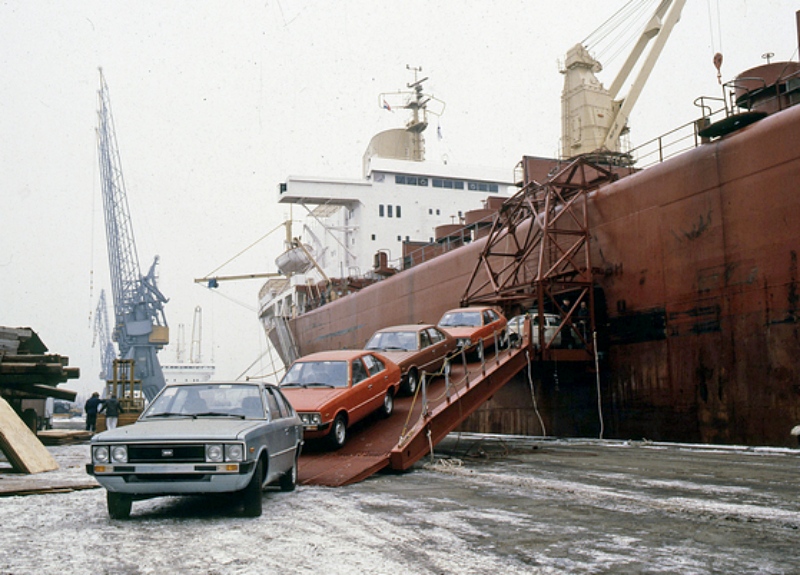
Models of the Pony, the first export car of Hyundai Motor, in July 1976 are being unloaded at the port of Guayaquil, Ecuador. (Hyundai Motor)
Bilateral ties date back earlier than car exports. During the Korean War (1950-53), Ecuador, as a non-permanent member of the United Nations Security Council, voted in favor of a resolution to support Seoul and sent 500 tons of food and medicine.
"That was the starting point of the friendship between the two countries," Ambassador Troya said.
Both sides set up official relations in 1962, and 14 years later, Ecuador became the first overseas market for Korean cars.
At this point, the ambassador stood up and showed a miniature of the Pony as a symbol of bilateral exchange. "Marking the 20th anniversary of exports, Hyundai Motor sent a delegation to Ecuador to find a vehicle still on wheels for display at a museum," he said. A Pony that ran 1.5 million km as a taxi in Ecuador for 20 years is displayed at Heritage Hall of the culture center at Hyundai Motor's Ulsan plant.
Culture can reach a country before economy. Mentioning Korean American singer Jinsop, the ambassador said, "He achieved tremendous success in the 1970s, topping Ecuador's pop charts and becoming a citizen after marrying an Ecuadorian woman. Though I was young at the time, I still remember how famous he was."
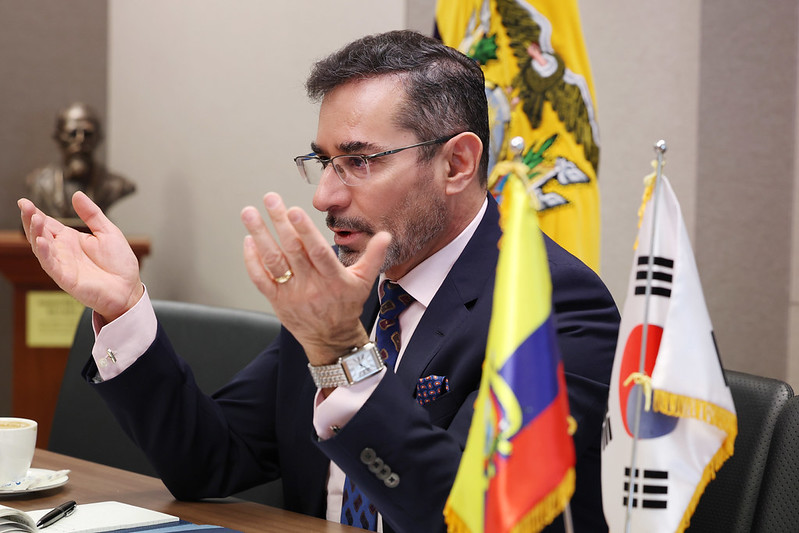
Ecuadorian Ambassador to Korea Patricio Esteban Troya Suarez on March 11 explains the direction of bilateral cooperation in an interview at his embassy in Seoul's Jongno-gu District. (Lee Jeongwoo)
After going home for Christmas last year, he said he saw changes in Ecuador like Korean restaurants and cosmetics stores at all major shopping malls in Quito and kimchi and ramyeon (instant noodles) on display on supermarket shelves.
Ecuadorian teens at K-pop competitions also showcased the dance moves and songs of K-pop girl groups.
"There is always power in culture. Sports, music and tourism are all connected, and that way, we get to know each other better," he said.
To broaden tourism exchanges, he mentioned efforts to connect travel agencies of both countries. To Koreans, he introduced Ecuador as "a country where four totally different natural environments -- the Galapagos, Andes volcanic region, Amazon and Pacific coast -- coexist within one country and ranks among the top five in the world in biodiversity."
Next year, both countries will mark the 65th anniversary of diplomatic relations.
On how he would like the milestone to be observed, the ambassador said after a pause, "I hope that the SECA's ratification will be complete in both countries and for either the Korean president or prime minister to visit Ecuador."
To conclude the interview, Ambassador Trope discussed food with a smile. Recommending Ecuadorian shrimp ceviche, which he said goes surprisingly well with kimchi and Korean beer, he said, "I hope an Ecuadorian restaurant opens in Seoul someday."
"Our embassy is always open. We welcome anyone who wants to introduce Ecuador to our Korean friends."
kimhyelin211@korea.kr