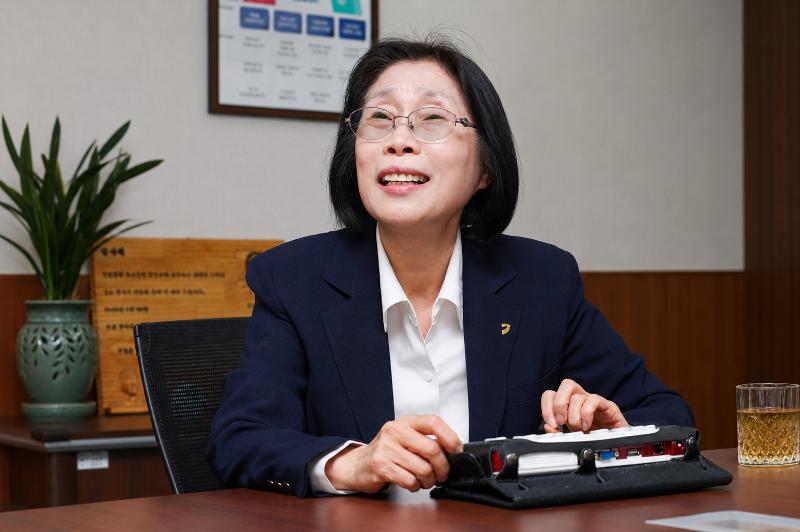
Lee Kyoung Hae, president of the Korea Disability Policy Development Institute, on April 29 gives Korea.net an interview at her institute's Eroom Center in Seoul's Yeongdeungpo-gu District. She stressed the significance of the Disability Rights Guarantee Act, saying, "This law will be a coordinate that changes existing norms and suggests new ones for our society."
By Yoon Sojung and Lee Ji Yae
Photos = Lee Jeongwoo
"I started singing without realizing it."
Lee Kyoung Hae, president of the Korea Disability Policy Development Institute (KODDI), said this is how she felt when the National Assembly on April 23 passed the Disability Rights Guarantee Act in a plenary session.
While at the legislative vote around 4 p.m. that day, she said, "Having spent the past 25 years shaping disability policy, I couldn't hide my joy at the thought of Korea's disability policy finally being put in order with the enactment."
The passage of this law came 19 years after efforts to enact it started in 2007. This took nearly four times as long as the Act on the Prohibition of Discrimination against Persons with Disabilities, whose journey from proposal to enactment took just five years from 2002-07.
The new law "redefines people with disabilities as holders of rights rather than objects of charity, protection and consideration,'" Lee said, adding that it "serves as a kind of coordinate for setting standards for our society and changing existing ones."
The following are excerpts of Korea.net's April 29 interview with Lee at her institute in Seoul’s Yeongdeungpo-gu District.
The National Assembly has finally passed the Disability Rights Guarantee Act. Why has the disability community wanted this this law for so long and what significance does it hold for disability policy?
Over 20 years have passed since the international framework on disability was changed from consideration and protection to independence and inclusion. The United Nations (U.N.) Convention on the Rights of Persons with Disabilities, adopted by the U.N. General Assembly in 2006, understands disability as a social issue. This means that disability is no longer something for individuals to overcome, adapt to or resign themselves to but for the government to bear the responsibility of removing the obstacles or barriers that create disability.
The fundamental rights of persons with disabilities are stipulated both in the Act on Welfare of Persons with Disabilities (enacted in 1981) and the Disability Discrimination Act. But Korean society still tends to consider such people merely as objects of care and consideration. For this reason, the need for legislation to more actively guarantee the rights of disabled people has been raised repeatedly. It was proposed as an item of national policy agenda with every new administration, but reaching social consensus hasn't been easy.
The Disability Rights Guarantee Act redefines people with disabilities not as objects of charity, protection and consideration but as holders of rights. It's a kind of coordinate point that proposes standards for our society and changes existing norms. It embraces fundamental legal provisions for the disabled such as the right to dignity, equality, independent living and self-determination. It will serve as the starting point for building a coherent policy framework by comprehensively reorganizing disability-related systems and policies created in a piecemeal manner.
What practical changes do you expect the new law will have on the lives of people with disabilities?
It will bring tremendous changes in their quality of life. This law stipulates that people with disabilities are entitled to enjoy all rights including basic ones, and that the government has the duty to guarantee and allow them to exercise those rights. It clearly states the government's obligation to remove all physical, non-physical and institutional barriers in society that such people encounter.
A key principle is respect for the right to self-determination of people with disabilities. So existing provider-centered services will make way for a demand-side, user-centric model. People with disabilities will no longer need to adapt their situations to institutional or service standards; instead, services must be designed and provided to meet their individual needs and demands. And to ensure effectiveness, the new law clearly stipulates the entire process, from policy formulation to evaluation of implementation, monitoring and verification.
Government policy seeks to provide more comprehensive welfare and expand job opportunities for people with disabilities such as opening regional support centers for disabled children in the country's 17 metropolitan and provincial governments and expanding eligibility for development rehabilitation services. Do you see the new law as a driving force for these efforts?
The planning, content, accessibility and delivery methods of projects and services for people with disabilities will be more tailored to the field and demand-centered. The government has emphasized a national responsibility system for the care of those with developmental disabilities and the expansion of jobs specifically for the disabled. The principle of this customized welfare support policy is in line with the rights-centered principle from the new law. So I believe that this will help accelerate the implementation of the government's national policy agenda.
Your organization's name will change under the new act's passage from the Korea Disability Policy Development Institute to the Korea Agency for the Protection of Rights of Persons with Disabilities, and the institute's role will grow more important.
The new law takes effect two years after its enactment. In its first year of implementation, our name will be changed to the Korea Agency for the Protection of Rights of Persons with Disabilities. Our functions and roles will be also considerably strengthened.
As a public institution in charge of disability policy, we carry out national policy projects like policy research and development, vocational rehabilitation, and support for disabled children and people with developmental disabilities. Under our new name, we will have new roles such as supporting the formulation of national basic plans, conducting surveys and managing statistics, and evaluating and monitoring services and projects. We will also focus more on research aimed at revising disability-related laws and services.
What roles will your institute focus on to complete disability policies?
Our goal is to create a society where everyone -- including people with disabilities -- can live happily and safely. We will faithfully act as a bridge between the public and the private sectors by conveying civic perspectives to the government and ensuring proper communication of government policies in the field.
Our most crucial role, however, is building social consensus. We must recognize and respect individual diversity and differences beyond the mere distinction between the disabled and non-disabled, and work in accordance with social consensus to protect the rights of everyone. I pledge to fully dedicate myself to creating such consensus.
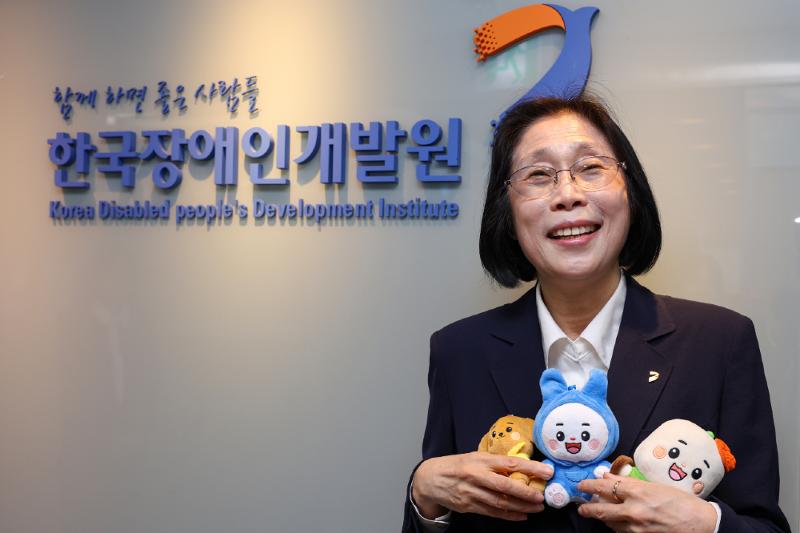
KODDI President Lee Kyoung Hae on April 29 holds dolls of her institute's mascots. She said the enactment of the Disability Rights Guarantee Act will accelerate the government's national task of providing customized social services to disabled people in a Korea.net interview at her institute's Eroom Center in Seoul’s Yeongdeungpo-gu District.
|
Who is Lee Kyoung Hae? Lee Kyoung Hae graduated in 1980 from the Department of Foreign Language Education at Ewha Womans University in Seoul. Right before graduation, she suffered from a disease that caused severe visual impairment. While battling her ailment, she moved to France for study and earned in 1993 a Ph.D. in modern French literature from the University of Toulouse. She is an expert in disability policy, serving as chair of the women's committee of a civic group delegation when Korea signed the U.N. Convention on the Rights of Persons with Disabilities in 2008. In 2023, she took over as KODDI's fifth president. |