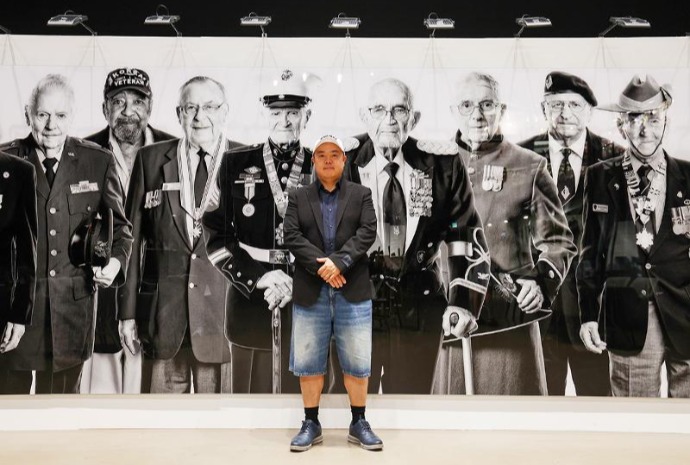
As conflicts and disputes deepen in today's world, the legacy of the Korean War looms larger. To mark the 76th anniversary of the conflict's outbreak this year, Korea.net is featuring foreign veterans of the war who defended freedom for the Republic of Korea. The first profile is of Gen. Ralph Monclar of France, who was selected in May as "Hero of the Month" by the Ministry of Patriots and Veterans Affairs.
Video = Park Daejin
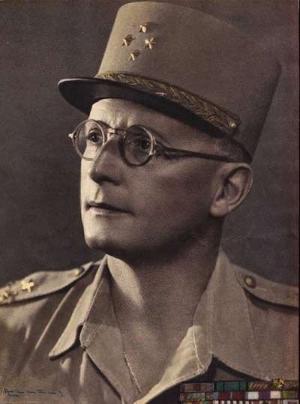
Gen. Ralph Monclar (1892-1964) of France (Ministry of Patriots and Veterans Affairs)
“My dear son. One day, you'll ask me why I had to leave for Korea. Your father came here so that young Korean children like you wouldn't have to wander the streets or in the water, mud or snow."
The noble convictions of Raoul Charles Magrin-Vernerey, better known by his pseudonym Ralph Monclar (1892-1964), is fully captured in a letter the French hero of the Korean War left for his one-year-old son.
To fight in the conflict, the seasoned battle veteran at age 59 relinquished his rank as a four-star general to lieutenant colonel to lead a battalion after France decided to deploy the unit. In February 1951, he played a decisive role in achieving victory at the Battle of Jipyeong-ri, the site of the war's fiercest fighting at the time, by turning the tide of the Chinese offensive.
Korea.net on June 17 visited the Monclar Korean War Research Centre at Kookmin University in Seoul to learn more about the general and the French troops who served in the war through an interview with the center's two co-directors: Lee Keunse, a professor at Kookmin's College of Liberal Arts, and Alain Nass, vice president of the Association of Veterans and Friends of the French Forces of the United Nations (U.N.).
The following are excerpts from the interview.
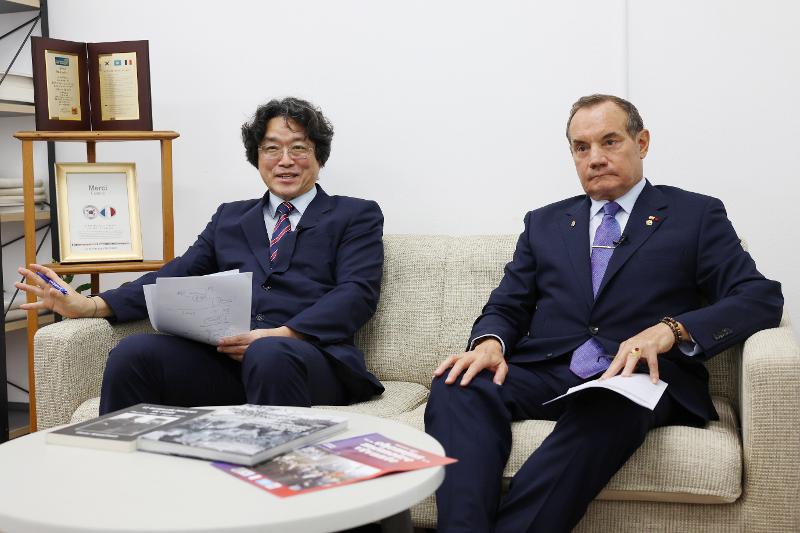
The co-directors of the Monclar Korean War Research Centre at Kookmin University in Seoul -- Kookmin professor Lee Keunse (left) and Alain Nass, vice president of the Association of Veterans and Friends of the French Forces of the United Nations -- on June 17 described Gen. Ralph Monclar as "a leader possessing both goodness and efficiency and a hero who fought for freedom his entire life." (Lee Jeongwoo)
Who was Gen. Ralph Monclar?
Nass and Lee: He was a great French war hero. He served in both World War I and II and was the first military leader to join Gen. Charles de Gaulle's "Free France" movement when the Nazis occupied France. He was a man of unwavering conviction in freedom who stood against all forms of totalitarianism and authoritarianism.
He was also a deeply compassionate man known for his decisiveness -- he voluntarily lowered his rank to lieutenant colonel to serve in the Korean War -- devotion to the Catholic faith and deep affection for his family.
What were the achievements and role of his French battalion in the Korean War?
Nass: During its three years of service in the Korean War, the French battalion won every one of its 14 high-intensity battles. Gen. Monclar had the most extensive war experience, so he provided effective operational guidance even to U.S. forces, who were leading U.N. troops at the time. This was the secret behind the French battalion's record of 14 victories in 14 battles.
What episodes show the importance of the Battle of Jipyeong-ri and Monclar's leadership?
Nass: The victory at the Battle of Jipyeong-ri in February 1951 was a decisive turning point that halted the Chinese offensive and paved the way for U.N. forces to advance northward. Despite being outnumbered 10-1 by the Chinese, the general rejected the U.S. recommendation to retreat, saying, "We'll hold our ground until the very last minute." Eventually, U.S. Commander (Matthew) Ridgway agreed with Monclar and pulled off a miraculous victory.
Explain Monclar's demotion of his rank from four-star general to lieutenant colonel to serve in the war.
Nass: It was a determination that France absolutely had to participate in the first coalition war of the newly established U.N. At the time, France was in a precarious position due to the Vietnam War. But the general visited politicians and persuaded them, saying, "I'll go even if I have to lower my rank, so please allow me to serve." This stemmed from his deep empathy with the plight of Korea, which had been invaded, by placing the situation of France—which was once occupied by Germany and later liberated—on a parallel trajectory.
Monclar is known to have shown special affection for Koreans and Korean soldiers.
Lee: The testimony of a Korean War veteran who held a cordial conversation with French President Emmanuel Macron during his state visit to Korea in April supports this. Gen. Monclar treated Korean soldiers with the respect given to full-fledged military personnel. He went to great lengths to care for them, even going as far as replacing military rations with rice to ensure that they ate properly and have uniforms and boots custom-made to fit the Korean physique. He also sent two Korean soldiers to study at the prestigious Saint-Cyr Military Academy in France, a tradition that continues to this day.
How do you want Monclar to be remembered by today's young generation?
Lee: Gen. Monclar was a commander who possessed both the kindness and efficiency characteristic of great leaders. He connected the warmth contained in letters and food to military efficiency through boosting morale. Following his philosophy that "war is about letters and food," he ensured that soldiers' letters to their families and loved ones were sent by the fastest means possible, regardless of cost.
The life and teachings of this general, who fought for freedom his entire life, are a legacy that young people today, at a time when authoritarianism is spreading worldwide and democracy is under threat, must reflect on.
Describe the background behind the launch of the center and its plans.
Lee: The 250-year history of exchange between France and Joseon (Korea), dating back to the 18th century, is the origin of East-West cultural exchange. While researching this history, I felt regret that records on French participation in the Korean War were largely unknown in Korea.
After receiving a donation of historical materials from the general's son, Roland Monclar, we set up the center at Kookmin University in July 2023 to manage them publicly. Joining forces with the French UN Veterans Association and others, we conducted a Ministry of Patriots and Veterans Affairs project to discover records of participating U.N. countries for two years, collecting and translating thousands of documents.
We host an international academic conference every year and conduct education and promotional activities for youth.
Nass: To fulfill the ultimate wish of the veterans of peace and reconciliation on the Korean Peninsula, we plan to promote the creation of peace parks in the Demilitarized Zone (DMZ) area and major battle sites such as Jipyeong-ri in Yangpyeong-gun County, Gyeonggi-do Province, Hwasalmeori Ridge in Cheorwon, Gangwon-do Province, and Danjang Ridge.
Any message for Koreans and French on the 140th anniversary of bilateral ties?
Nass and Lee: To comprehensively understand the relationship between our two nations, we must look beyond the mere milestone of 140 years and trace the history to the martyrdom of French priests who lived among the common people of Joseon in the 1800s. Both countries went through a period of cooperation under the protection of the French Concession during the era of the Korean Provisional Government in Shanghai, and through the Korean War, they became key partners sharing common values.
Due to the war in Ukraine, the legacy of the Korean War is again coming to the fore in Europe. Just as youth in Europe reflect on their own circumstances while observing Korea's division, I hope that Korean youth also reflect on the normalization and peace of the Korean Peninsula through the lens of the dedication of French troops who came from a distant land 75 years ago.
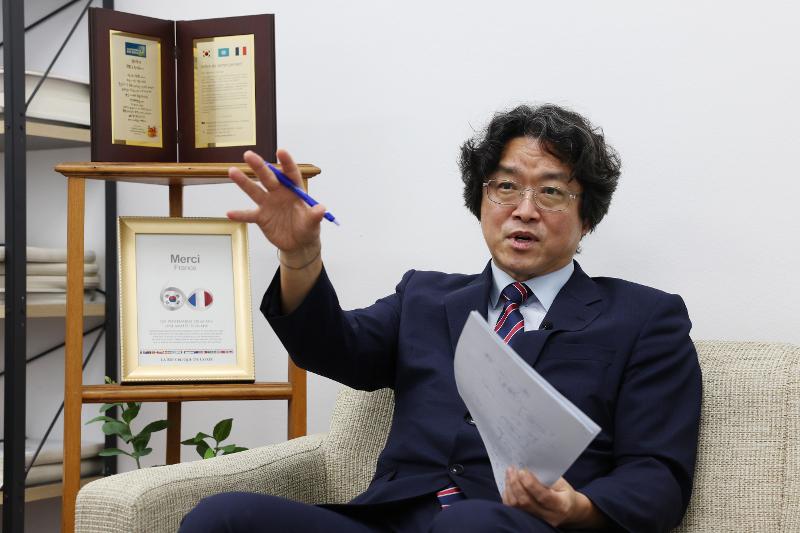
Kookmin University professor Lee Keunse, co-director of the Monclar Centre for Korean War Studies at his university, on June 17 said bilateral ties with France date back over 250 years and expressed hope that French youth interested in Korean culture could explore the rich and close history between the two countries through the center. (Lee Jeongwoo)
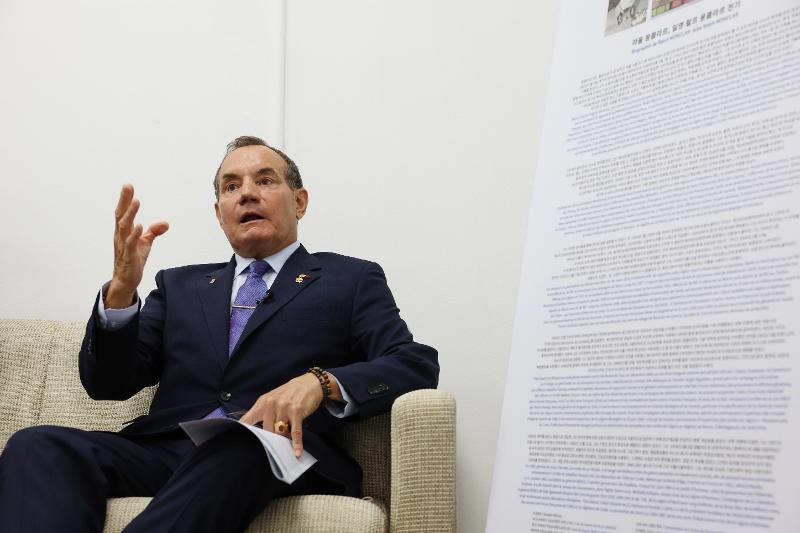
Alain Nass, the center's co-director and vice president of the Association of Veterans and Friends of the French Forces of the United Nations, said just as youth in Europe reflect on their own circumstances while looking at the division of Korea, he hopes that youth in Korea will also reflect on the normalization and peace of the Korean Peninsula through the dedication of the French troops who came from a distant land 75 years ago. (Lee Jeongwoo)
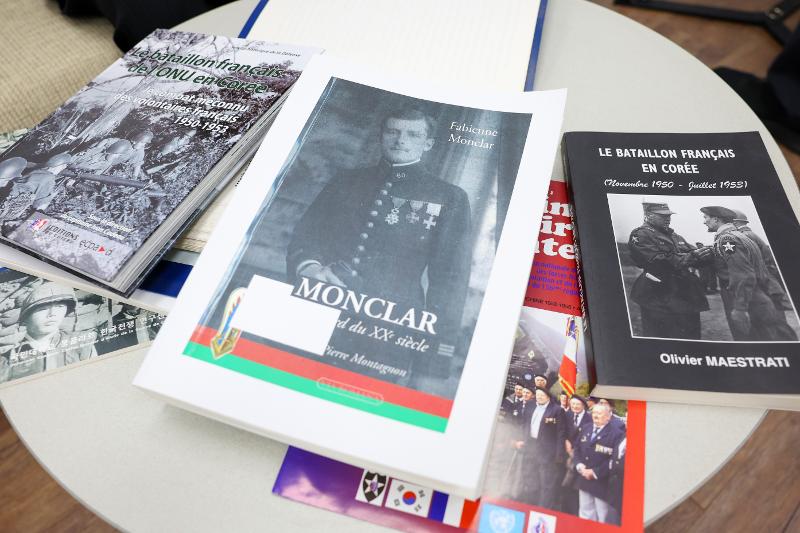
Opened in July 2023, the Monclar Korean War Research Centre at Kookmin University in Seoul translates and promotes thousands of historical documents through its project to uncover war records, as well as host international academic events. At the center is a memoir published by the general's daughter Fabienne Monclar. (Lee Jeong Woo)
arete@korea.kr