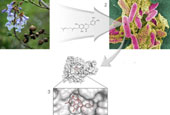
Researchers from the Korea Institute of Science and Technology (KIST) and Korea University have developed a technology to produce succinate, a material used to make bioplastics, from CO2-grown microalgal biomass.
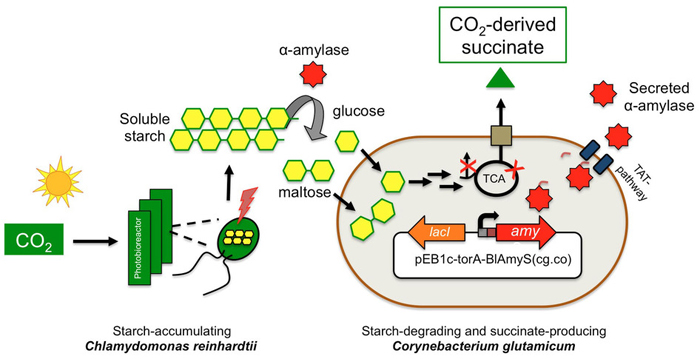
The engineered corynebacterium glutamicum, a microorganism, can produce the amylase enzyme all by itself, which can then degrade the starch within the microalgal biomass. This thus produces a highly efficient succinate without the need of an additional diastatic enzyme. After an additional process, the succinate, or succinic acid, can be used as a raw material to make plastics, coating pigments, urethane or solvents.
Microalgal biomass is a microorganism that lives on light and carbon dioxide and can be cultivated in large quantities. So far, lignocellulosic biomass has been used to produce succinate, but due to its complex chemical structure, it is difficult to bring about chemical and physical reactions in the pre-process phase. The process of making glucose by degrading starch or polysaccharide is also too complicated.
The bacteria used in the research is the engineered corynebacterium glutamicum, used to produce amino acids or hexane in the biochemical or food industries. It is expected to be applied to other existing projects. Corynebacterium glutamicum is a microorganism that is used to make, "bio amino acid," which is, again, used to produce animal feed or food additives.
The research was conducted as part of the Ministry of Science, ICT and Future Planning's "Korea CCS 2020 Project," a research initiative to secure original technologies to capture and store carbon dioxide. This particular research is meaningful because researchers developed a technology to use carbon dioxide, one of the causes of global warming, to produce bioplastics. The research results were published on July 24 in Scientific Reports, a sister-magazine to Nature.
"We developed a technology that can produce various chemicals by using microalgal biomass, which is a sustainable resource," said a KIST researcher.
By Limb Jae-un
Korea.net Staff Writer
jun2@korea.kr

The engineered corynebacterium glutamicum, a microorganism, can produce the amylase enzyme all by itself, which can then degrade the starch within the microalgal biomass. This thus produces a highly efficient succinate without the need of an additional diastatic enzyme. After an additional process, the succinate, or succinic acid, can be used as a raw material to make plastics, coating pigments, urethane or solvents.
Microalgal biomass is a microorganism that lives on light and carbon dioxide and can be cultivated in large quantities. So far, lignocellulosic biomass has been used to produce succinate, but due to its complex chemical structure, it is difficult to bring about chemical and physical reactions in the pre-process phase. The process of making glucose by degrading starch or polysaccharide is also too complicated.
The engineered C. glutamicum strains can produce succinate from pretreated microalgal biomass of CO2-grown Chlamydomonas reinhardtii.
The bacteria used in the research is the engineered corynebacterium glutamicum, used to produce amino acids or hexane in the biochemical or food industries. It is expected to be applied to other existing projects. Corynebacterium glutamicum is a microorganism that is used to make, "bio amino acid," which is, again, used to produce animal feed or food additives.
The research was conducted as part of the Ministry of Science, ICT and Future Planning's "Korea CCS 2020 Project," a research initiative to secure original technologies to capture and store carbon dioxide. This particular research is meaningful because researchers developed a technology to use carbon dioxide, one of the causes of global warming, to produce bioplastics. The research results were published on July 24 in Scientific Reports, a sister-magazine to Nature.
"We developed a technology that can produce various chemicals by using microalgal biomass, which is a sustainable resource," said a KIST researcher.
The research results about the development of a technology that can produce succinate, a raw material used to make bioplastics, out of CO2-grown microalgal biomass, is published on July 24 in Scientific Reports, a sister-magazine of Nature.
By Limb Jae-un
Korea.net Staff Writer
jun2@korea.kr