
A team of researchers has developed a fish collagen sponge scaffold using leftover fish skin that offers an alternative approach to healing wounds.
A team of researchers has developed a new skin tissue substitute to treat wounds that uses collagen extracted from leftover fish skin, a substance that's usually discarded during the manufacturing process.
The research team, led by Professor Jung Won-Kyo of the Department of Biomedical Engineering at Pukyong National University, extracted collagen from flatfish (Paralichthys olivaceus) to produce an integrated scaffold that can regenerate skin tissue three times faster than other collagens.
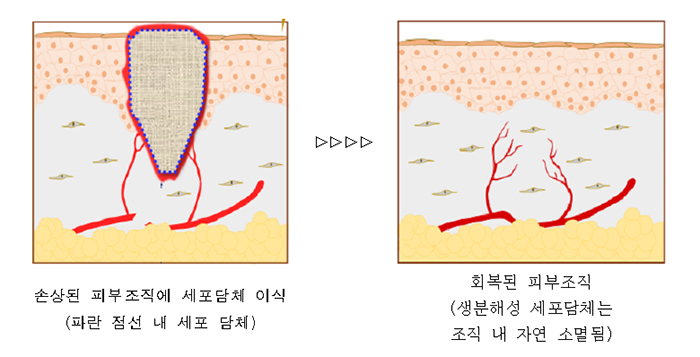
By applying the newly developed fish collagen scaffold to the wounded area (left), researchers are able to regenerate skin tissue three times faster than with other collagens.
In biology, a collagen scaffold refers to a biomedical material that, when applied to a wound, helps to accelerate the regeneration and division of skin cells while preventing infection and loss of moisture in the wounded area.
Scaffolds that are currently available on the market use collagen extracted from the skin and ligaments from pigs, horses or cows. However, the collagen extracted from land animals may contain diseases that can pose a potential threat to human health. On the other hand, there have been no reported cases of diseases being transferred from marine animals to humans, making fish collagen a better choice for medical treatments.
The results of a cell culture experiment conducted by the research team showed that fish collagen scaffolds did not transfer any toxins to the new skin tissue. In another experiment conducted over a two-week period, the team found that the fish collagen scaffold helped to regenerate skin tissue over three times faster compared to other scaffolds.
The research was published in the August 2015 edition of the International Journal of Biological Macromolecules and the new material is patent pending. The team will conduct several more experiments with the fish collagen scaffold to investigate its effect on skin generation, and then proceed with animal testing and clinical trials.
By Lee Hana
Korea.net Staff Writer
Photos: Korea.net Archive, Pukyong National University
hlee10@korea.kr