- 한국어
- English
- 日本語
- 中文
- العربية
- Español
- Français
- Deutsch
- Pусский
- Tiếng Việt
- Indonesian
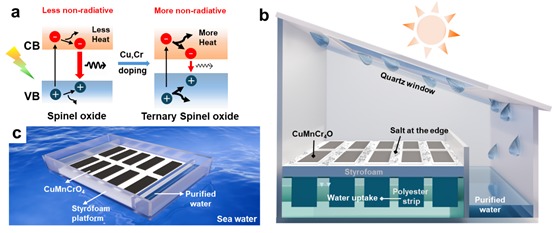
A research team at Ulsan National Institute of Science and Technology (UNIST) on Jan. 12 announced its invention of a solar-powered device that evaporates seawater. Shown are the operating principle and structure of this system. (UNIST)
By Charles Audouin
A domestic research team has developed technology that makes seawater drinkable by using sunlight, not electricity.
This enables the production of potable water seven times faster than natural evaporation methods.
The team at Ulsan National Institute of Science and Technology (UNIST) on Jan. 12 announced its solar-powered device that evaporates seawater.
When placed on seawater, the gizmo can produce 4.1 liters of drinkable water per hour in 1 square m, or some seven times faster than natural evaporation speed.
The key to the device's groundbreaking function is a special oxide coated on the surface. The team synthesized a new material with precisely aligned copper and chromium elements within a lattice structure of manganese oxide.
This material absorbs over 97% of incoming solar energy and suppresses its re-emission as light and maximizes efficiency by converting it into heat. The surface temperature of the device subsequently rises up to 80 degrees Celsius under sunlight, rapidly evaporating seawater.
Innovative engineering technology was also applied to resolving the problem of salt retention. Highly absorbent cotton was used in the upper part of the device where evaporation occurs.
The lower section is made of polyester possessing both hydrophilic and water-repellant properties that acts like a straw to draw seawater upward while preventing salt left over from sticking to the surface. This solves the inherent limits of conventional technologies that lead to salt crystals clogging the device and reducing performance.
The team said, "This technology is highly durable and easy to make into large devices, which could greatly help resolve water shortages in the future."
The study was published online on Dec. 16 in Advanced Materials, a global academic journal of materials and chemistry based in Germany.
caudouin@korea.kr