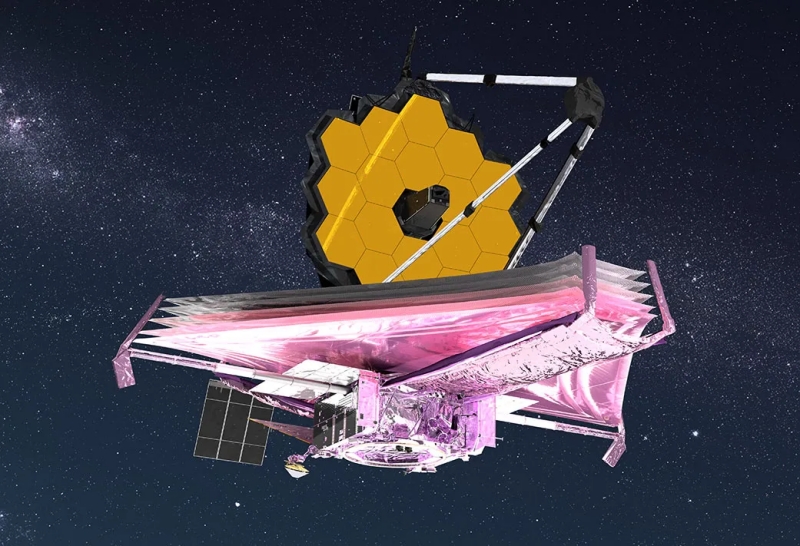
Artist illustration of James Webb Space Telescope (NASA)
By Park Hye Ri
A domestic research team has achieved a world first in identifying a key process in the early-stage formation of the solar system and planets.
The Ministry of Science and ICT on Jan. 22 said the team led by Lee Jeong-Eun, a professor of physics and astronomy at Seoul National University, used the James Webb Space Telescope to observe and confirm the process in which the explosive mass inflow of a protostar, or a star in its early formation stage, heats the inner regions of protoplanetary disks to high temperatures, causing the crystallization of silicates.
Comprising about 90% of Earth's crust, silicates are a key component of terrestrial planets and comets. Crystalline silicates are known to form only in high-temperature environments above 600 degrees Celsius.
The discovery of such silicates in comets located in the extremely cold outer reaches of the solar system, however, has raised questions within the scientific community about how these materials formed in high temperatures got to the outer solar system.
The researchers used observation time from the telescope to focus on the protostar EC 53 in the Serpens Nebula. The protostar's brightness changes once every 18 months, thus its dormant and eruptive phases are clearly distinguishable.
The team observed the dormant and eruptive phases of EC 53 to confirm that the characteristic infrared signal of crystalline silicates was detected only in the eruptive phase. It also found that such silicates formed within the inner disk could be transported by the disk wind to the cold outer regions.
"This research result exemplifies a scientific discovery made through accumulated experience over a long period," Lee said. "We will continue follow-up observations to verify the universality of the silicate crystallization and material transportation processes, as well as their dependence on evolutionary stages."
Conducted with ministry support for basic research projects, the study was published on Jan. 22 in the leading global scientific journal Nature.
hrhr@korea.kr