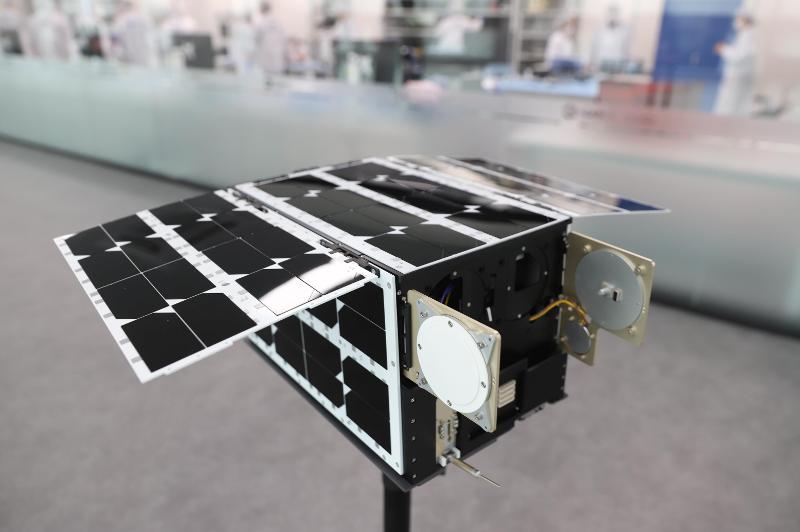
This is a full-scale mockup of the cube satellite K-RadCube made by Nara Space Technology demonstrating the deployment of solar panels and antennas in space. (Korea Astronomy and Space Science Institute)
By Margareth Theresia
K-RadCube, a domestically developed cube satellite, will be installed on Artemis 2, a NASA manned mission to explore moon, to observe cosmic radiation.
The Korea AeroSpace Administration (KASA) and Korea Astronomy and Space Science Institute (KASI) on Jan. 29 said they completed all ground preparation for the satellite's launch into space. Blastoff is scheduled between next month and April at the Kennedy Space Center in Florida.
NASA will conduct test flights of the Space Launch System (SLS) and Orion spacecraft on the Artemis 2 mission.
K-RadCube will be loaded on the Orion Stage Adapter to gauge cosmic radiation in the Van Allen radiation belt surrounding Earth at varying altitudes.
The observational data gathered during the mission will be used to study the effects of cosmic radiation on astronauts when they travel between Earth and the moon.
The launch is part of a joint project under a bilateral agreement signed in May last year with the U.S. The lead agency KASI is in charge of satellite development, construction of the radiation measurement payload, flight certification, management of mission operational data and disposal procedures after the mission is completed.
KASA Administrator Yoon Youngbin said, "K-RadCube is an important case that globally confirms Korea's capacity to develop and run deep space cube satellites and safety and reliability technologies applicable to manned space explorations."
"This will be an opportunity to expand Korea's technological contributions and roles in future lunar and deep space exploration."
margareth@korea.kr