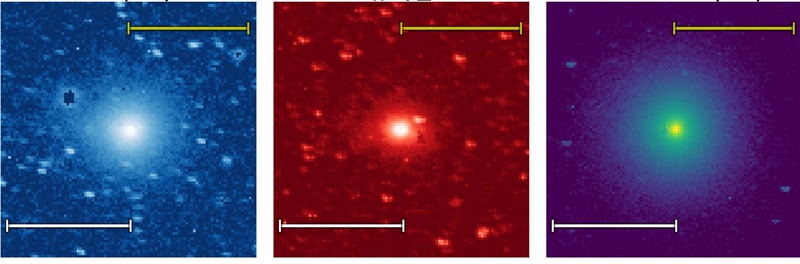
These are photos taken by the space telescope Spherex of (from left to right) water, organic matter and carbon dioxide emitted from an interstellar comet. (Korea Astronomy and Space Science Institute)
By Koh Hyunjeong
The space telescope Spherex, which was jointly developed by the Korea Astronomy and Space Science Institute (KASI) and NASA of the U.S. has captured images of water and organic matter emitted from the interstellar comet 3I/Atlas.
KASI plans to compare and analyze this exoplanetary comet with those in the solar system to understand the process of formation of exoplanetary systems and Earth.
The think tank on Feb. 9 said an international research team for Spherex observed 3I/Atlas twice last year -- once in August and once in December -- and compared and analyzed the results.
Observations confirmed the presence of organic molecules such as those of water, carbon dioxide, carbon monoxide and cyanide in 3I/Atlas' coma, or the nebulous envelope around the nucleus of a comet. Fundamental to life on Earth, organic molecules are usually detected by space telescopes since observation is difficult with ground-based telescopes due to the influence of Earth's atmosphere.
The team captured the moment when the comet grew brighter while ejecting water and gas into space.
The study was published on Feb. 3 in the Research Notes of the American Astronomical Society.
hjkoh@korea.kr