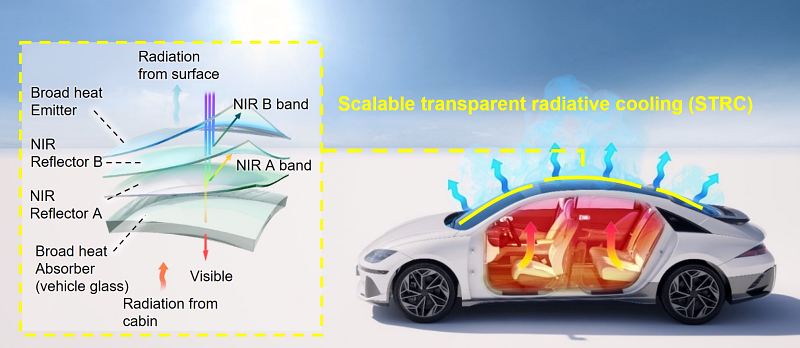
This concept diagram shows how a transparent cooling film drastically reduces the temperature in a vehicle during summer. (National Research Foundation of Korea)
By Kim Hyelin
A domestic research team has invented a transparent radiative cooling film that lowers the temperature inside a vehicle parked under the midsummer sun without electricity.
Applying this film to vehicle windows can lower interior temperatures as much as 6.1 degrees Celsius and cut energy consumption for cooling by about 20%.
The National Research Foundation of Korea on Feb. 11 said Seoul National University professor Ko Seung Hwan, Massachusetts Institute of Technology professor Gang Chen, and a joint research team of Hyundai Motor and Kia developed the large-area film attachable to vehicle windows.
The film differs from conventional automotive coating or tinting film by releasing heat accumulated inside a vehicle to the outside. Its multilayer structure comprising multiple nano-thin film allows over 70% of visible light to pass through, ensuring visibility while reflecting near-infrared rays, which greatly contributes to solar heat generation in sunlight, reducing heat inflow.
Heat inside the vehicle is released outward as mid-infrared rays, preventing the interior temperature from rising.
The researchers tested the film in countries with diverse climates like Korea, the U.S. and Pakistan in summer and winter and under parking and driving conditions. The results confirmed that vehicles with the film maintained lower interior temperatures in all conditions.
In summer, the savings in cooling energy were acute, with 17 fewer minutes required for a vehicle interior to reach a comfortable temperature after turning on the air conditioner.
Application of this technology to all passenger vehicles in the U.S. was estimated to slash 25.4 million tons of CO2 emissions per year, the equivalent of that from five million vehicles on the road.
The study was published on Feb. 4 in the online edition of the international academic journal Energy & Environmental Science published by the London-based Royal Society of Chemistry.
kimhyelin211@korea.kr