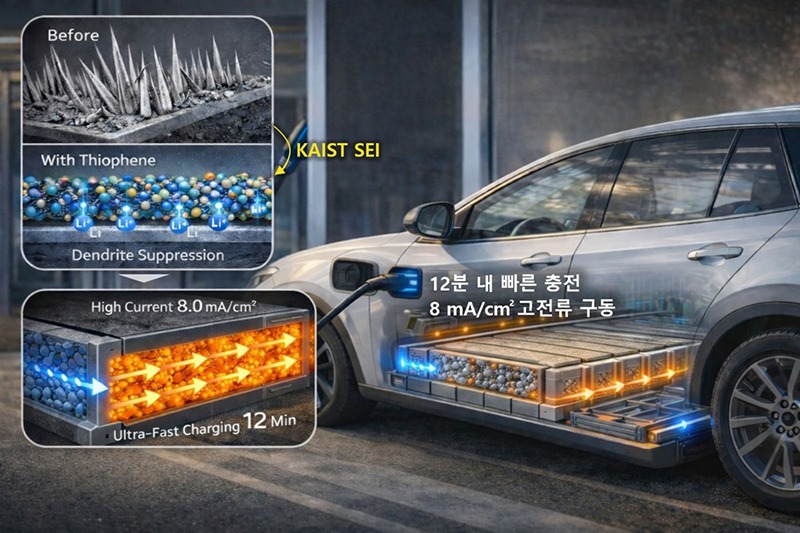
This artificial intelligence-generated image shows how a lithium metal battery can suppress dendrite growth through the addition of thiophene to an electrolyte. (Korea Advanced Institute of Science and Technology)
By Charles Audouin
A research team has developed a core technology to accelerate the commercial application of the state-of-the-art lithium-metal batteries.
The Korea Advanced Institute of Science and Technology (KAIST) on Feb. 24 said its joint project with Korea University developed an "intelligent protective film" that raises both battery lifespan and safety.
A lithium-metal battery can store more power than the more common lithium-ion model, meaning electric vehicles powered by the former can expect to travel longer distances.
The repeated charging and recharging of a lithium-metal battery leads to the formation of dendrites, structures shaped like tree branches that pose the biggest obstacle to the battery's commercial use. Dendrites can shorten lifespan and cause internal short circuits or a fire hazard if they pierce a battery's interior.
To resolve this issue, the researchers added the substance thiophene to the electrolyte, the liquid substance inside the battery, to form an intelligent protective layer allowing lithium ions to move stably across the electrode surface.
This layer has a self-regulating structure depending on the situation. Similar to a smart transit system that adjusts lanes based on traffic volume, the charge distribution in the layer changes flexibly as lithium ions move for the most efficient passage, suppressing dendrite formation even in environments with uber-fast shifts to greatly extend battery life.
By observing the battery's interior, the team confirmed that lithium accumulated evenly on the surface and was removed even under high currents, enabling stable operation.
This technology can be applied not only to certain batteries but all used in electric vehicles. Its use in future industries includes electric vehicles that drive long-range distances, urban air mobility and next-generation devices for high-density energy storage.
The team said, "This achievement will become the core foundational technology for next-generation electric vehicle batteries with high-speed charging and a long life."
This research was published on Feb. 2 in the China-based materials and energy journal InfoMat.
caudouin@korea.kr