- 한국어
- English
- 日本語
- 中文
- العربية
- Español
- Français
- Deutsch
- Pусский
- Tiếng Việt
- Indonesian
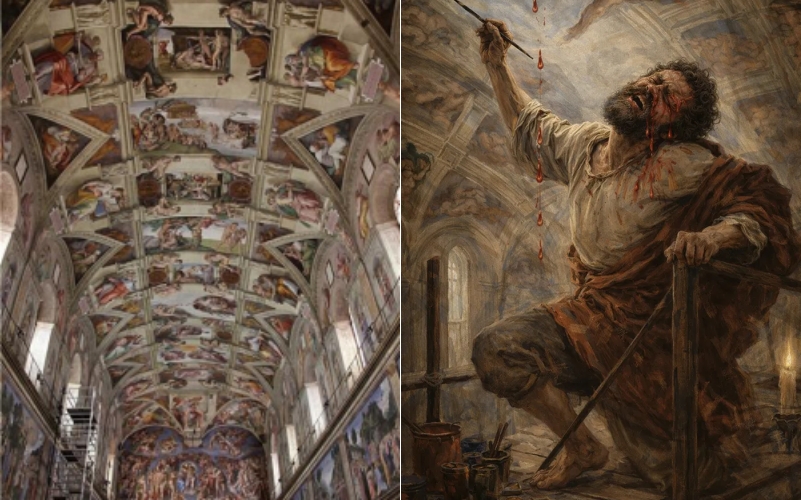
On the left is part of the ceiling of the Sistine Chapel in Vatican City and on the right is a hypothetical scene depicting Michelangelo painting his masterpiece. (KAIST)
By Kim Hyelin
About 500 years ago, Michelangelo, who was creating his masterpiece on the ceiling of the Sistine Chapel, had to battle paint dripping on his eyes.
A domestic research team has resolved this physical challenge that plagued him.
Led by Kim Hyungsoo, a professor at the Department of Mechanical Engineering of the Korea Advanced Institute of Science and Technology, aka KAIST, the team on March 12 announced its invention of a method to newly interpret and control "gravitational instability," the fundamental cause of liquids pouring downward due to gravity.
The study was posted online in January in the global academic journal Advanced Science and as the cover story.
The researchers' method was to mix a small amount of volatile liquid into a liquid suspended upside down. As the volatile component evaporated, the ensuing difference in surface tension formed a flow along the liquid surface that held the liquid attempting to go downward, suppressing instability caused by gravity.
Thus a liquid film defying gravity was formed solely through the natural evaporation process, removing the need for external energy input.
The team said it expects this technology to help make thinner and more uniform liquid film in precision coating, printing and additive manufacturing processes.
"This study shows that gravitational instability can be actively controlled without external energy by utilizing the natural processes of liquid composition and evaporation," professor Kim said. "It can be expanded to coating, printing and lamination technologies as well as fluid control in space environments."
kimhyelin211@korea.kr