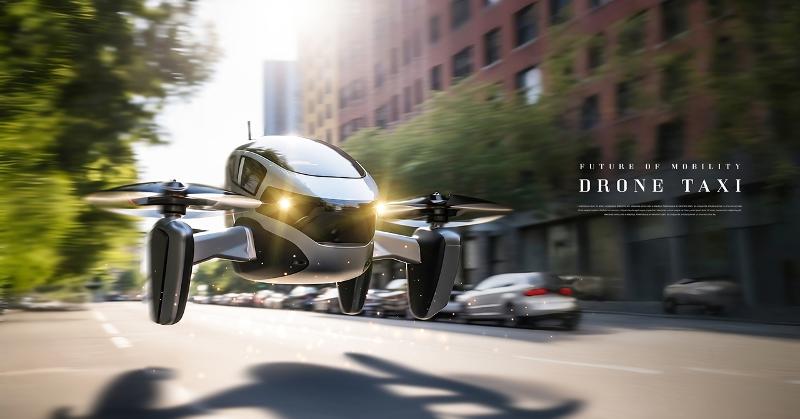
The Ministry of Land, Infrastructure and Transport on Feb. 26 released its 2030 Mobility Innovation Growth Roadmap targeting the innovation of modes of transportation and urban mobility overall, including the use of drone taxis (photo). (iClickArt) (Unauthorized reproduction and redistribution of this image is prohibited under copyright law.)
By Kim Seon Ah
A vehicle summoned by a smartphone stops in front of your home for the morning commute. Nobody is in the driver's seat but the vehicle autonomously analyzes traffic conditions to determine the fastest route to the destination.
Upon arrival downtown, you head for the vertiport on a building rooftop and board an urban air mobility (UAM) vehicle for commuting in the sky.
This scenario of reaching the other side of the city in just a few minutes regardless of traffic congestion could see the light of day in the near future.
The Ministry of Land, Infrastructure and Transport on Feb. 26 released its 2030 Mobility Innovation Growth Roadmap to revolutionize modes of transportation and overall urban transit based on artificial intelligence (AI). This plan stipulates the development of next-generation mobility methods such as autonomous vehicles, UAM and eco-friendly transportation.
First, large-scale demonstrations in cities will aim to commercialize fully autonomous vehicles (Level 4) based on AI by 2027. To this end, 200 self-driving cars will be deployed in Gwangju this year to test the technology on roads and gather data.
A forthcoming platform will integrate and share data on such driving and boost the technical development system that leads from demonstration to data and AI learning.
Commercial UAM use will begin in 2028 focused on public services. The ministry will launch safety systems including aircraft certification and cybersecurity and promote the construction of infrastructure such as vertiports and communication networks.
From 2030, it will support the expansion of services led by the private sector.
To expand eco-friendly transportation, the percentage of green models among new vehicles will be raised to 40% by 2030 and 70% by 2035. To this end, the ministry will devise safety regulations and recycling systems for electric vehicle batteries and speed up the development of future modes of transportation such as hydrogen-powered buses and trains.
Second Vice Minister of Land, Infrastructure and Transport Hong Ji-seon said, "With the pace of innovation accelerating at an unprecedented pace in all industries due to AI transformation, this roadmap can serve as a new milestone for the domestic mobility industry."
sofiakim218@korea.kr