- 한국어
- English
- 日本語
- 中文
- العربية
- Español
- Français
- Deutsch
- Pусский
- Tiếng Việt
- Indonesian
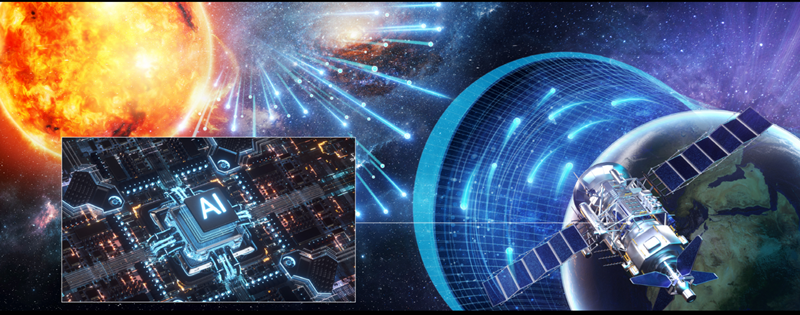
This schematic diagram shows the use of artificial intelligence neuromorphic semiconductors in space. (Ministry of Science and ICT)
By Koh Hyunjeong
A joint research team of the Ministry of Science and ICT, Korea Atomic Energy Research Institute, Chungbuk National University and the Belgium-based Interuniversity Microelectronics Centre (IMEC) on March 19 announced its world-first verification of next-generation artificial intelligence (AI) semiconductor technology that operates safely even in a space radiation environment.
This result is expected to prove essential in the localization of AI chips for space defense applications.
The main issue in space exploration is if semiconductor devices can withstand intense cosmic radiation, which damages and causes defects in such devices that lead to worsening performance and malfunctions.
The team created a synapse-mimicking transistor based on indium-gallium-zinc oxide (IGZO), a next-generation chip material, and confirmed its ability to resist radiation. Researchers fired a high-energy proton beam of 33 mega-electron volts using a proton accelerator, a radiation dose equal to over 20 years of exposure in a low-Earth orbit environment.
Experiments found that the switching of the transistor and the function of controlling the neuron connection strength of the neuromorphic device remained stable.
The handwriting recognition simulations demonstrated an accuracy rate of 92.6% and four-bit computing capability.
The team said its work will be developed into a core technology in AI semiconductors for aerospace applications.
The study was published on March 15 in the international journal Materials Science in Semiconductor Processing.
hjkoh@korea.kr