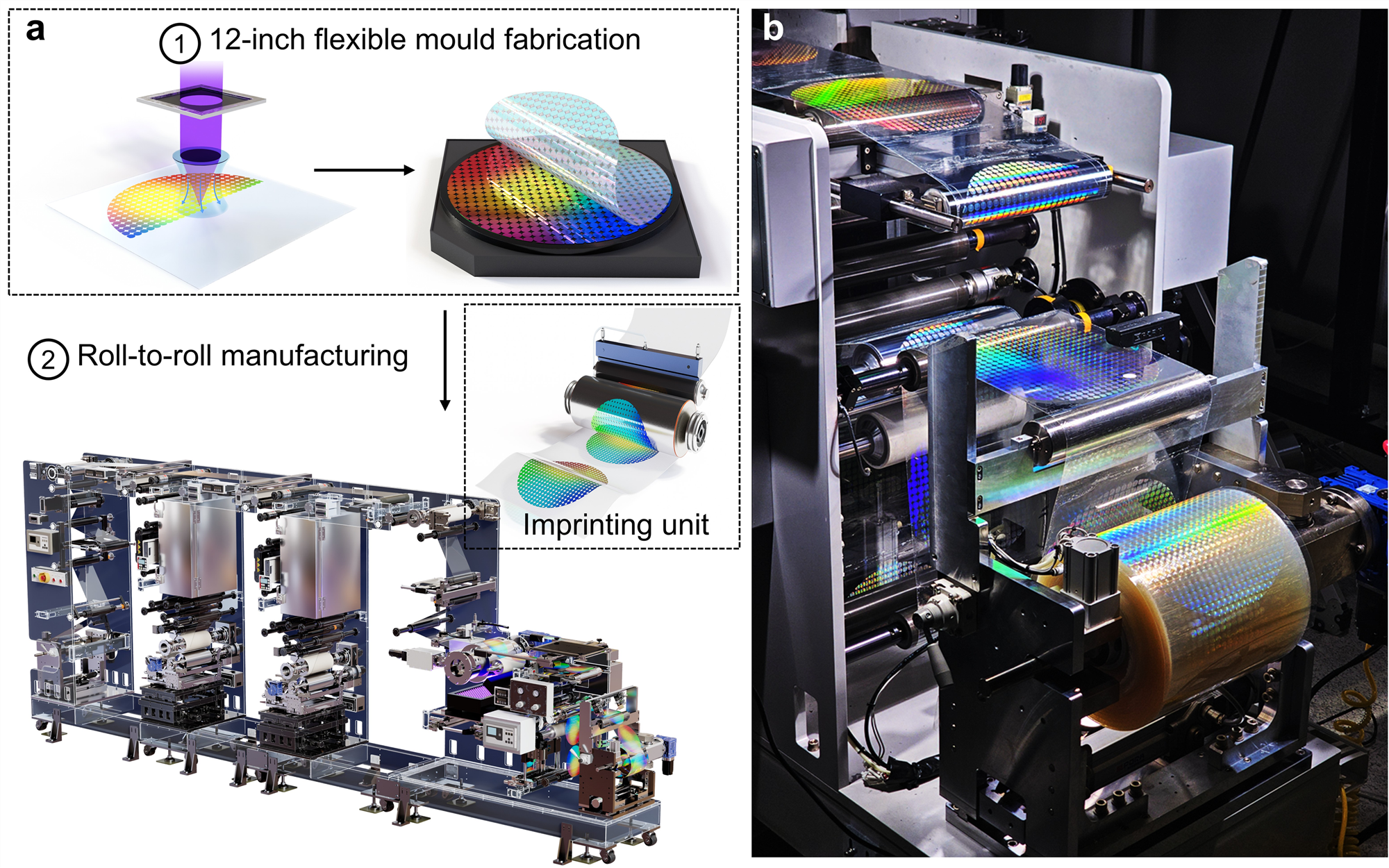
This image explains the mass production process of meta lens through roll-to-roll nanoimprinting. (Ministry of Science and ICT)
By Lee Dasom
A domestic research team has developed the world's first technology for mass producing metamaterial lenses, or "metalenses," that are hundreds of times thinner than conventional camera lenses and can control light with high precision.
The Ministry of Science and ICT on April 16 said the team led by professors Cho Gyoujin and Kim Inki from the Institute for Cross-disciplinary Studies at Sungkyunkwan University and another group led by Roh Junsuk, a professor at Pohang University of Science and Technology, jointly developed a "roll-to-roll nanoimprint" technology that can produce over 300 metamaterial lenses per second.
Metalenses constitute a next-generation optical device that can freely control the phase, amplitude and polarization of light at the nanometer level. Through a flat lens shape, they are hundreds of times thinner than typical lenses to allow ultra-thin designs and precise light control.
The previous production method for such lenses relied on complex and high-cost semiconductor processes that limited output to small quantities at the laboratory level.
To resolve such limits, the researchers independently devised a roll-to-roll nano-printing process that continuously prints nanostructures on flexible substrates, using Sungkyunkwan's roll-to-roll printing foundry technology.
This enables mass production of metalenses, which used to be made one by one using rigid nickel molds, in a continuous and high-volume process utilizing flexible polymer replication molds made from cylindrical rollers, similar to newspaper printing.
This breakthrough is considered a turning point for the mass production of metalenses, a longstanding problem in the global optical industry, and a milestone in the next-generation optical market.
The ministry said, "This is expected to not only solve the longstanding issue of protruding smartphone cameras but also initiate innovative changes across the entire spectrum of cutting-edge industries including lightweight augmented reality glasses, ultra-precision medical imaging equipment and space optical systems.
The study was published on April 16 in the leading global academic journal Nature.
dlektha0319@korea.kr