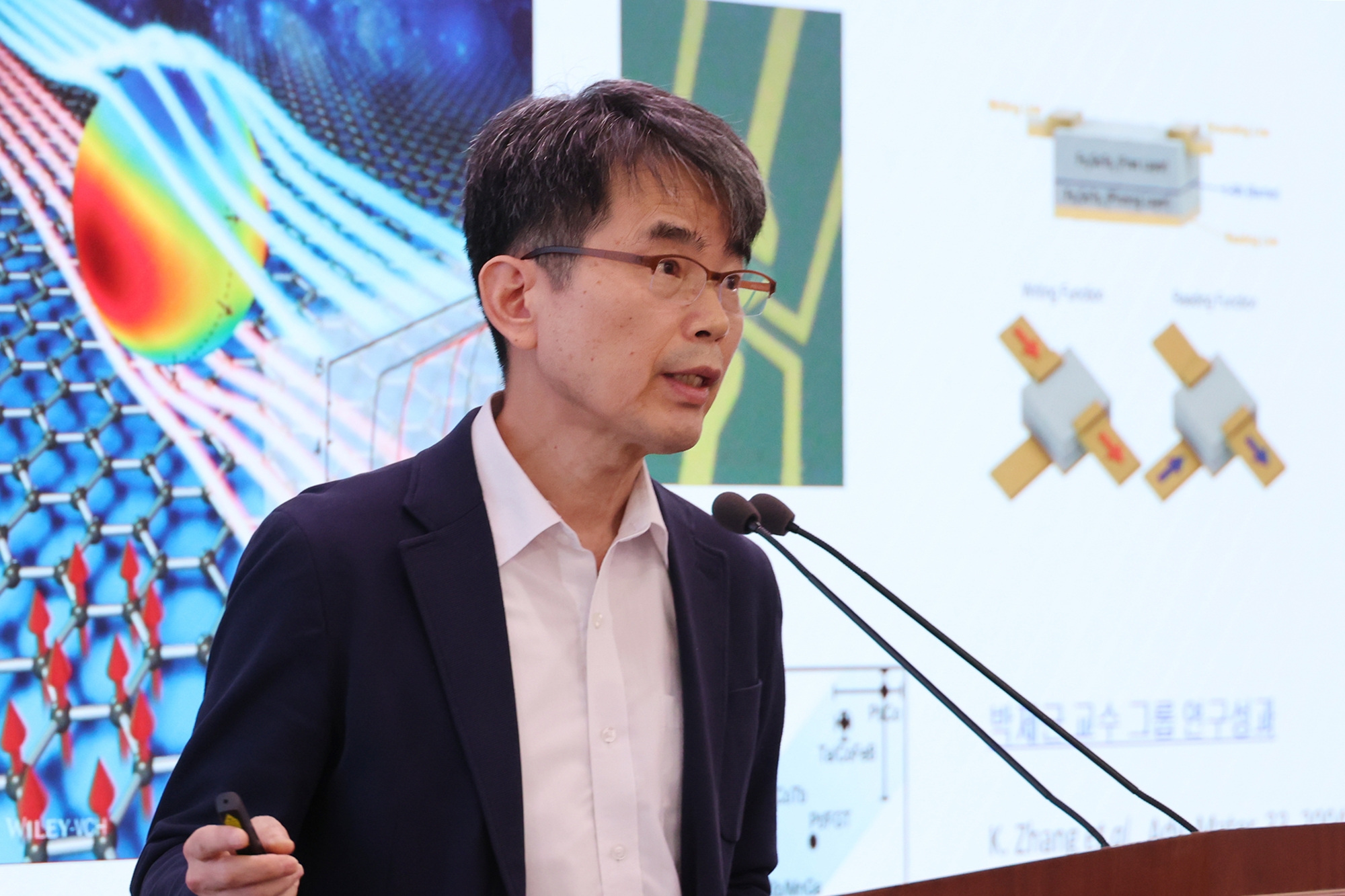
Park Je-Geun, a professor of physics and astronomy at Seoul National University, on April 20 explains his research team's findings in the field of "two-dimensional magnetic van der Waals" at Government Complex-Sejong in Sejong. (Yonhap News)
By Xu Aiying
A field of physics research pioneered by Korean scientists for over 15 years has set a standard guideline to lead global academia.
The Ministry of Science and ICT on April 22 said a research paper on two-dimensional magnetic van der Waals by a team led by Park Je-Geun, a professor of physics and astronomy at Seoul National University, was published in Reviews of Modern Physics, one of the world's leading journals in the sector.
Magnets commonly seen in daily life are three-dimensional objects with volume that stably maintain magnetism. But whether magnetic properties are exhibited in a two-dimensional planar state just one atomic layer thick has been a long-standing challenge in physics.
In 1943, Norwegian physicist Lars Onsager first proposed this theoretical possibility but not until 2016 was it verified by Park's research team. The latter created a two-dimensional magnetic van der Waals material by extracting a magnetic atomic layer of iron phosphorus trisulfide at temperatures below minus 118 degrees Celsius.
This paper systematically compiles the research history of Park's team since 2010.
Presenting new quantum phenomena, unresolved challenges and promising research directions, the paper is expected to serve as standard reference for global academia in this field. It also showed the feasibility of next-generation spintronics and quantum devices through spin-based quantum control technology within van der Waals magnetic materials, paving the way for future industrial applications.
Two-dimensional magnetic materials can be used extensively to develop uber-low-power magnetic memory and ultra-high-speed switching devices that surpass the performance and power efficiency limits of conventional electronic devices, and can be used to design quantum control platforms.
xuaiy@korea.kr