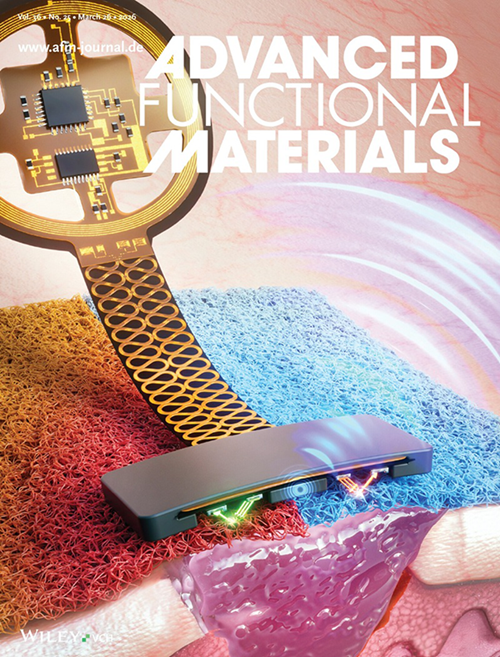
Researchers at the Korea Advanced Institute of Science and Technology (KAIST) are part of a team that developed a "smart dressing patch" that monitors wounds in diabetic ulcer patients in real time without the need for skin incision or a blood sample. (KAIST)
By Koh Hyunjeong
Researchers at the Korea Advanced Institute of Science and Technology (KAIST) have helped develop a "smart dressing patch" that monitors the wounds of a diabetic ulcer patient in real time without the need for skin incision or a blood sample.
The school on May 14 said a research team led by Park Inkyu, endowed chair professor at KAIST's Department of Mechanical Engineering, developed a wireless and power-free optoelectronic sensor patch in collaboration with scientists at Hanbat National University and the Korea Institute of Machinery and Materials as well as California Institute of Technology of the U.S.
This patch can simultaneously gauge a wound's glucose concentration, acidity (pH) and temperature changes. Deterioration of the condition causes the dressing to change color, making it easy to detect danger signals.
The battery-free patch uses near field communication technology. Holding a smartphone close simultaneously supplies power and transmits data transmitted, thus patients and medical staff can immediately check on a wound on their devices.
Allowing real-time management of wounds without the need for a blood sample, this method is expected to drastically improve not only treatment convenience but also quality of life for diabetics.
The study on March 26 appeared on the cover of the international journal Advanced Functional Materials.
hjkoh@korea.kr