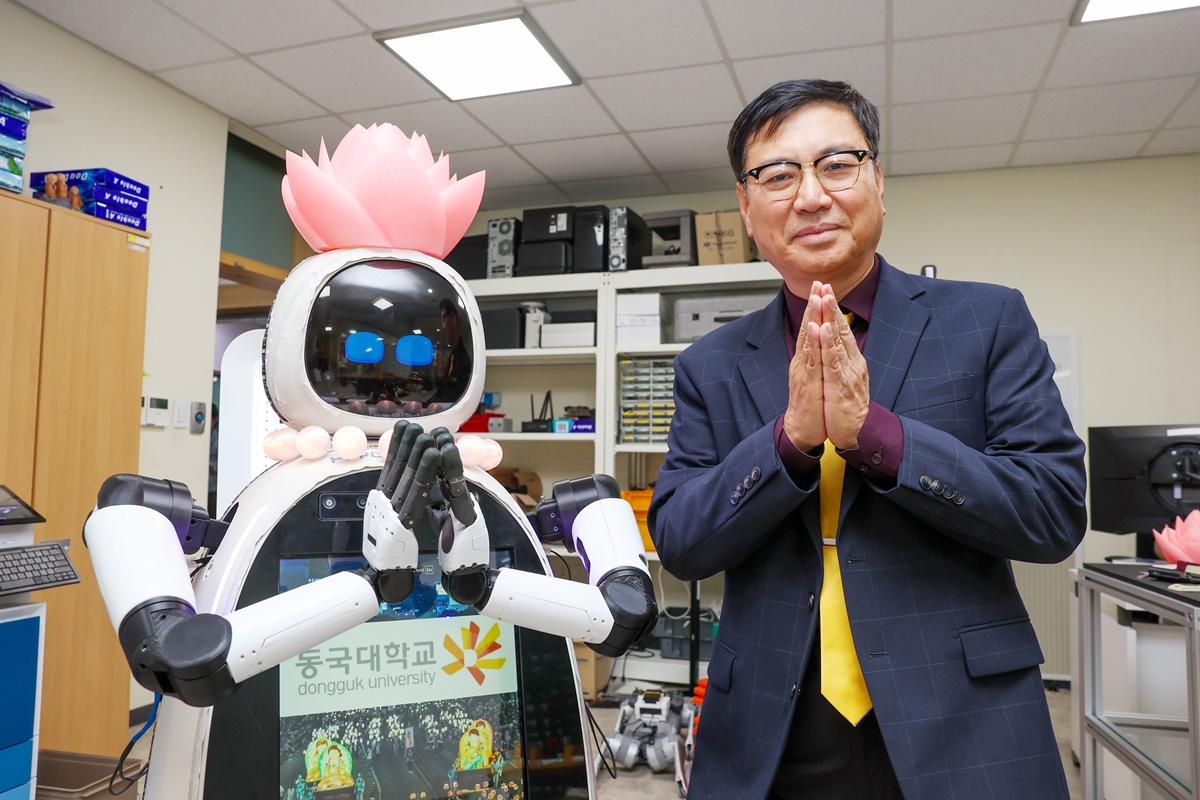
Ven. Hyeahn (left), the country's first artificial intelligence-driven robot Buddhist monk, and its developer Lim Joong Yeon, a professor at the Department of Mechanical, Robotics and Energy Engineering of Dongguk University, perform hapchang (anjali mudra), a traditional Buddhist hand sign of respect.
By Lee Dasom
Photos = Lee Jeongwoo
An object has a small, round head with a stubby body, with shoulders and arms connected by elbow joints and fingers at each joint. Despite having a body made of metal, it has a heart that seeks to convey warm comfort.
This is Ven. Hyeahn, the nation's first Buddhist robot monk powered by artificial intelligence (AI).
Can robots attain enlightenment? Can they form emotional bonds with humans? And if so, can human monks be replaced by robots?
As AI expands to religion, interest in gizmos like Hyeahn is rising.
Warm companion who soothes weary human heart
Lim Joong Yeon, a professor at the Department of Mechanical, Robotics and Energy Engineering of Dongguk University in Seoul, on May 15 introduced Hyeahn as above at the school's Googi Research Center. The gizmo is designed to recognize people, approach them and greet them with hapchang (clasped hands) to forge an emotional bond, and Lim said this nonverbal behavior is what differentiates Hyeahn from chatbots or guide robots.
In Korean and English, the AI monk explains to domestic and foreign tourists Korean Buddhist culture including location information, the meaning of hapchang and Buddhist doctrine.
Through "on-device AI" technology, it can communicate with users without delay even in areas with poor cellular reception. An "intent classifying" function automatically distinguishes the intent of a user's question and provides verified answers based on search augmentation generative technology.
Lim said he is considering expanding Hyeahn's multilingual capacity, focusing on those spoken by the most foreign tourists in Korea such as Chinese and Japanese.
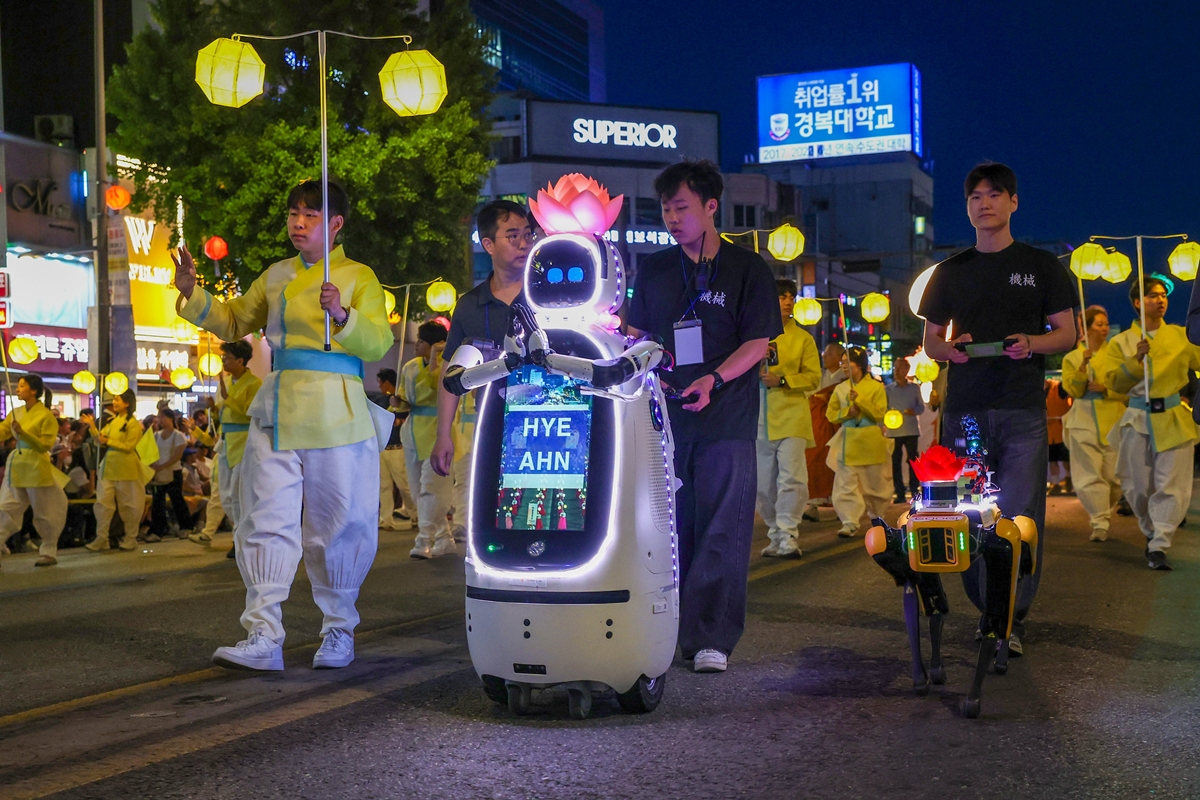
The AI-powered monk Ven. Hyeahn (left) and Googi (right), a four-legged patrol and safety robot equipped with multiple sensors, on May 16 walk at the parade of the annual Lotus Lantern Festival in Seoul's Jongno-gu District a week before the holiday Buddha's Birthday.
Guide who assists right thought
Another highlight of Ven. Hyeahn is its study of an extensive volume of Buddhist material to clearly and accurately explain their principles. A robot cannot attain enlightenment or replace interpersonal and spiritual connections between people, but can convey doctrines and information to help monks focus more on propagation and practice of Buddhism.
"The subject who rules the mind is people themselves," Lim said. "Robots are just helpers who stand by users on the path of practice to remind them of the values of compassion and wisdom, mitigating their loneliness and guiding their thoughts in the right direction."
Hyeahn is still a work in progress. Lim said the next step for his creation is "mind care" and is developing a seon (Zen)-based mind healing feature that reflects the user's emotional state to provide bigger comfort.
Another function in the works is a companion to aid meditation practice.
"The responsibility for finding meaning in life and making decisions lies with humans, and a robot is merely a reliable assistant," the professor said through Hyeahn. "I hope that AI serves as a bridge that reinforces warm connections between people."
dlektha0319@korea.kr