- 한국어
- English
- 日本語
- 中文
- العربية
- Español
- Français
- Deutsch
- Pусский
- Tiếng Việt
- Indonesian
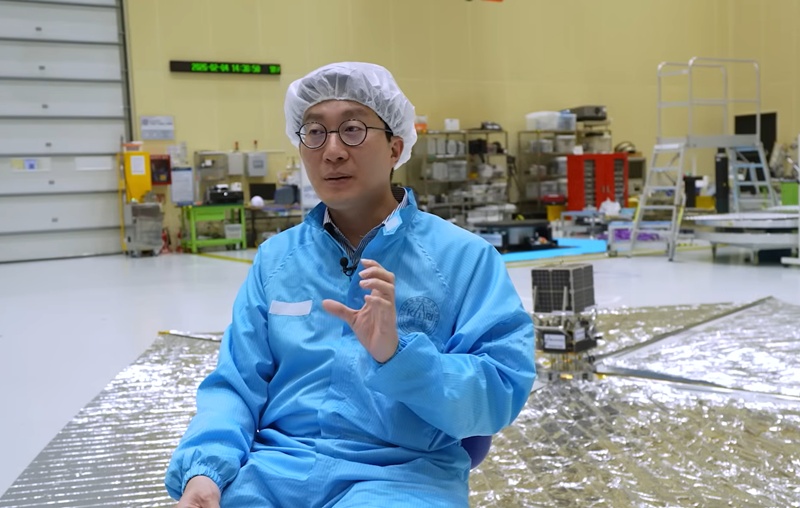
Kim Min-ki, a principal researcher at Korea Aerospace Research Institute (KARI) in Daejeon, explains an orbital departure device that can capture and remove space debris. (KARI)
By Koh Hyunjeong
Debris orbiting Earth is a new threat created by the space industry. Defunct satellites and rocket debris travel at speeds over 8 km per second, jeopardizing the safety of spacecraft and astronauts.
Thus collisions with space debris, once only seen in movies, have emerged as a real-world problem.
The Korea AeroSpace Administration last year identified about 20,000 pieces of space debris, with some re-entering Earth's atmosphere but most remaining in orbit to raise the danger of collision with other space objects. The problem is the incredibly high cost of removing such debris.
Korea Aerospace Research Institute (KARI) is working to resolve this problem. The think tank recently announced its development of an orbital deorbiting device capable of capturing and removing the rapidly surging amount of space debris in low Earth orbit and a successful ground demonstration. The key lies in a "separable" system that divides the satellite used to remove space debris from the device that deorbits.
Conventional methods for removing such debris saw cleanup satellites capture the trash and re-enter the atmosphere with it, which would incinerate the debris. The critical flaw of this approach was its use of expensive satellites as disposable assets, making it extremely uneconomical.
KARI tackled this problem head-on by loading multiple small orbital departure devices on one single cleanup satellite. The satellite remains in the orbit for multiple uses, while the devices attach themselves to specific debris for the latter's removal.
The institute said this approach can drastically improve reusability and cost-effectiveness of cleanup operations.
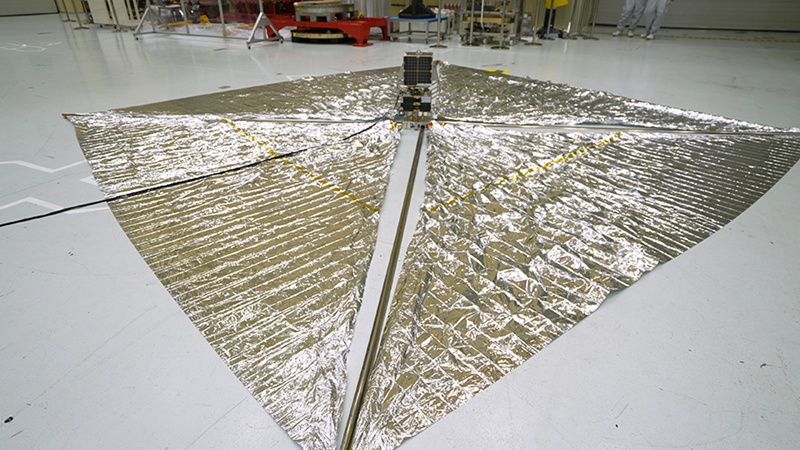
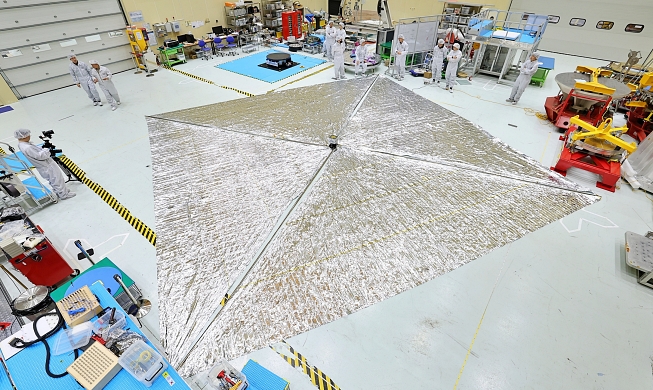
This is the orbital escape device being tested at the Satellite Test Building of Korea Aerospace Research Institute in Daejeon.
The new orbital deviation device is a compact unit the size of an electric rice cooker and with a sophisticated operating principle.
First, an adhesive towing plate is attached to space debris to pull it toward the device. Four grippers firmly secure the debris in place, after which a drag sail spreads in all directions.
The main unit is small but expands to about 25 square m when the sail is deployed.
The sail spreads using only elastic energy and with no need for a propeller or separate power source. Once deployed, the sail generates drag through friction with fine atmospheric particles in low Earth orbit, and this frictional force slows the debris, gradually lowering its orbit.
In the end, this "de-orbiting" mechanism causes the debris to re-enter the atmosphere and burn up.
Before application in space, the research team tested the device's three main functions: towing, capture and deployment of the drag sail. Members confirmed removal of the debris under a non-powered method by minimizing the use of electric actuators.
Application of this technology is expected in other space-related uses like rendezvous and docking and deep-space solar sail propulsion as well as removal of space debris.
"Space debris around Earth continues to increase," said Kim Min-ki, a principal researcher at KARI. "This research marks a major achievement in confirming the potential of a new technology for space debris removal offering both reusability and cost-effectiveness."
hjkoh@korea.kr