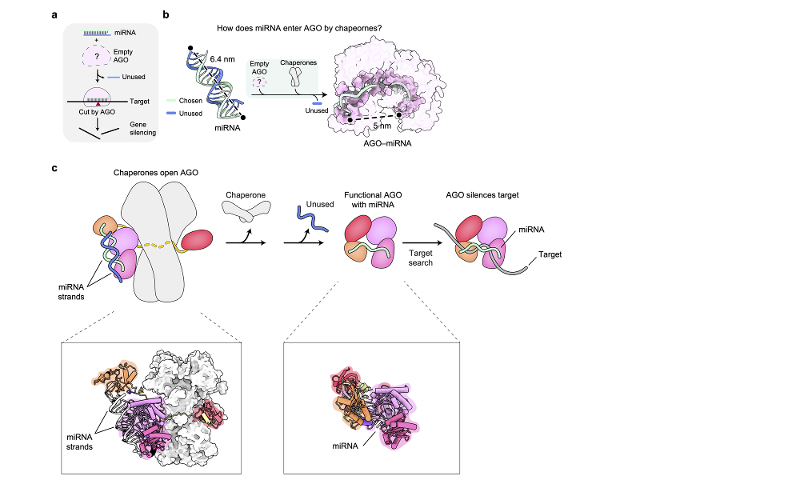
The diagram shows the process through which an Argonaute acquires the ability to suppress target genes. (Center for RNA Research at Institute for Basic Science)
By Kim Seon Ah
A domestic research team has shown a way to develop RNA therapeutics that can precisely regulate gene expression more efficiently and safely.
The Ministry of Science and ICT on June 11 said the team led by Kim V. Narry, director of the Center for RNA Research at the Institute for Basic Science, and Roh Soung-Hun, a professor at Seoul National University's School of Biological Sciences, is the world's first to identify the activation process of Argonaute, a protein that regulates gene expression.
An Argonaute binds to microRNA (miRNA) and degrades target messenger RNAs (mRNAs). The mechanism through which miRNA attaches to Argonautes to fulfill their function had been unknown, and this was considered an obstacle to the development of RNA therapeutics.
In a world first, the team isolated and purified the Argonaute complex bound to a chaperone protein and analyzed its structure using cryo-electron microscopy. The results showed that the chaperone keeps the Argonaute open to aid miRNA binding.
Once binding is complete, the chaperone detaches to cause the Argonaute to turn into its active structure.
Through in-vitro experiments, the team also verified that the Argonaute complex accurately cuts target mRNA and identified the mechanism through which the Argonaute functions stably only in the presence of double-stranded miRNA.
RNA's chemical properties, its double-helix structure and length of 20-24 bases were also found to be crucial for Argonaute binding. The impact of chemical residue in siRNA therapeutics during the assembly process was also identified.
This discovery is expected to help develop RNA therapies to treat intractable diseases such as Alzheimer's and metabolic disorders.
The study was featured on the June 11 edition of the international journal Nature.
sofiakim218@korea.kr