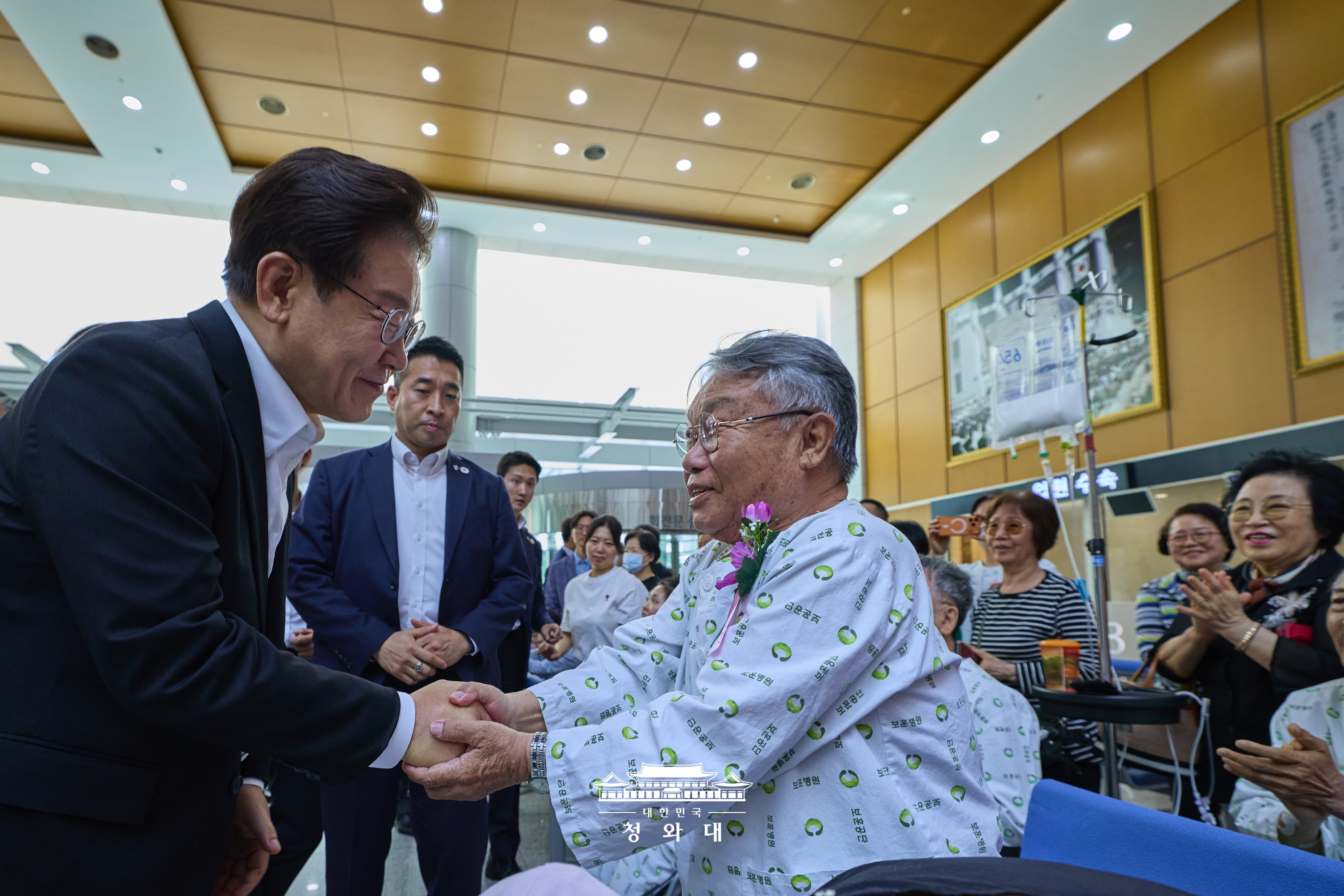
President Lee Jae Myung (left) on June 6 meets a decorated veteran receiving treatment at the VHS (Veterans Health Service) Medical Center in Seoul's Gangdong-gu District on the occasion of Memorial Day. (Cheong Wa Dae)
By Margareth Theresia
The country's public healthcare and treatment for veterans are evolving into advanced rehabilitation systems using artificial intelligence (AI) and robotics.
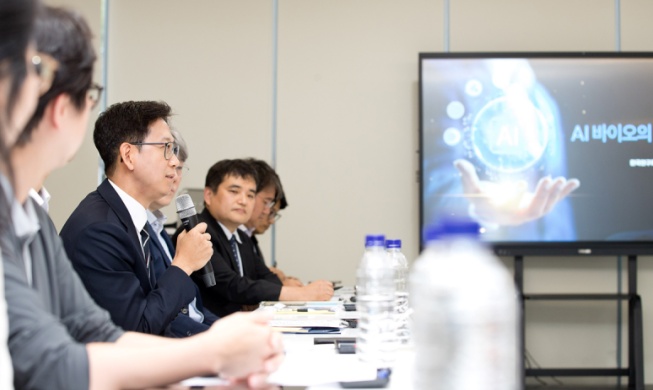
On May 21, the VHS (Veterans Health Service) Medical Center in Seoul's Gangdong-gu District held a presentation for foreign media on the cutting-edge domestic public and veterans' healthcare systems, featuring the Korean model of integrated public medicine that combines rehabilitation and specialized care using assistive devices.
Launched in 1953 as the Daegu No. 2 Relief Hospital under the Ministry of Health and Social Affairs during the Korean War, the hospital is a leading medical institution for decorated veterans and their families. With 32 departments and approximately 1,400 beds, it provides comprehensive services ranging from acute treatment to rehabilitation and long-term, home and hospice care.
Its integrated system seamlessly combines medical care and social welfare.
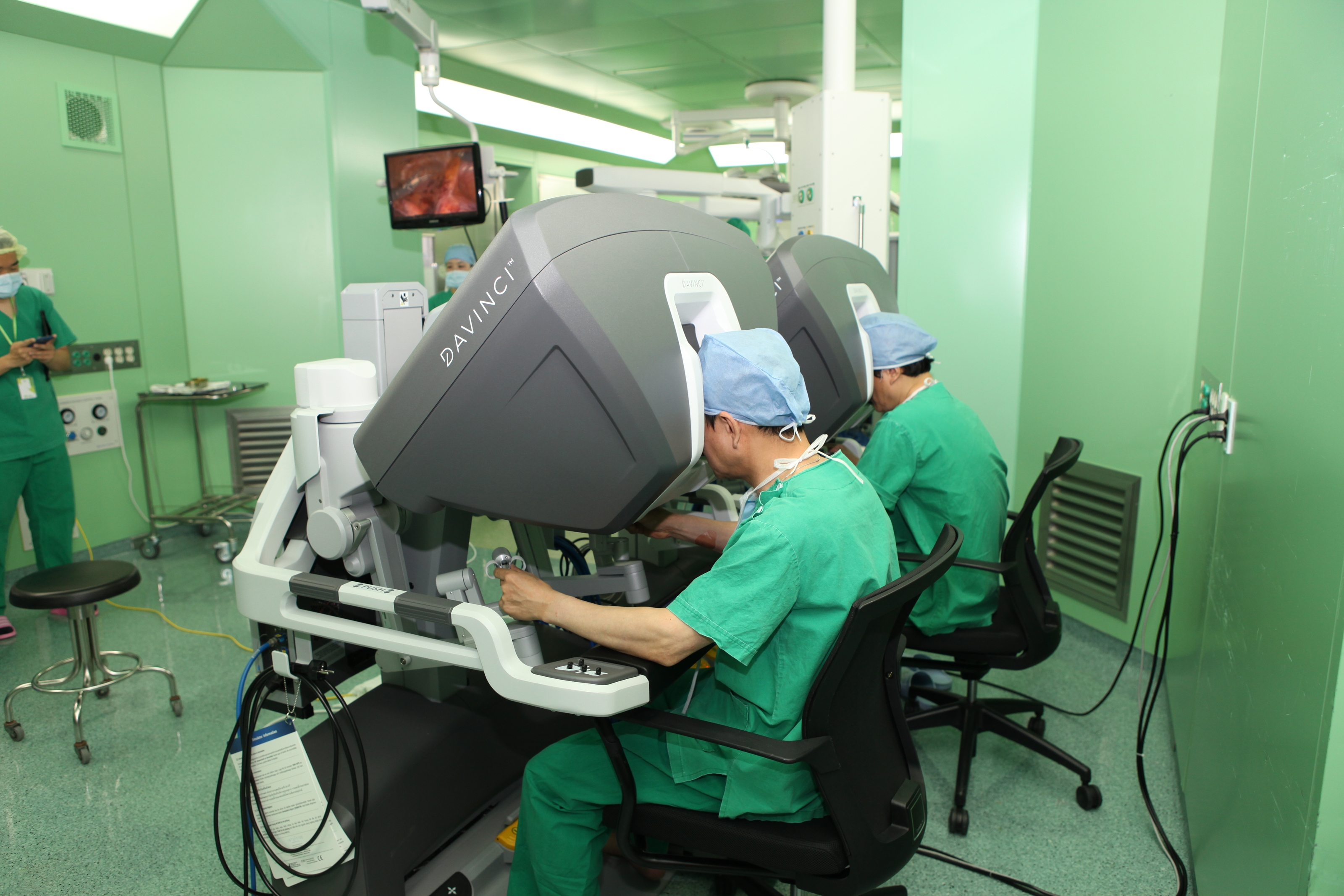
Robotic surgery room at VHS Medical Center in Seoul's Gangdong-gu District (VHS Medical Center)
The center is accelerating digital transformation by gradually applying AI-based diagnostic assistance systems and digital monitoring to clinical settings. Leading examples include the radiology department's AI program for interpreting chest and lung disease, the nuclear medicine department's project to assist the diagnosis of Alzheimer's and dementia, and the gastroenterology department's real-time system to detect endoscopic lesions.
Other advanced equipment include devices to measure blood vessel size during cardiovascular procedures to aid decision making, as well as smart monitoring that catches vital signs such as heart rate, electrocardiogram and blood pressure in real time.
In the second half of this year, a 24-hour patient monitoring system will be launched alongside smart wards to mark the official start of the hospital's full-scale transformation into a digital-centric smart medical facility.
The hospital is also expediting the expansion of a smart healthcare culture including robotic surgery, 3D-printed prosthetics, biobank-based precision medicine and virtual reality training.
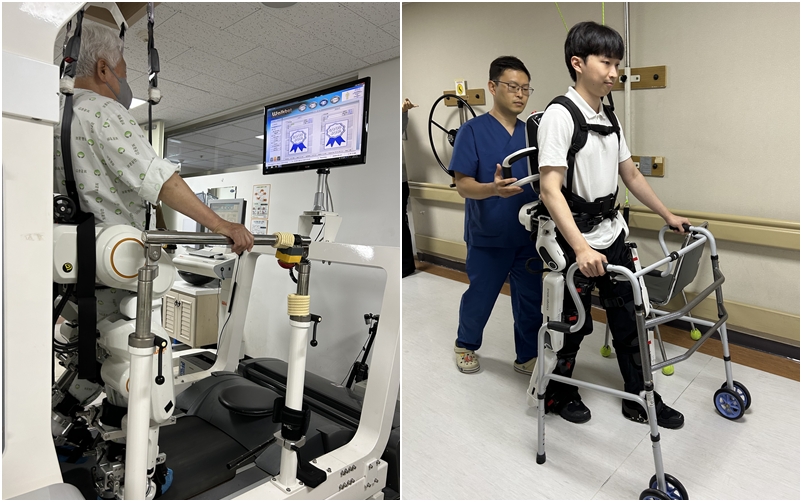
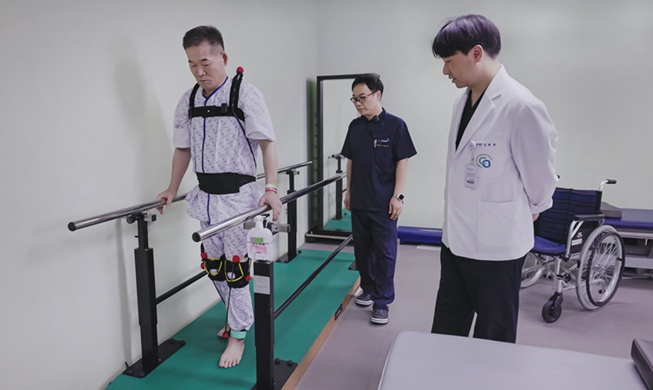
A patient (left) uses the Walkbot in a robot therapy session at the VHS Medical Center's rehabilitation section, and another (right) uses Angel Legs during rehabilitation. Patients with brain injuries advance from the Walkbot to Angel Legs based on recovery stage.
Another notable feature is the close coordination and operating systems between the rehabilitation and assistive device centers.
The former provides personalized therapy using the wearable walking assistance robot Angel Legs and a 3D motion analysis system. Angel Legs assists patients by compensating for their lack of strength based on gait analysis data, thus facilitating repetitive training and functional recovery.
The prosthetics and orthotics center specializes in making customized devices like artificial limbs spanning arms, legs and eyes and orthopedic shoes. Portable and high-precision 3D scanners and printing quickly examine the wrinkles and skin tone of the affected area to create a precise prosthetic by replicating the exact shape of the opposite limb.
The VHS Medical Center is thus emerging as a one-stop integrated healthcare system that covers the entire care continuum from rehabilitation to the creation of prosthetic and assistive devices and support for social reintegration.
margareth@korea.kr