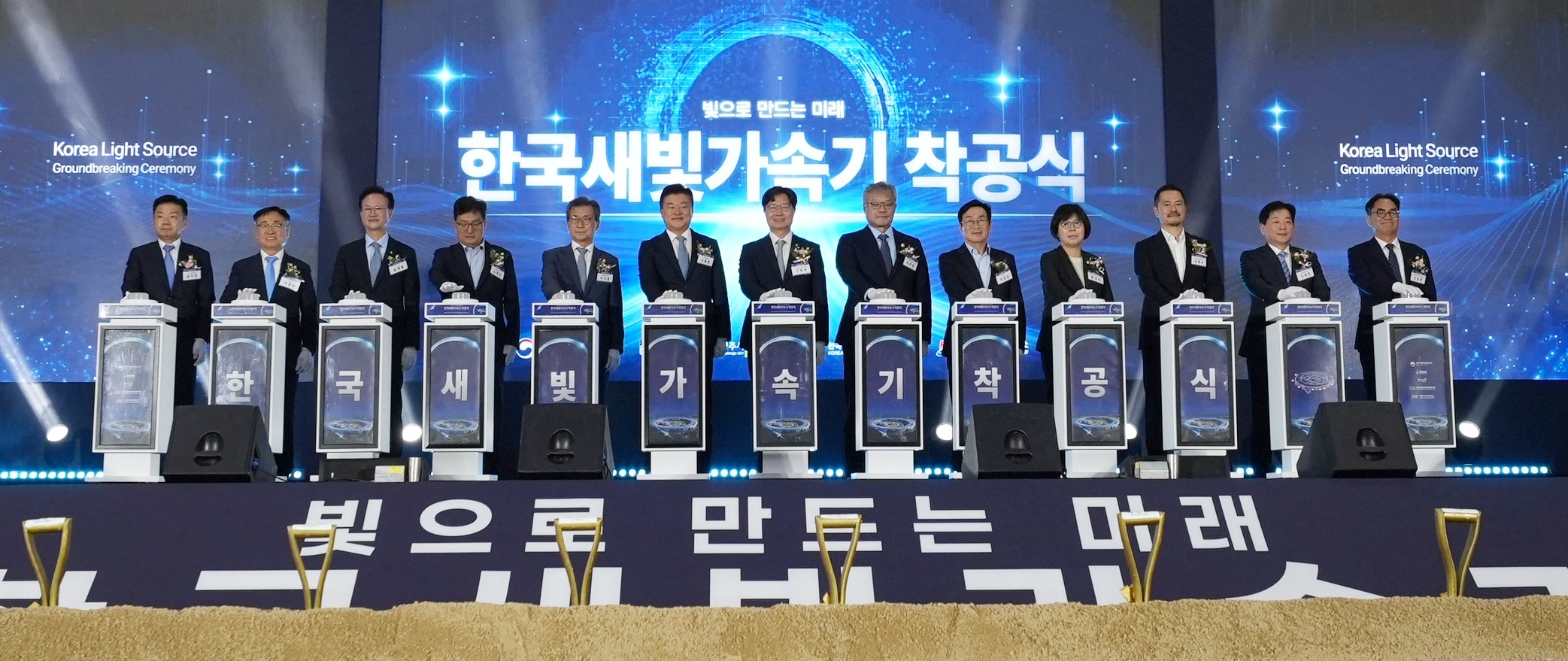
The Ministry of Science and ICT and the Korea Basic Science Institute (KBSI) on July 27 held a groundbreaking ceremony for the Korea Light Source at the project site in the town of Ochang-eup in Cheongju, Chungcheongbuk-do Province. (KBSI)
By Charles Audouin
Construction of the Korea Light Source (KLS), the country's next-generation multipurpose synchrotron radiation accelerator, officially began on July 27.
The Ministry of Science and ICT and the Korea Basic Science Institute said they hosted a groundbreaking ceremony at the KLS site in the town of Ochang-eup in Cheongju, Chungcheongbuk-do Province. Attending the event were about 300 people including government officials, members of the scientific community and residents.
A synchrotron is a circular research facility that accelerates electrons to nearly the speed of light, or about 300,000 km per second, to generate extremely powerful X-rays. Dubbed a "super giant microscope," the device analyzes the structure and properties of matter at the atomic level with uber precision.
The KLS will generate light 100 times brighter than the synchrotron in Pohang, Gyeongsangbuk-do Province, to support a range of research in sectors like semiconductors, new drug development, electric vehicle batteries and structural analysis of new materials. The facility is scheduled for completion by late 2029.
Korea will be just the sixth country to have such a device following France, the U.S., China, Japan and Sweden.
The ministry said, "We will do everything to ensure the successful construction of the facility to allow researchers and industry to benefit from world-class research infrastructure."
caudouin@korea.kr