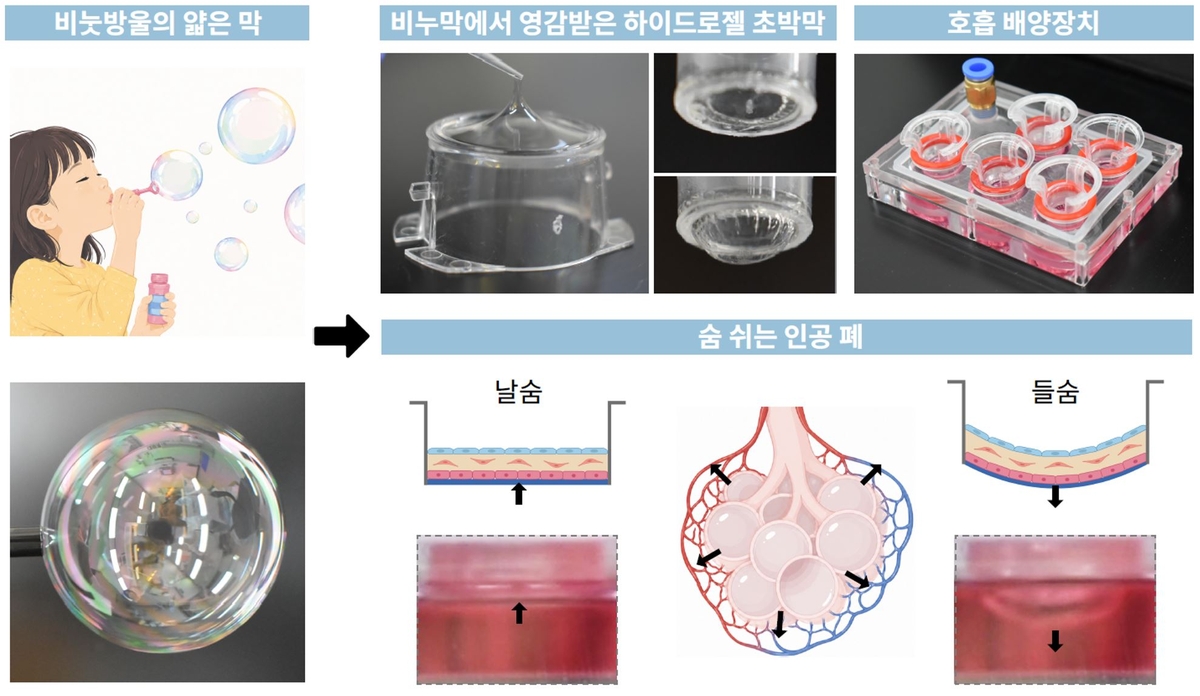
This 3-D artificial lung model replicates the formation of an ultrathin membrane inspired by soap bubbles and the movement of alveoli during respiration. (Pohang University of Science and Technology)
By Margareth Theresia
Domestic researchers have developed an ultrathin artificial lung model that can stably withstand approximately 240,000 repetitive breathing movements.
Pohang University of Science and Technology on Aug. 18 said a research team led by Jung Sungjune, a professor of materials science and engineering and IT convergence engineering, developed the model that replicates the movement of alveoli -- the tiny air sacs in the lungs -- and observes how lung cells respond.
Every time someone inhales and exhales, alveoli repeatedly expand and contract, something that affects not only the growth and function of lung cells but also the progression of inflammation and disease. Yet conventional methods of cell culture struggle to replicate the movements of real lungs, while hydrogels, which are as soft as human tissue, can easily tear when made into thin film.
The study drew on the principle by which a thin film forms when a mold is removed from soapy water. By adjusting the viscosity and surface tension of a hydrogel solution, the team created a thin membrane and later cured it with ultraviolet light to improve both its flexibility and durability.
Next, 3D bioprinting was used to layer vascular cells, a basement membrane and epithelial cells on top of the film, creating a three-layer structure resembling alveoli.
The development of a "breathing actuation system" was based on how lungs expand and contract in response to changes in pressure. When run for 14 days at 12 cycles per minute, similar to the breathing rate of a resting adult, the ultrathin membrane maintained stability even after 240,000 cycles.
In experiments involving infection with the influenza A virus, the team also confirmed that inflammatory and antiviral responses of the lungs differed depending on if breathing movements occurred.
The study was published on July 30 in Advanced Materials, an international journal of materials science.
margareth@korea.kr