- 한국어
- English
- 日本語
- 中文
- العربية
- Español
- Français
- Deutsch
- Pусский
- Tiếng Việt
- Indonesian
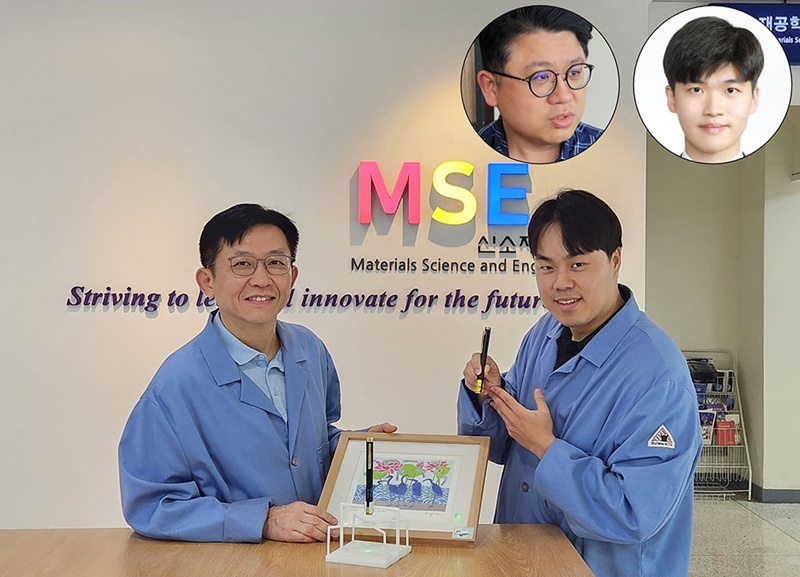
Professor Kim Sang Ouk (left) and researcher Yang Geon Gug are from the Korea Advanced Institute of Science and Technology and professor Kwon Seok Joon and researcher Im Seong-Gyun from Sungkyunkwan University are shown in the upper righthand corner.
By Koh Hyunjeong
Photos = Korea Advanced Institute of Science and Technology (KAIST)
A new technology allows user verification of an item's authenticity simply by shining light on it, using extremely tiny particles to create a unique pattern for each product as a "nano-fingerprint."
A research team led by professor Kim Sang Ouk of the Department of Materials Science and Engineering at the Korea Advanced Institute of Science and Technology, in collaboration with another group led by professor Kwon Seok Joon of Sungkyunkwan University, on Aug. 26 announced the development of physical unclonable function (PUF) technology that enables authentication using light.
The team caused spherical particles measuring several hundred nanometers (one-billionth of a m) to self-assemble on the surface of water. Since the position and orientation of the particles vary each time, it creates "colloidal nanopatterns” with distinct shapes, things that researchers use as distinctive nano-fingerprints specific to each product.
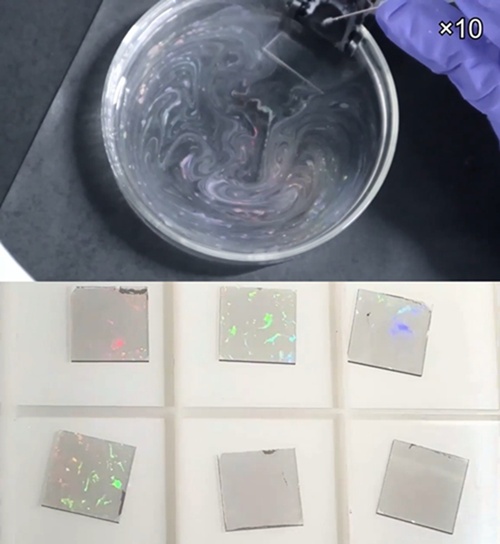
The top photo shows the process by which particles measuring hundreds of nanometers in size instantly assemble on the water's surface to form nanopatterns, and the bottom displays samples of nanopatterns created this way.
Dubbed PUF, this technology uses the unique physical traits of each object to make replication difficult. It operates on a principle similar to that of human fingerprints.
Conventional PUFs often need expensive microscopes or specialized equipment to detect minute differences. But this new model enables easy verification of nano-fingerprints using only a smartphone flashlight and a laser pointer.
The researchers utilized the reflection patterns that appear when white light is shone on the surface and the diffraction patterns that form when a green laser is shone on it. They confirmed that the same patterns consistently appeared every time, whether from a white light from a smartphone flashlight or a green laser pointer shone on the surface.
During the manufacturing stage, the patterns made from each of the two types of light are preregistered. Comparison of the pattern produced when light is shone in the same manner with the registered patterns allows verification of product authenticity.
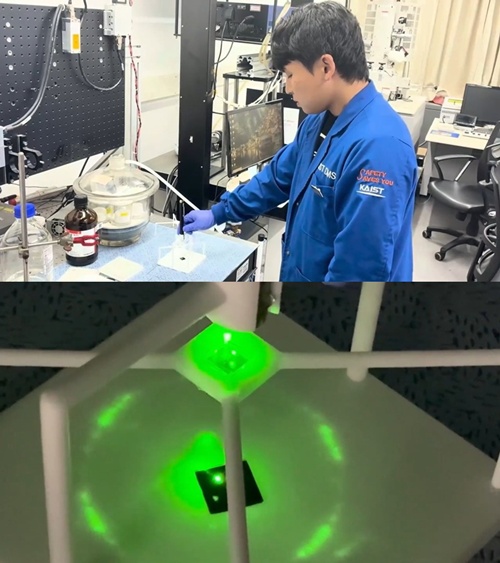
A green laser (top) is used to observe the diffraction pattern of a nano-fingerprint. A unique diffraction pattern (bottom) is formed when the nano-fingerprint is illuminated by a green laser (bottom).
Counterfeiting is difficult because two different types of light can verify a single nano-fingerprint. To create a fake, replication involves not only the pattern formed by the clustered particles but also the distinct patterns that appear when illuminated by a flashlight and a laser pointer.
The team also confirmed that this technology can be applied to a range of materials such as plastic, metal, transparent film and hydrogel.
The film is also expected to be used as a security sticker that does not block a product's design or appearance. This technology is foreseen to allow not only authentication of electronic products and Internet of Things devices, but also prevention of counterfeiting luxury goods, artworks and pharmaceuticals.
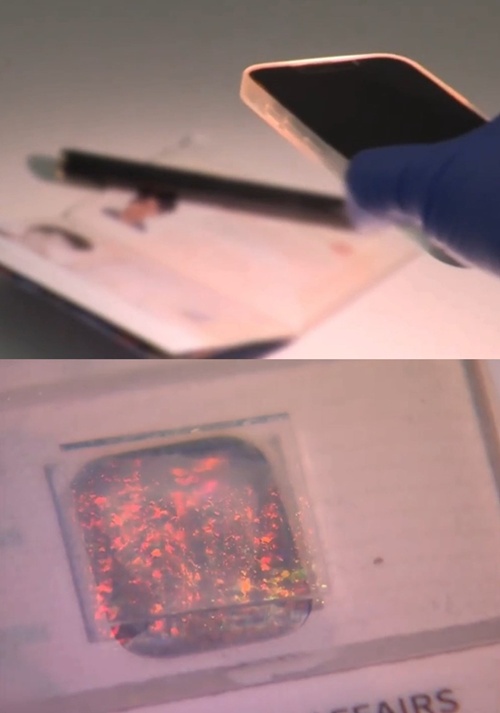
A smartphone flashlight (top) shines on the nano-fingerprint security label attached to a passport, while a flashlight (bottom) creates a unique reflective pattern.
"The key finding of this study is our creation of a random structure difficult to hack but still able to perform easy authentication through simple tools such as a smartphone flashlight or a laser pointer," Kim said. "We expect this to evolve into next-generation security technology applicable in everyday life such as for authenticating electronic devices and anti-counterfeiting labels."
The study was featured online on July 23 in the international academic journal Nature Communications.
hjkoh@korea.kr