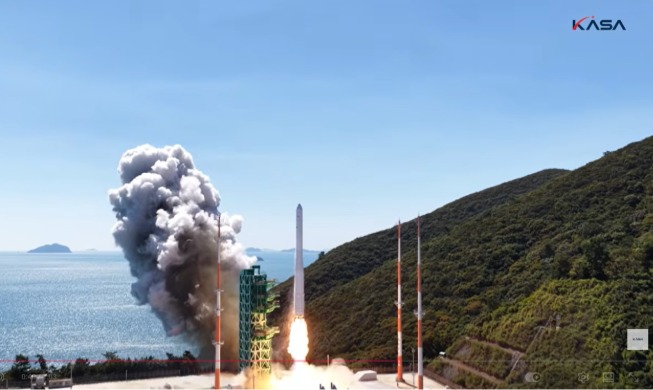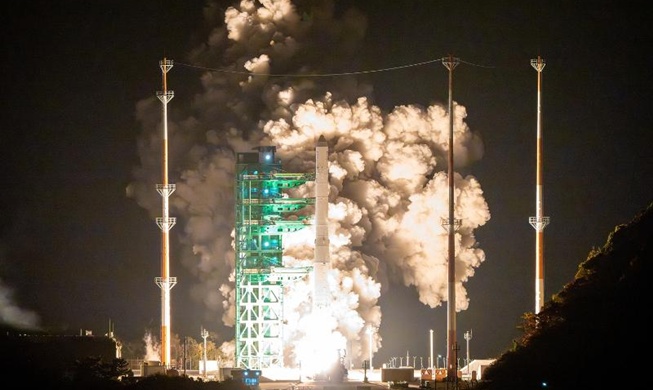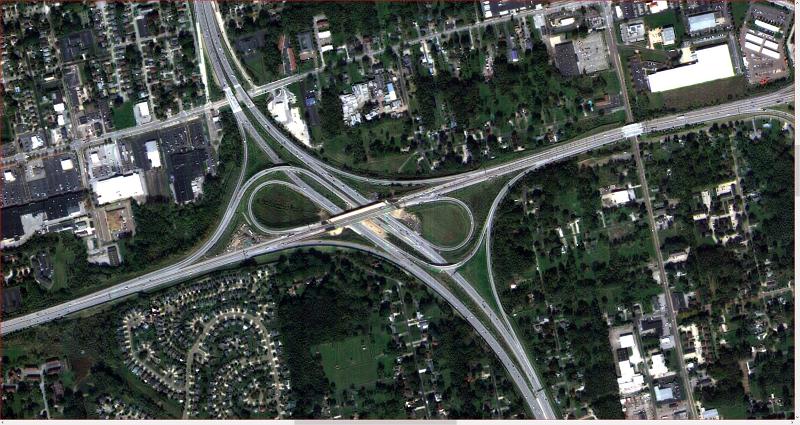
The Korea AeroSpace Administration (KASA) and the Korea Advanced Institute of Science and Technology on Oct. 15 said the second through sixth units of the country's first microsatellite constellation sent their first Earth observation images to a ground station. Shown is a view of Ohio captured by the microsatellite cluster. (KASA)
By Yoo Yeon Gyeong
A constellation of five microsatellites launched into space aboard the domestically developed rocket Nuri earlier this month has sent ground observation images of Earth approximately 14 hours after going into space.
The Korea AeroSpace Administration (KASA) and the Korea Advanced Institute of Science and Technology on Oct. 15 said the second through sixth units of the constellation captured their first images of the planet's surface and transmitted them to a ground station approximately 14 hours and 29 minutes after launch.
This confirmed the normal functioning of the satellite body and optical payload immediately after launch. All five microsatellites from the first mass-produced batch are communicating seamlessly with the ground station, with their core systems like power generation and altitude control maintaining normal operating condition.
The time needed to acquire initial imagery was far less compared to previous satellites thanks to improvement of initial inspection procedures based on operational experience from previously launched prototypes and demonstration satellites, as well as use of automation technology enabling the simultaneous operation of multiple satellites.
"This early acquisition of imagery is a major milestone that proves the stable in-orbit operation of a domestically mass-produced microsatellite, building on the technical expertise we developed through the operation of prototype and demonstration models," KASA Administrator Oh Taeseog said. "We will do our best to ensure that this leads to satellite-based information services that truly benefit the public."
dusrud21@korea.kr