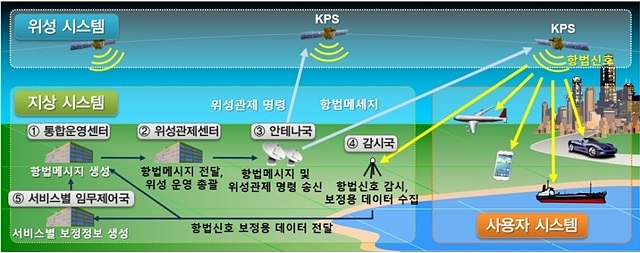
This conceptual diagram illustrates the composition and operating principles of the Korean Positioning System. Ground systems transmit navigational messages to satellites, which in turn provides navigational signals to users such as aircraft, vehicles, ships and smartphones. (Korea AeroSpace Administration)
By Uyen Nguyen
The Korean Positioning System (KPS), the country's project to develop its own satellite navigation system, has entered the manufacturing, assembly and testing phase.
The Korea AeroSpace Administration (KASA) on Nov. 23 announced a critical design review (CDR) for the KPS from Nov. 24-27 at the Korea Aerospace Research Institute in Daejeon's Yuseong-gu District, in cooperation with the Ministry of Land, Infrastructure and Transport, Ministry of Oceans and Fisheries, and Korea Coast Guard.
The CDR is the final check process before production of a flight model to verify if the KPS is designed to properly meet the functional and performance requirements for its missions.
This will comprehensively assess the design maturity and interoperability of the satellite, ground and user systems that make up the KPS. Afterward, manufacturing and assembly of the first KPS satellite will begin, as well as development of ground systems for verification.
The KPS will provide high precision positioning, navigation and timing information across the Korean Peninsula and its surrounding regions. Public funds worth a combined KRW 3.72 trillion will go into the deployment of eight satellites by 2035.
The first satellite is slated for launch in September 2029, with a launch mass of 3.7 tons and mission lifespan of 13 years and three months.
Once the KPS is fully operational, Korea will be just the seventh country to have its own satellite navigation system following the U.S., Russia, the European Union, China, India and Japan.
Offering high-precision positioning data with a margin of error of 5 cm, the KPS is expected to see applications across a range of industries. It will raise the operational safety of aircraft, self-driving vehicles and drones while supporting helping the adoption of artificial intelligence and digital transformation in sectors like autonomous shipping and smart ports.
The KPS is also predicted to help protect lives and ensure public safety by supporting maritime search and rescue operations.
uyen81@korea.kr