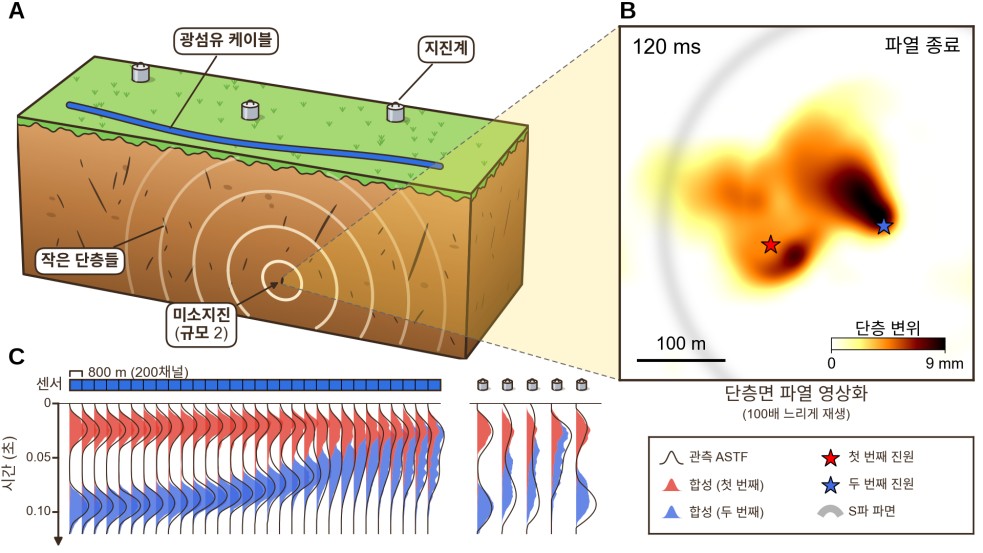
The illustration shows ruptures in small earthquakes captured by underground fiber optic cables.
By Jeong Euiseok
Photos = Ministry of Science and ICT
Domestic researchers have discovered a new way to see how ruptures occurred in small earthquakes at a resolution of a millisecond.
The Ministry of Science and ICT on Nov. 27 said a research team led by Kim Young Hee, a professor at Seoul National University, visualized the rupture of a magnitude 2 earthquake at one millisecond intervals and found that it occurred in two distinct stages instead of one single, continuous rupture.
Small earthquakes under magnitude 3 are observed quite frequently, but their weak seismic waves and brief ruptures have made it difficult to determine exactly how geological fractures break underground. Such ruptures were thought to take the simple form of a "circular crack" expanding in a single, uniform process.
The team applied distributed acoustic sensing (DAS) to a 28-km stretch of fiber optic telecommunications cable crossing the Brawley Seismic Zone in Southern California. DAS measures how the fiber stretches and contracts by analyzing changes in the light reflected back from a laser pulse.
By continuously recording subtle ground deformations at approximately 7,000 points spaced 4 m apart, the researchers effectively transformed a single strand of fiber optic cable into an ultra-dense seismic monitoring network.
In May 2021, the team reconstructed the fault rupture process of a magnitude 2 earthquake that occurred near the fiber optic line.
Detailed analysis showed that this 2021 quake was not a single, continuous rupture but a two-stage event occurring sequentially in two adjacent yet non-overlapping zones. The second rupture began on an adjoining fault segment approximately 0.042 seconds after the first.
Sixteen smaller earthquakes that followed over a period of about three hours were found to have occurred in separate, non-overlapping areas within a 500-m span.
Kim said, "By utilizing telecommunication optical fibers, we can use a small earthquake as a new window to examine the mechanisms of fault movement, and this approach could be expanded into systematic comparative research on the variance of rupture patterns by region."
The application of DAS to underground telecommunication fiber optic cables is expected to enhance earthquake risk analysis and response capabilities in large metropolitan areas.
The team's findings were published on Nov. 27 in the international journal Science.
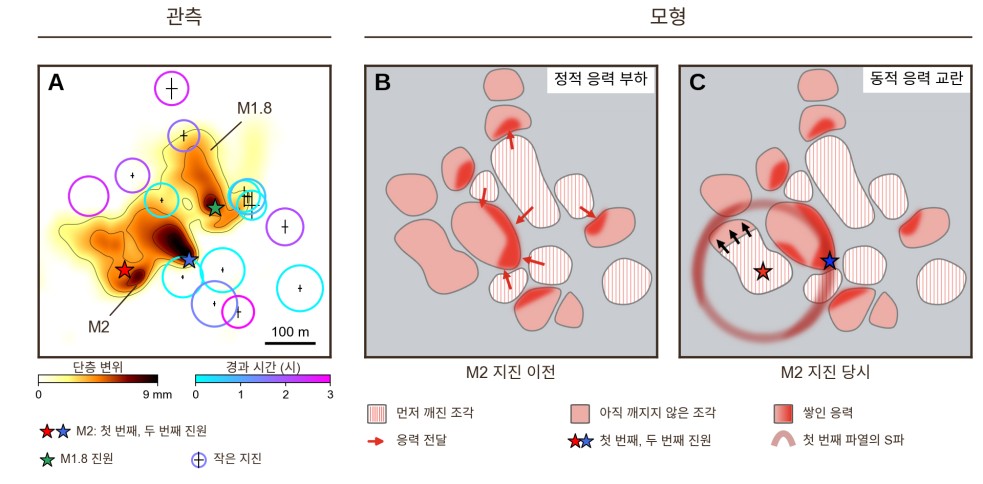
Process through which small earthquakes rupture adjacent segments of fault
innocence@korea.kr