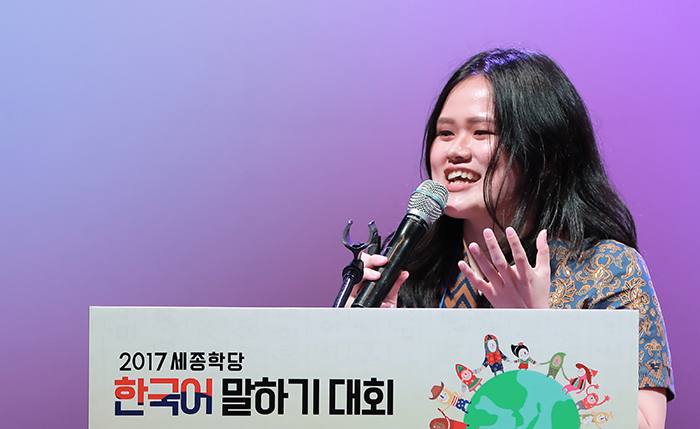
Maggie Yang from Indonesia, winner of the 2017 King Sejong Institute Korean Speech Contest, shows off her Korean language skills at the KBS Art Hall in Seoul on Sept. 18.
By <font color="#0070c0">Hur SomEe </font>and <font color="#0070c0">Kim Young Shin</font>
Photos = King Sejong Institute Foundation
Seoul l Sept. 18, 2017
On Sept. 18, a Frenchwoman who can make kimchi, a Sri Lankan humming along to K-pop, and Indian fans of Korean soap operas all gathered at the KBS Art Hall in Seoul to take part in the of 2017 King Sejong Institute Korean Speech Contest. They were all fluent Korean speakers. Listening to them with your eyes closed, they couldn't be told apart from native speakers.
The 12 finalists made it through some grueling competition. Only one out of 113 made it. A total of 1,359 students who attend 117 Sejong Institutes in 54 nations were taking part in the event.
In the first round of the finals, to select the top three contenders, contestants spoke about their experiences related to “Kimchi and Cheese,” “Seoul and Jeju” or “K-pop and Traditional Gugak Music.” They entertained the audience by skillfully using Korean idioms, like “I would die for kimchi.” (김치라면 사족을 못 쓴다), and, “Names and natures do often agree.” (보기 좋은 떡이 먹기도 좋다).
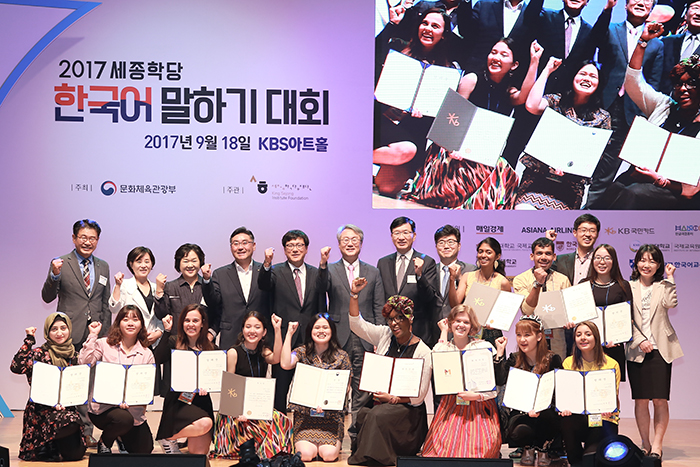
The 12 finalists and representatives of King Sejong Institutes pose for a photo at the KBS Art Hall where the 2017 King Sejong Institute Korean Speech Contest takes place on Sept. 18.
Of the three contestants who made it to the second round of the finals, there was one from France, Indonesia and Estonia. The winner was Maggie Yang from Indonesia who works at the Korea-Indonesia Electronic Government Cooperation Center in Jakarta.
“I studied Korean for four years at the Sejong Institute at the Korean Cultural Center in Indonesia just so that I could watch Korean soap operas and entertainment shows without captions,” said Yang.
She clearly explained the similarities and differences between Korea and Indonesia, mentioning the importance of rice and table manners.
“I studied Korean for six years at the Sejong Institute at the Korean Cultural Center in France,” said Bah Leyla, the French contestant who came in second. “I’m going to develop my Korean skills further because it's my dream to do a commentary for a Korean documentary.”
Maret Luud, who took the third place and the popularity award, expressed her love for Korean music with the language skills she gained by studying Korean for two years at the King Sejong Institute in Tallinn. She also got a round of applause from the audience for performing a traditional dance from Estonia in traditional Estonian clothes.
The King Sejong Institute will provide a scholarship to the 12 finalists to study Korean at 12 universities in Korea, including Kyunghee University and Korea University.
The institute has hosted a yearly King Sejong Institute Korean Speech Contest since 2014 to boost students’ speech skills and to motivate them to study harder.
sehp91@korea.kr