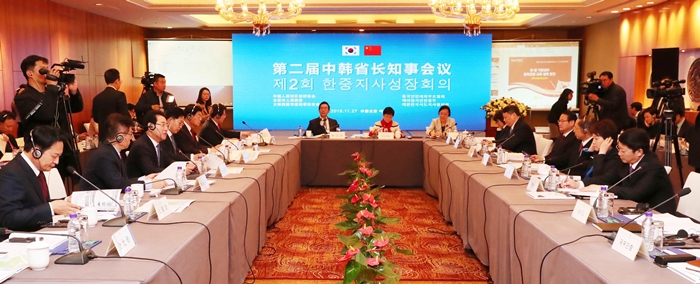
Government officials from Korea and China hold a meeting to discuss cooperation at the local government level in Beijing on Nov. 27. (Jeollanam-do Provincial Government)
By <font color="#0070c0">Lee Kyung Mi</font> and <font color="#0070c0">Lee Hana</font>
Environmental issues like the increase of atmospheric particulate matter, or the problem of spillover, when TV and radio signals reach locations beyond the intended coverage area, don't only concern the country in question. As these issues have an impact on neighboring regions, they can be the cause of conflict between countries.
In the case of Korea, the impact of Chinese smog and yellow dust on its air quality, is one such example.
In order to solve such an issue, it's necessary for both the country of origin and its neighbor to take a stand. Though it may be a sensitive topic, given bilateral interests, Korea and China are taking action to address the problem together.
With air pollution in Korea getting worse by the day due to airborne particulate matter from China, local governments from the two sides will cooperate on improving air quality and combating climate change.
On Nov. 27, representatives from seven Korean cities and provinces including Seoul, Daegu and Chungcheongnam-do Province, and from 10 Chinese cities and provinces gathered in Beijing to announce a joint statement that outlines such measures.
This is the first time that an agreement to combat climate change has been signed by a delegation of local government officials from Korea and China.
The two sides stressed the importance of protecting the environment and stated that they will "work together to ensure sustainable development while strengthening cooperation on air quality and climate change."
Mayor of Seoul Park Won-soon, who chaired the meeting as head of the Governors Association of Korea, said that climate change and air pollution are issues that cannot be solved unless Korea and China join hands. "I hope the joint statement will provide a framework to further our common cause," he said.
"I propose we create a climate and weather forecast cluster, as a means to share information and carry out joint research," said Chungcheongnam-do provincial governor Yang Seung-jo. "There are no borders for particulate matter. It's imperative that we monitor transboundary environmental problems like air pollution together, and establish reduction measures as partners."
km137426@korea.kr