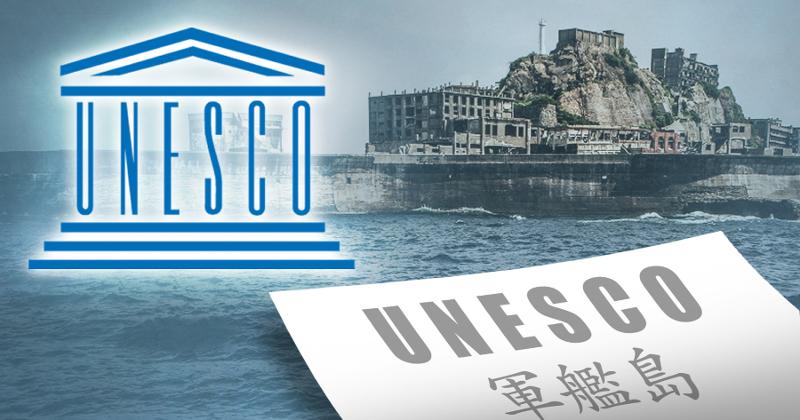
In the process of 23 Meiji industrial sites being designated UNESCO World Heritage in July 2015, the Japanese government pledged to set up an information center explaining the history of forced Korean workers on Hashima (Battleship) Island. (Yonhap News)
By Kim Young Deok and Lee Jihae
Q. What problem does the Industrial Heritage Information Centre in Tokyo pose?
A. In 2015, Japan applied to register 23 Meiji Industrial Revolution sites on the UNESCO World Heritage list and pledged to the international community to build an exhibition center that commemorates forced work victims. Koreans, Chinese and prisoners of war from Allied countries were mobilized to seven of those sites during World War II. The center in Tokyo, however, mainly shows content that denies Japan's forced mobilization and discrimination of the victims.
Q. Does the center deny Japan's forced mobilization?
A: It makes it seem like no discrimination occurred between Koreans going to Japan to work before World War II (from the early 1910s to 1930s) and those forcibly mobilized for labor. The center makes it seem like the life of the former type of Koreans was the latter's.
Q: Briefly describe how Koreans were forced to work during Japanese colonial rule of the Korean Peninsula.
To proceed with the Pacific theater of World War II (1941-45) that it started, Japan enacted the National Mobilization Law in April 1938. It utilized human resources, materials and capital from not only its mainland but also from the colonies and territories it occupied.
Q: How many workers did Japan forcibly mobilize and to what sectors?
A: Official statistics from the Japanese government say at least 7,804,376 people were forcibly mobilized a year: 6,552,883 from the Korean Peninsula and 1,251,493 from other areas. Such workers were from the peninsula, Japan, the southern part of Sakhalin Island, Chinese territory and Manchuria, the Pacific, Southeast Asia and Taiwan. They were mobilized to places such as munition factories, engineering and construction sites, coal and metal mines, port and transportation sites, deforestation areas and collective farms.
Q: Did Japan officially apologize for using forced workers?
A: Japanese politicians have issued several public apologies. At the World Heritage Committee session in July 2015, Japanese Ambassador to UNESCO Kuni Sato officially acknowledged her country's history of forced mobilization.
Q: What is the Japanese government's stance on the global criticism it has received?
A: The Japanese government's excuse is that Sato didn't know the topic well and that her words were a slip of the tongue. Yet Tokyo declared that what she told the world was an official government statement.
Q: Why did the Japanese government change its stance?
A: Yuji Hosaka, a professor at Sejong University in Seoul and an expert in Korea-Japan relations, said, "The Abe administration tries to hide and glorify Japan's past war of aggression and insists no problems with the Japanese military. The administration is operating an exhibition that distorts history such as the Industrial Heritage Information Centre to change the Self-Defense Forces into an official military."
Q: What should the Japanese government do?
A: It needs an exhibition that "remembers the victims," just as Sato promised to the world in Japan's process of registering the Meiji industrial sites as UNESCO World Heritage.
kyd1991@korea.kr