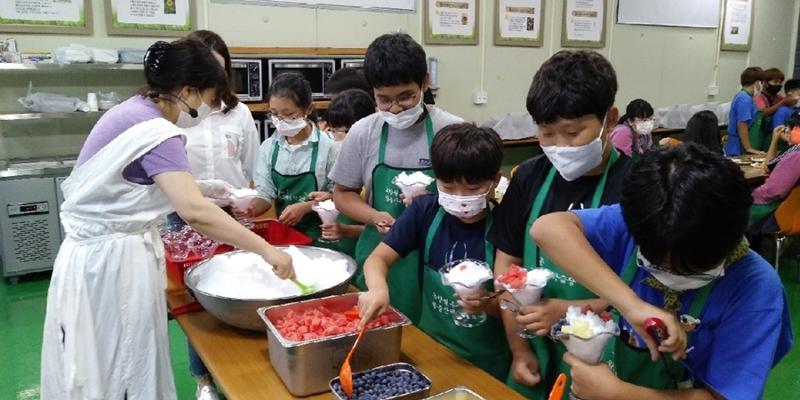
With the COVID-19 pandemic showing no signs of abating, students from Seoul are attending schools in rural areas for a semester or more through a "farm study" program. Shown here are students at Gurim Elementary School in Yeongam-gun County, Jeollanam-do Province, on July 5 making the traditional shaved ice dessert bingsu with seasonal fruits. (Jeollanamdo Office of Education)
By Lee Jihae
Foreign media have covered a program for sending students from Seoul to learn in rural areas amid the continuation of the COVID-19 pandemic.
Such students attend schools in rural regions for a semester or more to experience seasonal changes with all five senses and eat seasonal crops that they harvest, attracting the attention of Japanese and British media.
In the article "Studying in mountain towns to escape Korea's academic stress and education fervor," the Japanese daily Asahi Shimbun on Aug. 10 said the program's purpose is to "experience nature and regional development." It added that the students are taking a break from their competitive society and the COVID-19 pandemic.
The BBC on its website's Asian news section in June also featured the program in its article "South Korea: Swapping Seoul megacity isolation for village life."
Last year on Dec. 7, the Seoul Metropolitan Office of Education and Jeollanamdo Office of Education agreed to launch the program under a working-level accord. The first edition came in March this year in the first semester, with 81 students participating.
The welcoming ceremony for the second semester took place on Aug. 23, with 57 of the 151 students taking part extending their participation.
Seoul school superintendent Cho Hee-yeon said, "We hope that the rural study program's policy, which can develop ecological sensitivity in daily life, can spread to regions other than Jeollanam-do Province."
"We plan to actively communicate so that students adjust well to rural life and are safe in the second semester as well."
jihlee08@korea.kr