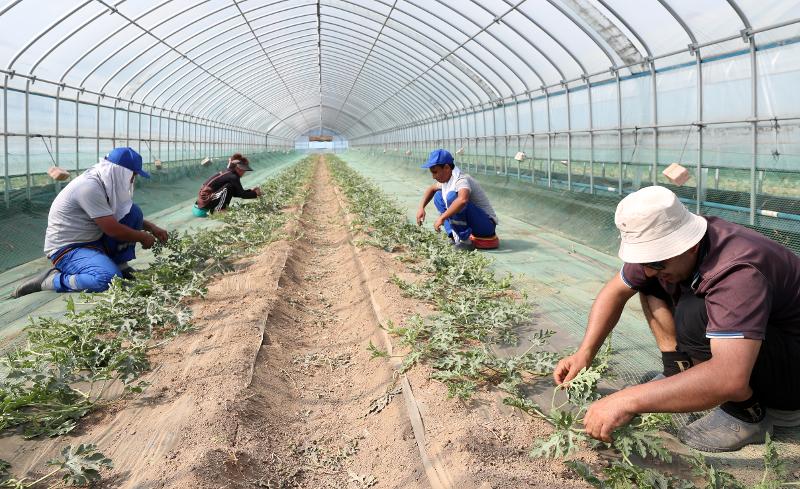
The government next year will allow 7,000 more foreign workers to enter the country under the "non-professional" (E-9) employee visa to raise the overall number to 59,000. Shown are Uzbek workers on May 14 at a watermelon greenhouse in Yanggu-gun County, Gangwon-do Province. (Yonhap News)
By Lee Jihae
The government next year will raise the number of foreign workers allowed to enter the nation under the "non-professional" (E-9) work visa to 59,000, up from 52,000 this year.
The Ministry of Employment and Labor and the Office for Government Policy Coordination (OPC) on Dec. 28 approved during a meeting of the Foreign Workforce Policy Committee a plan on the adoption and management of foreign workers next year, with the higher labor quota as the highlight.
In expectation of continued entry and departure problems by foreign workers due to the recent surge in COVID-19's omicron variant, the permissible stays of E-9 holders and those on the "work and visit" (H-2) visa, who are estimated at 40,000 in total number and whose visas were slated to expire between Jan. 1 and April 12, were extended for a year.
The number of foreign nationals allowed to work in the country will also increase.
Manufacturing companies with under 50 staff that were earlier allowed 20% more foreign staff will continue to enjoy this benefit through next year.
In coastal fisheries, the number of foreign crew will be doubled from two to four per vessel. Two foreign workers will also be allowed at small-scale poultry or pork farms, and the number at a paprika cultivation venue will be raised from 20 to 25.
International students on the D-2 visa for those pursuing a degree full time or studying under an exchange program can work under an E-9. Those eligible are graduates from Korean universities who unsuccessfully applied for professional employment requiring the "professor" (E-1) or "specially designated activity" (E-7) visa and wish to work under the E-9.
To resolve the labor shortage in parcel delivery, food service and lodging, the H-2, a visa normally reserved for ethnic Koreans from overseas, will be available to foreign workers in the three sectors. For parcel delivery, handling land-based cargo will be added to the list of industries granting the H-2 but limited to loading and unloading cargo. In food service and accommodations, in-house cafeterias at public institutions and operation of resort condos and four to five-star hotels will be newly included.
From 2023, the process of granting the H-2 to a sector will change from a "positive" approach in which the government names individual industries eligible to grant the visa into a "negative" system that simply announces business lines ineligible for it and the ones not named being eligible. Relatively high-paying sectors with no labor shortage such as finance, research and development, and information and communications will be excluded from granting the H-2.
OPC Minister Koo Yun-cheol said, "Considering the quarantine situation including the onsite labor shortage due to the COVID-19 pandemic over the past two years and the recent spread of the omicron variant, the government prepared a plan on adopting and managing foreign workers."
jihlee08@korea.kr