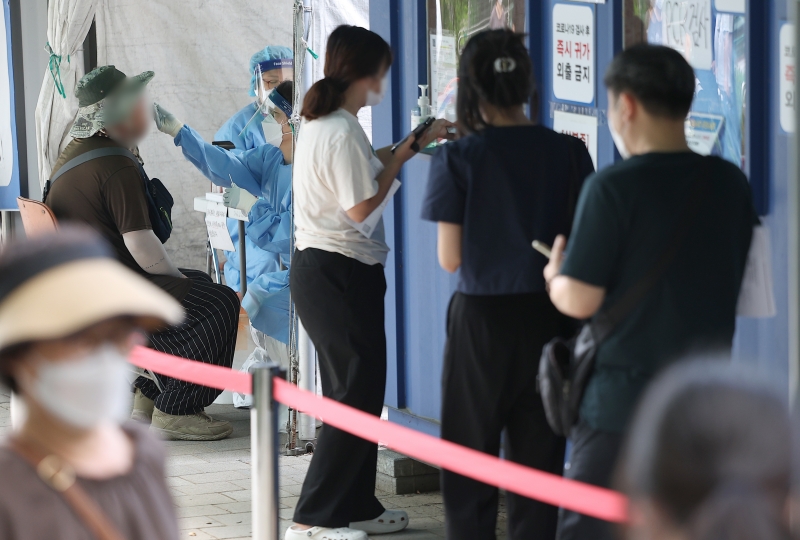
The government on Aug. 31 will downgrade COVID-19's infectious level from Class 2 to the lowest figure of 4. Shown are people in line to get tested for the coronavirus at a screening clinic of a public health center in Daegu's Dalseo-gu District. (Yonhap News)
By Park Hye Ri
COVID-19's infectious level on Aug. 31 will be cut to the lowest Class 4 from 2.
The Korea Disease Control and Prevention Agency (KDCA) on Aug. 23 said, "From Aug. 31, the COVID-19 alert level will be reclassified as Level 4 due to the drastic drop in disease risk (fatality rate) and slower transmission during summer. Phase 2 measures will also start under the roadmap for adjusting the crisis level."
Quarantine authorities will monitor COVID-19 outbreak trends and changes every week instead posting daily data on the number of infections reported and tabulated, a system that lasted three years and seven months.
A multi-layered surveillance system using 527 monitoring centers will observe those testing positive for the coronavirus, screen for coronavirus based on wastewater samples and upgrade the integrated sample surveillance system for some 400 respiratory infectious diseases.
Certain tests for COVID-19 will incur costs. The rapid antigen test administered by medical professionals available at hospitals and clinics for KRW 5,000 will jump up in price to KRW 40,000 to KRW 50,000.
Polymerase chain reaction (PCR) tests, which are given free at screening centers for those getting a positive result from a self-testing kit, will remain free but only for people from high-risk groups including those aged 60 and above and employees at high-risk facilities.
Despite the downgrade, COVID-19 screening clinics at public health centers nationwide will remain open. Staff at facilities vulnerable to infection, patients awaiting hospitalization and their guardians will be required to take free PCR tests at screening centers.
The government will retain its system of free support for COVID-19 treatment and vaccination and partial coverage of hospital costs for critically ill patients.
To protect high-risk groups and facilities susceptible to infection, the coronavirus crisis level will remain at "alert," with the mask-wearing rule indoors to continue at general hospitals and other vulnerable facilities like geriatric nursing homes.
KDCA Commissioner Jee Young-mee said, "We will continue improving our capacity to respond to infectious diseases and maintain a joint cooperation system with the international community through smooth implementation of our mid- to long-term plans."
hrhr@korea.kr