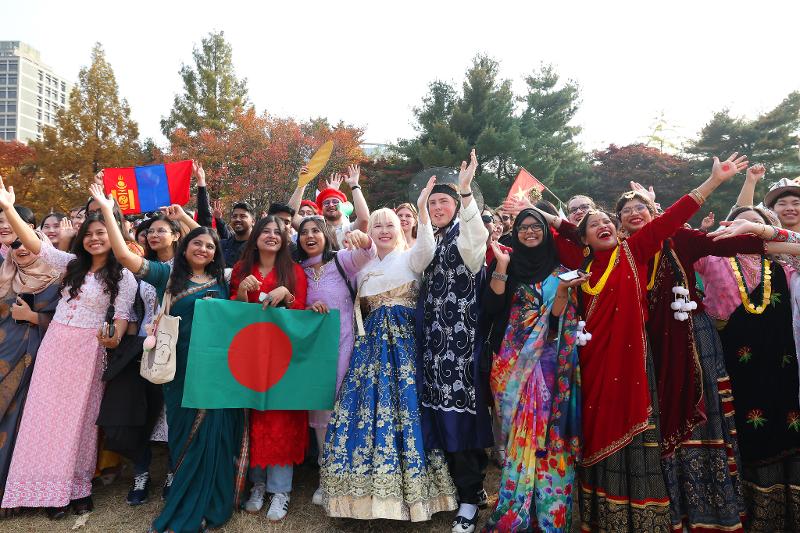
One in 20 people in Korea has expat, naturalized citizen or second-generation immigrant roots. Shown are international students on Nov. 6 attending an event marking Ajou International Day at the lawn area of Ajou University in Suwon, Gyeonggi-do Province. (Lee Jeong-woo)
By Margareth Theresia
One in 20 people in the country has expat, naturalized citizen or second-generation immigrant roots.
The Ministry of Data and Statistics on Dec. 8 quoted data as saying the country's resident immigrant population was 2,715,000 on Nov. 1 last year, up 134,000 year on year.
The term "immigrant background population" refers to people with at least one parent of foreign origin or those with a history of immigration including expats, naturalized and recognized citizens, and second-generation immigrants.
Those with such a background comprised 5.2% of the national population of 51,806,000, up three-tenths of a percentage point.
By type, expats accounted for the largest share with 2,043,000 (75.2%), followed by second-generation immigrants possessing Korean nationality with 381,000 (14%), naturalized and recognized citizens 245,000 (9%), and others 46,000 (1.7%).
By age group, those in their 30s accounted for the highest proportion of the immigrant background population with 660,000 (24.3%), followed by 20-somethings with 570,000 (21%) and 40-somethings 419,000 (15.4%).
The Seoul metropolitan region had the highest share of such people with 56.8%. Gyeonggi-do Province had the most individuals in the category with 887,000 (32.4%), followed by Seoul with 475,000 (17.5%), Incheon 180,000 (6.6%), Chungcheongnam-do Province 176,000 (6.5%) and Gyeongsangnam-do Province 168,000 (6.2%).
margareth@korea.kr