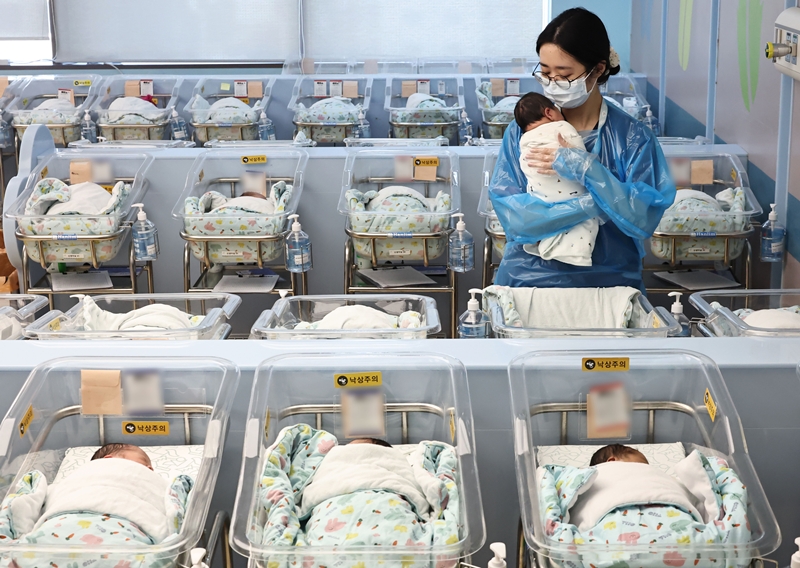
The country's birth rate last year grew for the second straight year. Shown is a nurse on Dec. 26 holding a baby at the newborn unit of Cha University's Ilsan Medical Center in Goyang, Gyeonggi-do Province. (Yonhap News)
By Margareth Theresia
The number of births in the country last year rose for the second straight year.
The Ministry of the Interior and Safety on Jan. 5 reported 258,242 births last year, up 6.56% or 15,908 from 2024.
The number of births thus rose for two consecutive years since seeing its first rebound in nine years in 2024, but the population decline continued as the number of newborns was lower than that of deaths.
By region, Gyeonggi-do Province had most births with 77,702, followed by Seoul (46,401) and Incheon (16,786) among metropolitan cities and provinces. By city, county and district, the Gyeonggi-do cities of Hwaseong (8,116), Suwon (7,060) and Yongin (5,906) took the top three spots, followed by Cheongju (5,525), Chungcheongbuk-do Province, and Goyang (5,522), Gyeonggi-do.
The population gap between the Seoul metropolitan area and those not in the region further widened. Greater Seoul saw a population of 26,081,644 last year, up 34,121 from 2024, and other places 25,035,734, a decrease of 133,964.
"The number of births rose for the second straight year, and the population of the Chungcheong-do provinces outside of the capital increased in a significant change," Vice Minister of the Interior and Safety Kim Min Jae said. "As the population gap between metropolitan and non-metropolitan regions keeps expanding, we pledge pan-government efforts to devise and promote policy to reverse this trend for balanced regional development."
margareth@korea.kr