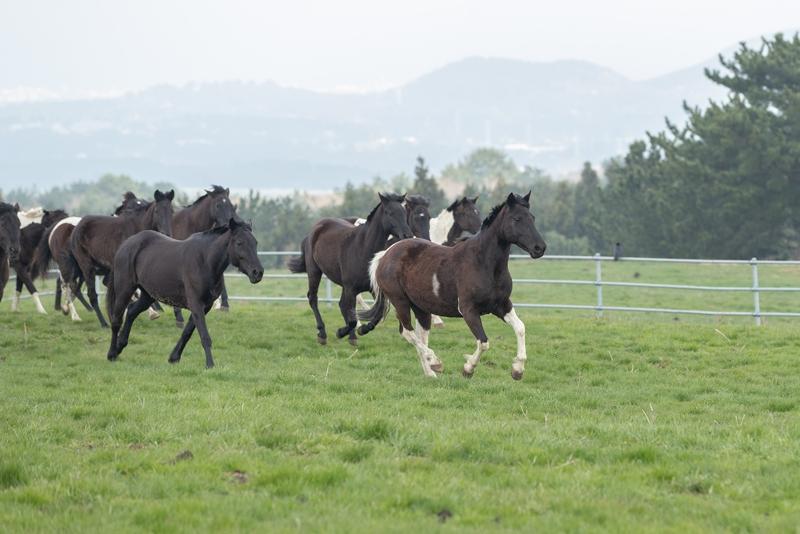
The National Institute of Animal Science under the Rural Development Administration from 2009 has developed a horse breed for riding by humans.
By Lee Jihae
Photos = National Institute of Animal Science of Rural Development Administration
A domestically developed breed of horse for riding by humans boasts both strength and elegance.
The National Institute of Animal Science (NIAS) under the Rural Development Administration (RDA) has spent 16 years trying to popularize horseback riding in the country. The institute's painstaking development of the RDA riding horse signals the evolution of the domestic horse industry from spectator horse racing to leisure horseback riding, as well as laying the basis for sports customized for the Korean physique and sentiment.
Countries where horse racing and equestrianism have developed in parallel have systematically bred horses for specific purposes such as dressage, rehabilitation and endurance racing. Korea, however, has focused on horse racing without developing its own breed, showing the separation of horses for racing and riding.
The practical solution to resolve the problem and perfect a Korean-style riding model is the RDA riding horse. Developed by NIAS since 2009, the breed has a clear goal: advancement of a homegrown riding horse optimized for the Korean physique and living environment.
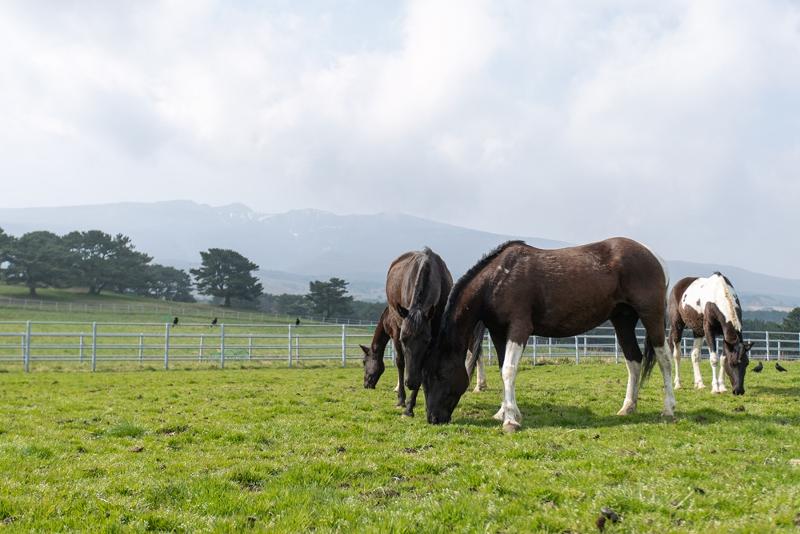
RDA-developed riding horses eat grass on Jeju Island.
The RDA model is a crossbreed between horses native to Jeju Island and racing thoroughbreds. The objective was to create a mid-size horse between the large thoroughbred and small Jeju horse, making it comfortable for Koreans to ride.
The height of an adult RDA riding horse from the ground to the saddle is 141.5 cm. The plan is to reduce the imposing presence of the foreign thoroughbred (average height 162-167 cm) while compensating for the Jeju horse's small stature (115-125 cm) and aiming for 145-150 cm. NIAS is in the middle of the optimization phase to fine-tune the height.
Changes in body shape raise riding accessibility. Foreign breeds are difficult for beginners or children to ride as well as care for, but the RDA's is comfortable for youth and women and ideal for recreational, educational and experiential riding.
Such research is not confined to appearance and physique. Genetic studies are underway to create the black and black-and-white spotted coat colors preferred by people.
Above all, the RDA breed has gained kudos for passing on temperamental traits like docility and patience, two traits crucial to daily riding and setting the standard for a good riding horse.
Use of the RDA riding horse has expanded to law enforcement and public safety. In December last year, two were assigned to the mounted unit of Jeju's autonomous police force to patrol tourist sites, inform about traffic order and provide safety.
The horses are undergoing training and conditioning to adapt to urban noise, crowds reactions and patrol environments.
NIAS will gather behavioral data from these horses to confirm their utility and expand their activity scope to public, tourism and daily life applications.
With 2026 the Year of the Red Horse under the East Asian zodiac, the RDA breed is part of an effort to set a new standard for the domestic horse industry through autonomy from the import-reliant structure. Thus this bioengineered galloper punctuates the potential of the sector to shift its focus from racing to the public sphere.
jihlee08@korea.kr