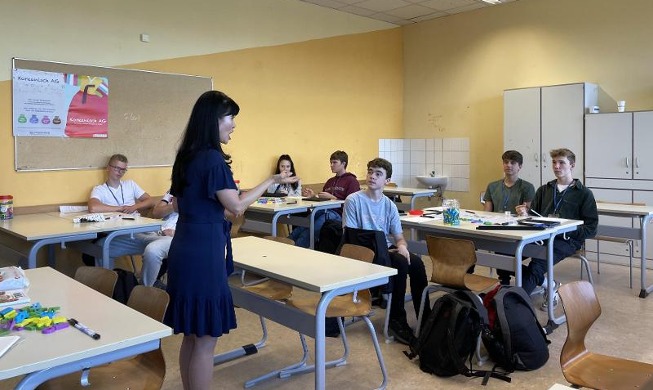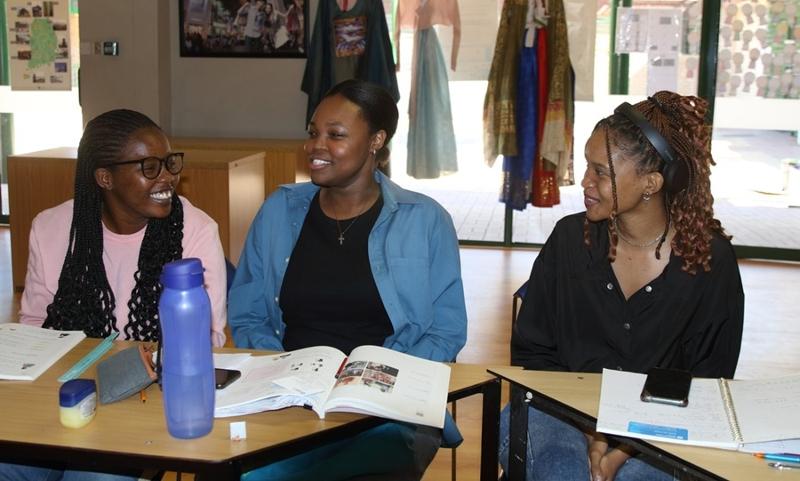
Students in an intermediate Korean-language class at the King Sejong Institute branch in Gaborone, the capital of Botswana, on May 11, 2024, discuss Hallyu (Korean Wave).
By Lee Jihae
The number of elementary, middle and high schools abroad that offer Korean-language classes rose 54% over the last four years, with the number of students learning Korean at these schools growing 38% to 236,000.
Rep. Kim Moon-soo of the National Assembly's Education Committee on May 10 announced this after receiving Ministry of Education data on schools worldwide offering Korean-language education. The number of such institutions rose 9.9% year on year to 2,777 late last year.
By year, the figure steadily increased from 1,806 in 2021 to 1,928 in 2022, 2,154 in 2023 and 2,526 in 2024, marking a 54% surge over the past four years.
The figure spans the number of elementary, middle and high schools abroad that offer Korean as a regular or afterschool class as of December each year.
The number of students of Korean at such schools rose 38% over the four-year period from 170,563 in 2021 to 236,089 in 2025. Growth reached 6.1% between 2024 and last year.
Forty-seven countries last year had schools offering such classes, up five from 2021. Over the past year (2024–25), Uzbekistan saw the largest growth by adding 68 such schools, followed by Sri Lanka (43), Vietnam (37), the Philippines (26), Brazil (24) and the U.S. (21).
The ministry attributed the growth of such schools to growing demand for Korean-language education stemming from higher global interest in Hallyu (Korean Wave) and studying in Korea; government financial support for the operation of such courses, distribution of related textbooks and training of teachers in host countries; and promotion and cooperation of Korean education centers and their networks abroad.
jihlee08@korea.kr