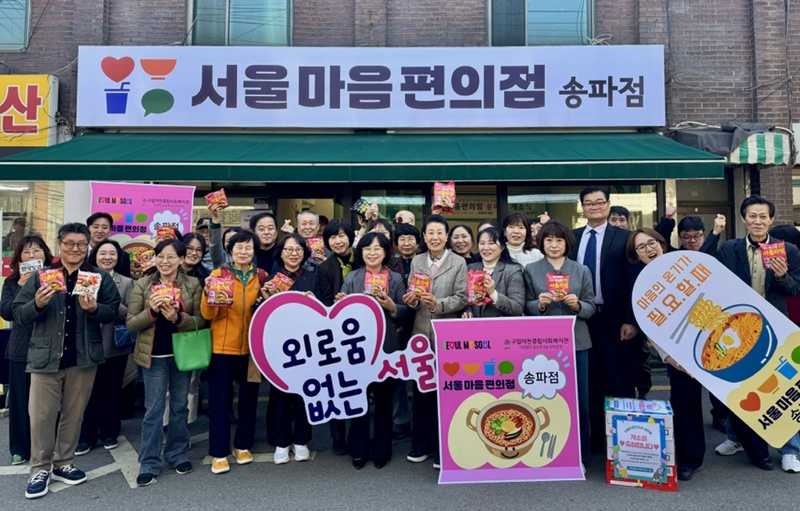
Officials and residents on April 7 pose for a group photo at the opening ceremony for the branch of Seoul Mind Convenience Store in Seoul's Songpa-gu District. Attendees hold packets of ramyeon (instant noddles), the chain's symbol, and placards reading "Seoul Without Loneliness" and "When You Need Warmth of the Heart," pledging to create a community free from loneliness and isolation. (Macheon Welfare Center)
By Hong Angie
Though eating alone has grown widely common, behind this familiar trend are quite a few people who feel lonely and isolated.
To allow people who feel isolated to rest and reconnect with others, the Seoul Metropolitan Government runs 19 branches of Seoul Mind Convenience Stores across the capital. Community welfare centers are rolling up their sleeves to provide counseling and programs to alleviate the mental burden of loneliness and isolation.
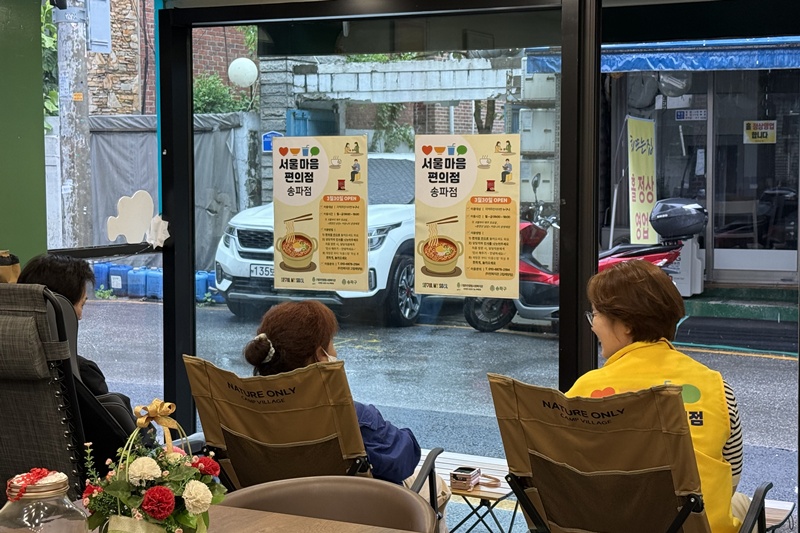
Jeong Su-jin (right), a social worker at the isolation prevention team of Macheon Welfare Center who manages the Seoul Mind Convenience Store branch in the city's Songpa-gu District, on May 20 chats with visitors. (Hong Angie)
Instant noodles not as bait but as connecting tool
"This place isn't just where you get free ramyeon (instant noodles), it's where residents who feel lonely and isolated can be naturally discovered and connect."
Jeong Su-jin, manager of the chain's branch in the city's Songpa-gu District, on May 20 explained the meaning of the project. As a social worker at the isolation prevention team of Macheon Welfare Center in the nearby neighborhood of Macheon-dong, she said her role as the store manager is not to boost sales but rather look out for residents in their daily lives.
The branch attracts a diversity of visitors ranging from those feeling lonely because of their jobs as delivery drivers and middle-aged and older adults isolated from society while caring for sick relatives. Many said they were initially reluctant to go to a welfare center, but the familiar label "convenience store" made them feel at ease to enter.
Another trait of the chain is the high proportion of middle-aged and older people using the facility. "Middle-aged and older adults often find it difficult to even ask for help," Jeong said. "They tend to open up more naturally in everyday spaces than at welfare centers."
"Someone walked in and hesitantly asked, 'Do you sell gimbap (seaweed rice roll)?' and opened up about their feelings," she said. "Another person said, 'I walked in because I was drawn to the name 'convenience store.'"
"I feel that this place has the power to attract lonely people."
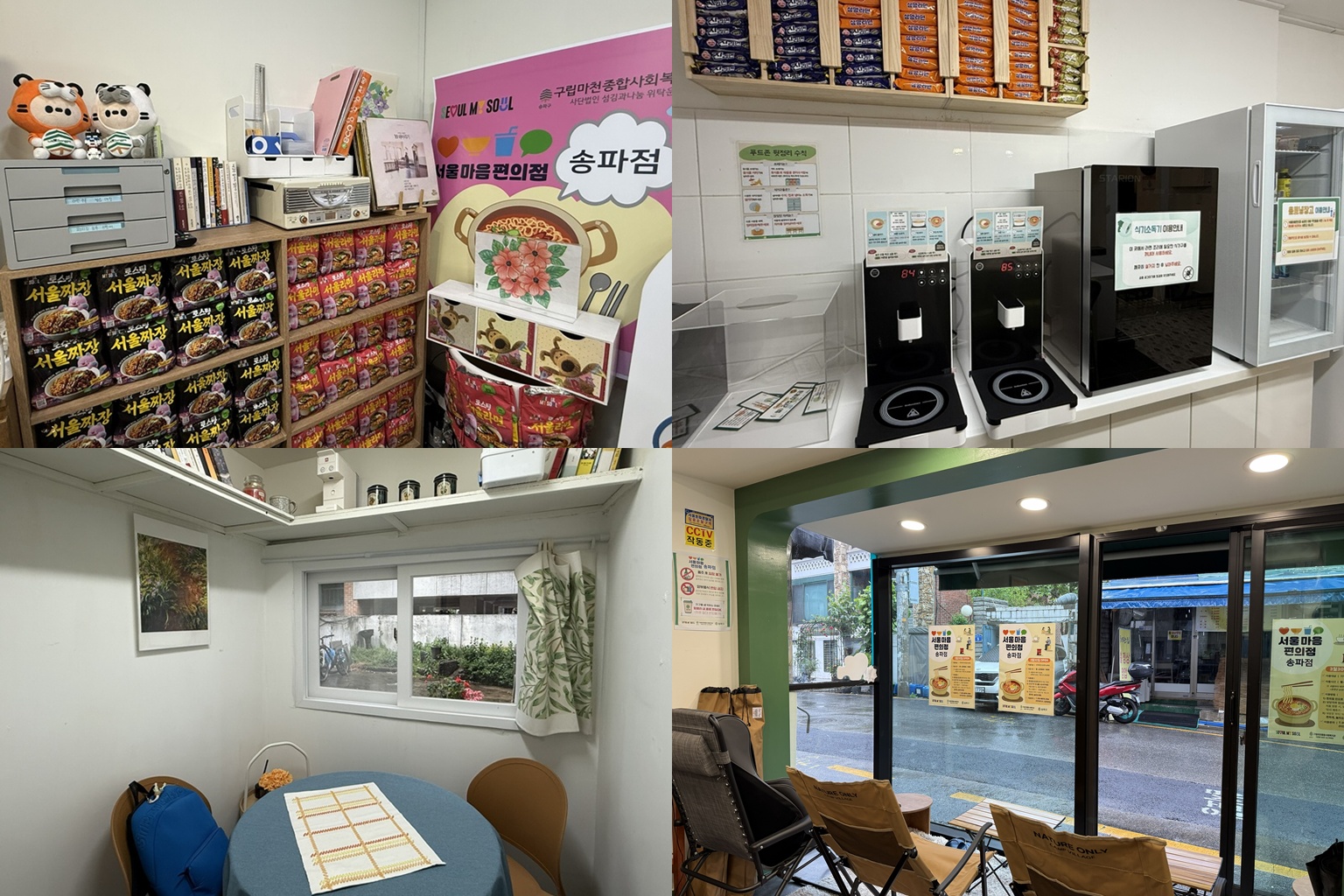
This is the interior of the Seoul Mind Convenience Store branch in the city's Songpa-gu District. Situated close to the daily routes of residents like community centers, markets and police boxes, the branch is designed to allow people in need of help to visit without reservation and regain emotional stability and social connection. (Hong Angie)
Place of comfort for lonely people
Single-person tables and quiet seating areas are laid out throughout the space. This strategic arrangement considers how people who are alone could feel uncomfortable initially sitting across from someone.
The branch's practice of offering free food is not just borne from charity. Instead, this is a way to break the ice with residents participating in the program or are in need of counseling, with a focus on building and restoring relationships.
A range of customized programs seek to stimulate interactions between residents. They include "Good Morning Convenience Store," which helps restore mind and body; "Sunny Day Class," which supports isolated households in returning to daily life; "Romantic Dining," specialized for middle-aged and older men; "Macheon-dong Brothers," which teaches woodworking and crafts; and "Humanities Gathering," for women.
"Welfare shouldn't be something that people wait for inside a building, it must be close to the daily lives of residents," Jeong said. "I hope that this chain is the starting point for lonely people to reconnect with society."
The city government plans to raise the number of branches to 25 by year's end.
shong9412@korea.kr