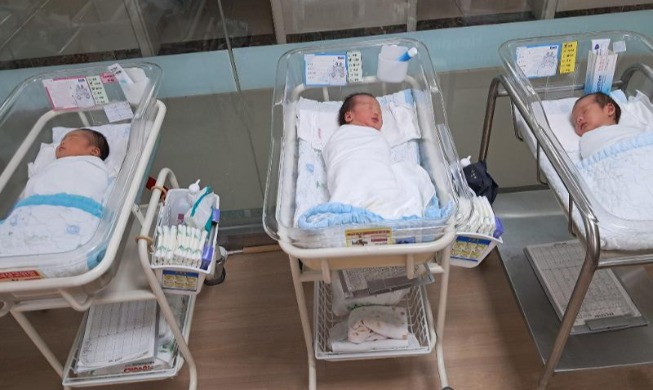
The national population reached 51,817,000 last year, staying at the 51 million mark for the 11th consecutive year. (iClickArt) Unauthorized reproduction and redistribution of this image is prohibited under copyright law.
By Lee Jihae
The national population last year reached 51,817,000, staying at the 51 million mark for the 11th consecutive year due to the rising influx of expats offsetting a fall in that of Koreans.
The Ministry of Data and Statistics on July 28 released a 2025 population and housing census report showing a rise of 12,000 (0.02%) in the population from the previous year.
The number of citizens was 49,708,000, a dip of 54,000 (0.1%) and continuing a decline that began in 2021.
The expat population, however, went up 66,000 (3.2%) to hit 2,109,000, the fourth consecutive year of growth since 2022, when the figure was 1,752,000.
The percentage of expats in the population also climbed to 4.1%. This steady growth offset the decline in the native-born population to maintain overall population size.
By age group, 50-somethings accounted for the largest share in national population at 16.7%, followed by those in their 60s (15.3%), 40s (14.8%), 30s (13.5%) and 20s (11.7%).
Next were teens (8.8%), trailed by those in their 70s (8.6%), children ages 0–9 (5.7%), people in their 80s (4.1%), and those aged 90 and older (0.7%).
By gender, the male population of 25,936,000 was up 5,000 from 2024, while that of females rose 7,000 to 25,882,000. The sex ratio, or the number of males per 100 females, was 100.2, similar to the figure two years ago.
Ethnic Koreans from China was the most represented expat group with 535,000 (25.3%), followed by Vietnamese (318,000 or 15.1%), non-Korean Chinese (221,000 or 10.5%), Thais (159,000 or 7.5%), Uzbeks (91,000 or 4.3%) and Nepalis (84,000 or 4%).
Reflecting the increase in foreign residents, the number of multicultural households rose 2.8% (12,000) to 450,000 last year, its 11th straight year of rise since 2015.
jihlee08@korea.kr