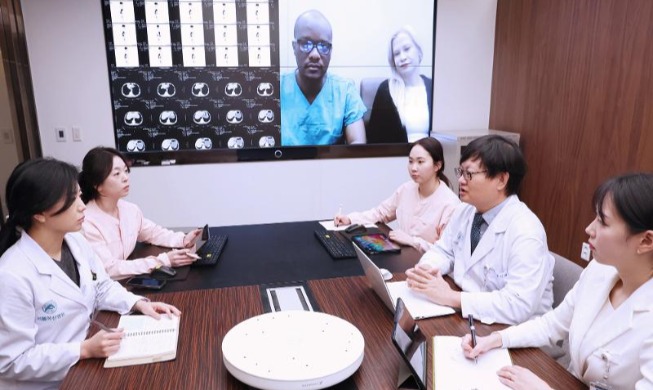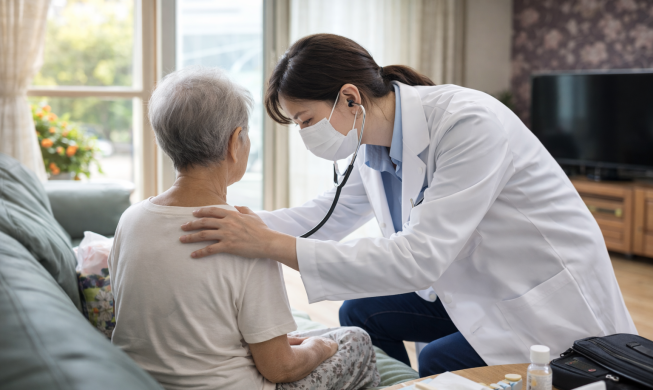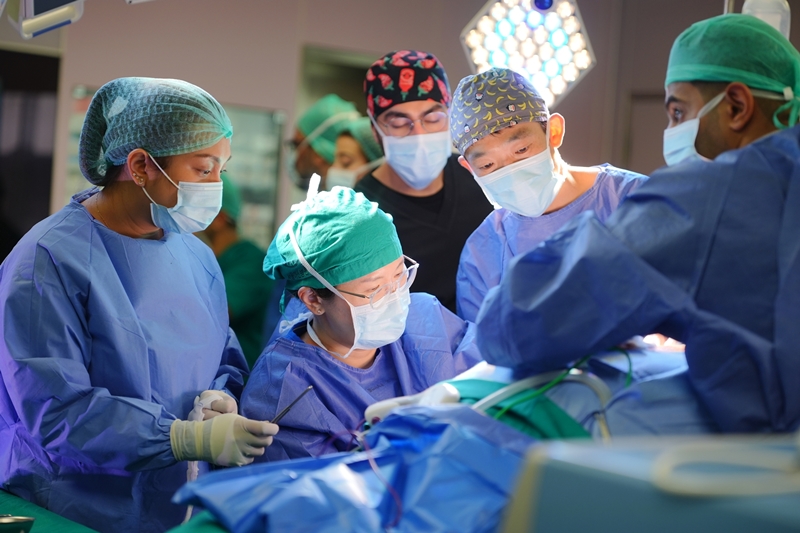
The Korea Health Industry Development Institute on Sept. 17 released the results of a 2025 survey on foreign perceptions of Korean medicine. Shown are medical staff from Asan Medical Center in Seoul last year teaching in Kuwait surgical techniques for treating patients with complex recurrent thyroid conditions. (Asan Medical Center)
By Xu Aiying
The country's medical tourism is known to have greatly benefited from growing global awareness of and interest in Korean culture.
The Korea Health Industry Development Institute on Sept. 17 said this in releasing the results of a survey last year on foreign perceptions of Korean medical services. Conducted online from Nov. 28 to Dec. 23 last year, the study surveyed 7,100 people ages 18 and above in 25 cities across 16 countries including the U.S., China, Japan and Vietnam.
A survey on overseas consumer perceptions of Korea as a leading nation in bio-health manufacturing and medical services found that the country ranked first in cosmetics for the second straight year, third in medical services, up from fifth, fourth in pharmaceuticals, up from sixth, and fifth in medical devices, up one notch.
Awareness of the overall quality of domestic medical services was 70.1%, up from 68.1% in the previous survey.
In a survey of 5,858 respondents who said they planned to go abroad for medical reasons, Korea was the most preferred destination (37.3%), followed by the U.S. (33.4%) and Japan (30.7%).
The percentage of respondents with the intent to visit Korea for medical procedures or tourism rose to 61.2%, up 1.4 percentage points from 2024. By country, the rise in points was especially high in the U.S. (19), Saudi Arabia (12.5) and Thailand (12).
In addition, 62.9% said Korean cultural content influenced their decision to use Korean medical services, especially among those in Kazakhstan (85.3%), Saudi Arabia (80.3%), Vietnam (79.8%) and the United Arab Emirates (79.5%).
The study also found high global recognition of Korean medical institutions abroad and experiences with them. Overall, 59% said they knew that such facilities were in their countries, 28.8% could identify specific institutions and 32.6% used such a center in their countries.
xuaiy@korea.kr