
FC Seoul and Gwangju FC of the K League on May 17 play a game without spectators at Seoul World Cup Stadium in the capital's Mapo-gu District. The photo shows hand sanitizer provided on the bleachers.
By Kim Young Deok and Lee Jihae
Photos = Jeon Han
Seoul | May 17, 2020
With pro soccer leagues worldwide suspending play due to the novel coronavirus disease (COVID-19), the Korean league has set a global benchmark in opening its 2020 season on May 8.
The Korea Professional Football League, aka the K League, decided to start its season after all of its estimated 800 players tested negative for the coronavirus. A league manual on responding to COVID-19 while reflecting the sport's characteristics was also released to ensure safe operations.
Korea.net on May 17 visited World Cup Stadium in Seoul's Mapo-gu District on the date of a game between FC Seoul and Gwangju FC to observe the quarantine measures there. No spectators were allowed at the match.
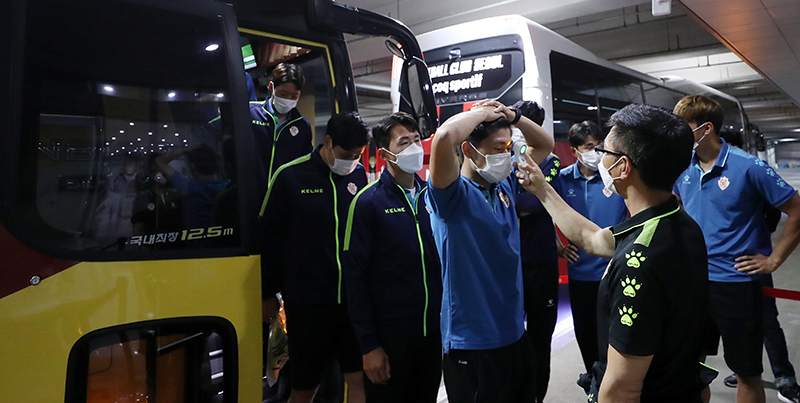
Gwangju FC players on May 17 get their temperatures checked after arriving at World Cup Stadium in the capital's Mapo-gu District and before entering their locker rooms to prepare for their game against FC Seoul.
Protective measures began the day before the game. Players and coaches had their temperatures checked three times -- at 10 a.m. the day before the game, the same time on game day and when they entered the stadium.
At 5:20 p.m. on game day, the players arrived in their locker rooms to prepare for their game, which began at 7 p.m. All of them wore masks and had their temperatures checked prior to entering their locker rooms under their respective team's supervision. Any player whose temperature exceeds 37.5 degrees Celsius was banned from entering the stadium.
Thorough quarantine measures were also taken during the game. Each team entered in a line apart from that of its opponent. Players and coaches bowed their heads instead of shaking hands. The stadium also sported a different look. K League General Manager Cho Yeon Sang said players were instructed to bring and use their own water bottles instead of sharing them, and that the customary practice of exchanging jerseys with players on the other team after the game was banned.
The stands were empty, but pre-recorded applause and cheers from fans pulsated throughout the stadium. Fans abroad got a taste of the passion of Korean fans through online broadcasts, an unusual scene brought about by the pandemic.
"It's sad that we can't see fans in the stadium," Cho said. "We plan to gradually push ahead with games with spectators depending on how the COVID-19 situation unfolds."
"Korea has received global attention by setting a benchmark in COVID-19 quarantine."
He added, "With K League games broadcast in 36 countries including Turkey and Brazil, we will boost the league's status abroad and set a model of successful quarantine in sports."
kyd1991@korea.kr