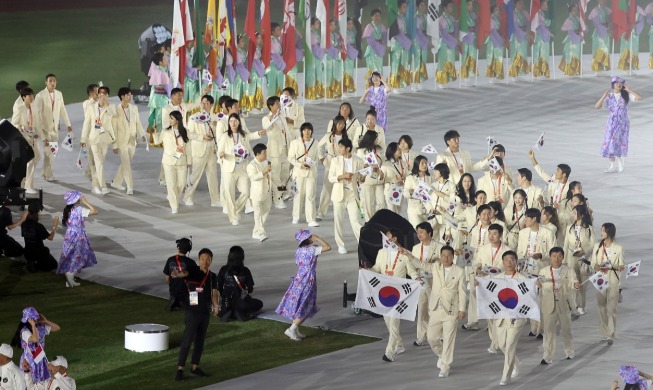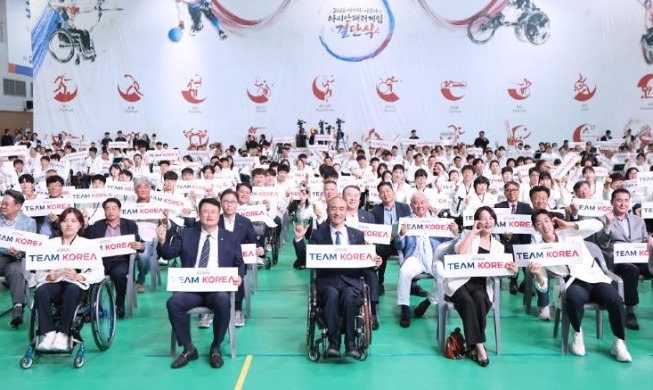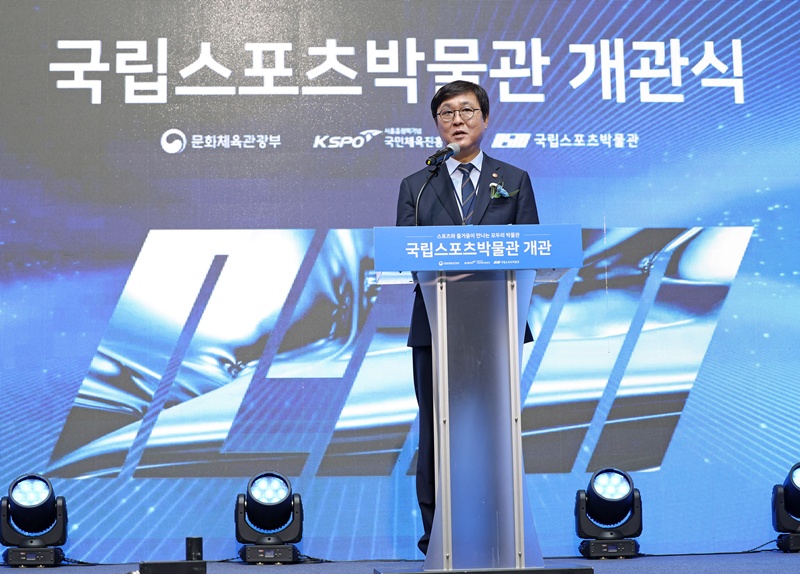
Minister of Culture, Sports and Tourism Chae Hwi-young on Oct. 15 delivers a congratulatory speech at the opening ceremony of the National Sports Museum of Korea in Seoul’s Songpa-gu District. (Ministry official Heo Man-jin)
By Lee Ji Yae
The National Sports Museum of Korea on Oct. 15 opened at Olympic Park in Seoul's Songpa-gu District as the country's first facility that documents the country's athletic history and collects and preserves sports heritage from home and abroad.
Attending the opening ceremony were Minister of Culture, Sports and Tourism Chae Hwi-young; Korea Sports Promotion Foundation CEO Ha Hyung Joo; Rep. Nam In-soon, deputy speaker of National Assembly; Rep. Lee Jae-jung, chair of the National Assembly's Culture, Sports and Tourism Committee; and Songpa-gu chief Seo Kang-seok.
Minister Chae highlighted the meaning of holding the ceremony on the occasion of Sports Day, saying, "Even when our people were stripped of their nation, they preserved their ethnic identity through sports."
Reflecting on how global tournaments such as the 1988 Seoul Summer Olympics and Paralympics displayed Korea's capabilities to the world, he added, "We will support the museum to turn it into the central hub for our sports heritage, preserving our legacy and broadly sharing its value with the public."
After the ceremony, visitors toured permanent exhibition galleries with commentary from curator Park Hyo Jung.
Permanent Exhibition Hall 1 traces the history of domestic sports, which were shaped by coaches and the public as well as athletes. Exhibits of note include video footage of marathoner Sohn Kee-chung, who won the gold medal the 1936 Berlin Summer Olympics but bowed his head in an act of defiance against Japan, and bronze medalist Nam Sung-Yong.
Also on display is the medal of Suh Yun-bok for winning the 1947 Boston Marathon. This space reflects Korea's hardships during its colonial period and its achievements in sports after liberation.
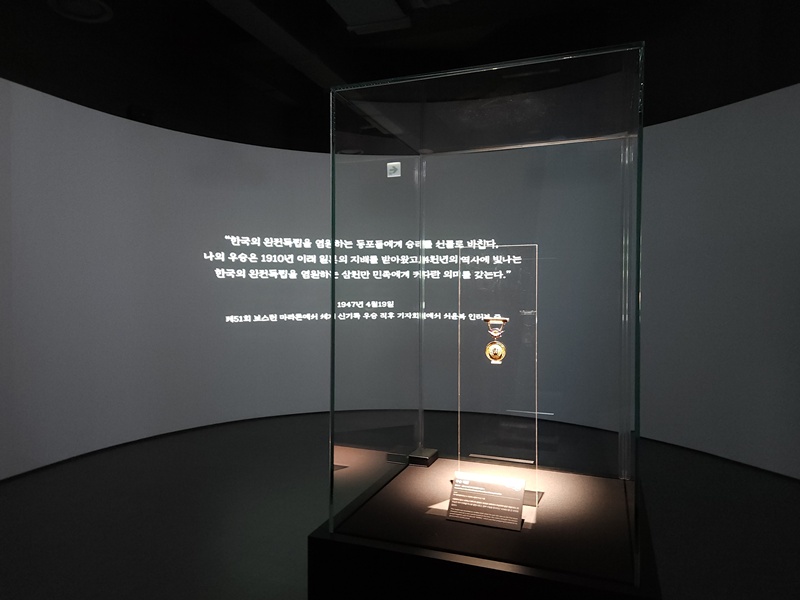
The medal earned by Suh Yun-bok in 1947 for winning the Boston Marathon is displayed at Permanent Exhibition Hall 1 of the National Sports Museum of Korea in Seoul's Songpa-gu District. (Lee Ji Yae)
Permanent Exhibition Hall 2 displays the growth of elite sports in the country through equipment and uniforms used at global competitions, along with medals earned by prominent athletes. Another space there shows recreational sports and athletic day activities at schools from different eras.
Illustrating how spectators are instrumental in preserving sports memories as well as athletes, a corner shows items donated by fans along with personal stories.
The Seoul Olympic Hall sheds lights on the legacy of global tournaments including the Seoul Games. Centered on the statue of the boy who rolled a hoop in silence at the opening ceremony, the exhibit brings back nostalgic memories with displays of the hoop used at the event and the LP of "Hand in Hand," the official theme song of the tournament.
Another theme is how international competitions impacted Korean society and sports development, including how hosting of the Olympics led to the launch of the Korea Sports Promotion Foundation.
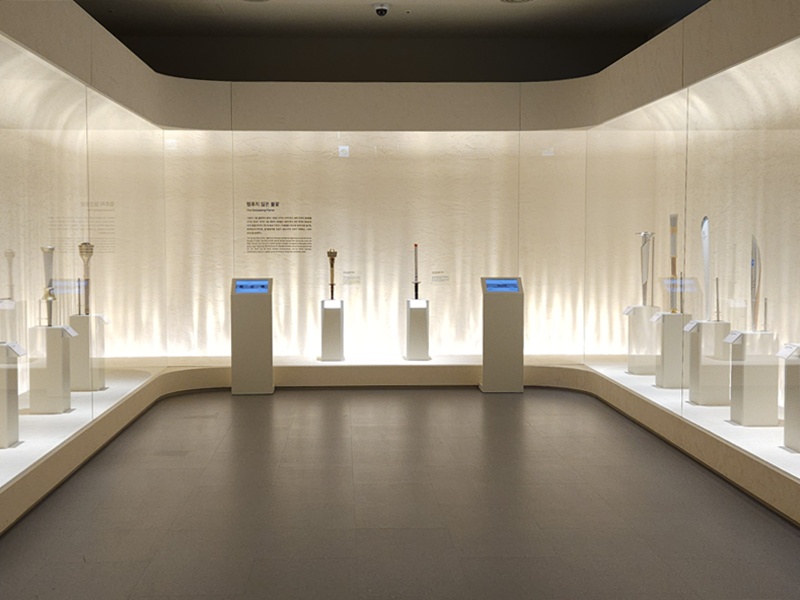
These are Olympic torches displayed at the Seoul Olympic Hall of the National Sports Museum of Korea in Seoul's Songpa-gu District. (Lee Ji Yae)
Opened after more than a decade of receiving donations and acquiring items, the museum goes beyond competition records to highlight the lasting impact of sports on Korean society and life.
Open daily from 9:30 a.m. to 5:30 p.m. except on Mondays, the museum is free for the public.
ljyhwa@korea.kr