The government will set up policies to accomplish its dual goals of promoting innovation across the country and helping people to be happier in their day-to-day lives.
A total of 14 government ministries, including the ministries of Culture, Sports and Tourism, Education and Health & Welfare, announced their plans during a 2015 policy briefing on January 21 at Cheong Wa Dae.
Gov’t to pursue happiness for the people through the arts, education, welfare
The Ministry of Culture, Sports and Tourism (MCST) announced policies aimed at helping people be happier and designed to upgrade people's quality of life. The ministry will extend its “Culture Wednesday” program where discounts and benefits are offered at art galleries, theaters, museums and movie theaters on the last Wednesday of every month. It will increase the number of participating organizations, promote related events and expand the number of regions around the country that are involved in the program. It will also offer more opportunities for people to enjoy the arts in their everyday life by running related programs, such as “small art galleries,” “art villages” and the “dream orchestra.” The ministry will also promote humanities-related projects, like Humanities on the Road.
The culture ministry also announced its policies aimed at developing the creative industries specifically through cultural events. The MCST said it would promote Hallyu content, such as video games, cartoons and the fashion industry, which would in turn lead to the production of corporate products. To promote such Hallyu content, it will form a jointly-funded investment fund with China amounting to KRW 200 billion in order to support the creation of joint content between the two countries.
In this regard, President Park Geun-hye said, “We need to lower the barrier of access to culture so that all people can enjoy the creative industries through cultural and artistic programs that are customized for the day-to-day life of the people.”
Policies to promote innovation in the educational sector were also announced at the briefing. The Ministry of Education unveiled its plans to introduce a vocational school system based on Switzerland’s system and to open top tier colleges which will incubate students' technical skills in cooperation with specialized high schools. The education ministry also said it would carry out a project to foster universities that focus on industrial demands in order to narrow the gap between the education at the university level and the actual requirements of the industrial sector.
In regard to innovation in the civics classroom, the education ministry has decided to vitalize the teaching of democratic citizenship at schools. To this aim, the ministry will teach key values, such as liberty, democracy, the constitutional system and about laws and equality, in order to help people build an understanding of democracy and citizenship, as part of being a member of the community, of society and of the country.
The government also announced policies to strengthen the welfare system for all workers. Minister of Employment and Labor Lee Ki-Kweon said, “We will improve the double structure between regular and non-regular workers in the labor market based on the basic agreements of the Trilateral Commission involving labor, corporations and the government. We will also encourage firms to employ more regular workers and help workers continue working until they reach retirement age.”
The Ministry of Employment and Labor (MOEL) said it would extend the introduction of recruitment that focuses on performance and ability, and compensation systems. Most importantly, starting this year it will adopt a new recruitment system in the public sector by expanding the possible number of recruits for an open position.
The Ministry of Gender Equality and Family (MOGEF) announced policies to support the female labor force and working parents. The ministry said it would test-run six support centers for working mothers and fathers, and provide consultation services at night or outreach consultations for families with working parents.
The government revealed measures to reduce medical costs and to foster the health and welfare industries. To lower the burden of medical expenses for four major illnesses and for uncovered expenses, the Ministry of health and Welfare will expand health insurance to cover 200 items or procedures which had been categorized as uncovered items. This will reduce the burden of medical expenses on households worth about KRW 420 billion. This April, the ministry will begin remote medical treatment for emergency patients. The ministry will also extend remote medical service for military units on the front line or at rehabilitation facilities. To improve the quality of childcare, the ministry said it would overhaul the preparation courses for childcare center teachers and reduce the number of children a childcare center looks after.
The briefing also involved policies for a clean and healthy living environment. The Ministry of Environment said it would solve four main environmental issues that are particularly close to people's day-to-day lives, including fine dust, green tide and bad odors. In this regard, the ministry will take action, such as setting up a nationwide warning system that will announce the amount of particulate in the atmosphere, a no-driving system and a system of spraying roadways with water. It will also install facilities to prevent pollutants from flowing into branches of the Nakdonggang River and take measures, such as planting more water-based plants, in order to improve the water quality and to reduce the occurrence of green tide algal blooms.
Gov’t to speed up action to promote innovation, structural reform
In regard to structural reform at the local government level, the Ministry of Government Administration & Home Affairs (MOGAHA) announced plans to reshape local governments by merging similar local bodies, while putting the convenience of residents as the top priority. The ministry will introduce so-called “daedongs,” large local community centers, by grouping two or three local community offices together. This will take place at three regions across the country, including Sigeung-si (city) in Gyeonggi-do (Gyeonggi Province). It will also designate towns with more than 70,000 people as so-called “responsible towns” so that these towns can carry out some functions which were previously conducted at higher levels of the district offices. By reforming local centers, the daedongs or responsible towns will be able to carry out tailored, one-stop services concerning welfare or safety issues, helping residents more promptly. The facilities vacated due to these consolidations will be reused as various welfare facilities.
Concerning reform of the public sector, the MOGAHA said it would reduce the debt ratio of 26 large public corporations by 10 percentage points each year. It will also conduct a review of all government organizations and merge or close some which have similar or the same functions.
Regarding structural reform, the Anti-Corruption & Civil Rights Commission said it would actively protect the rights of all citizens by improving incorrect policies and unfair legislation, which weakens society's trust of government. To strengthen public communications, the commission will also build a so-called “one-stop communications system” by integrating the online petition channels currently run by government ministries, such as “Sinmungo” or the e-People of the Korean Government system, the regulatory reform petition portal and Bokjiro, the portal for public welfare.
Finally, the government also announced policies to bolster the safety of the nation. The Ministry of Public Safety and Security announced that it would bolster its preliminarily response system in order to effectively deal with disasters and accidents. The ministry said it would build a rescue system that can mobilize within half an hour or an hour. To this aim, it will establish more 119 special rescue teams in the Seoul metropolitan area and in Gyeongsang-do (North and South Gyeongsang Provinces), as well as in the Chungcheong, Gangwon and Jeolla-do provincial areas. The ministry will add more special marine rescue teams currently dispatched in the South Sea, and make sure there is coverage in the East and Yellow Seas, as well.
In regard to food safety, an information portal will be run which will provide information about food safety by integrating food safety information of 159 items which are currently covered by 12 separate government ministries, such as the Ministry of Agriculture, Food & Rural Affairs, Education and Oceans & Fisheries.
By Yoon Sojung
Korea.net Staff Writer
Photos: Cheong Wa Dae
arete@korea.kr
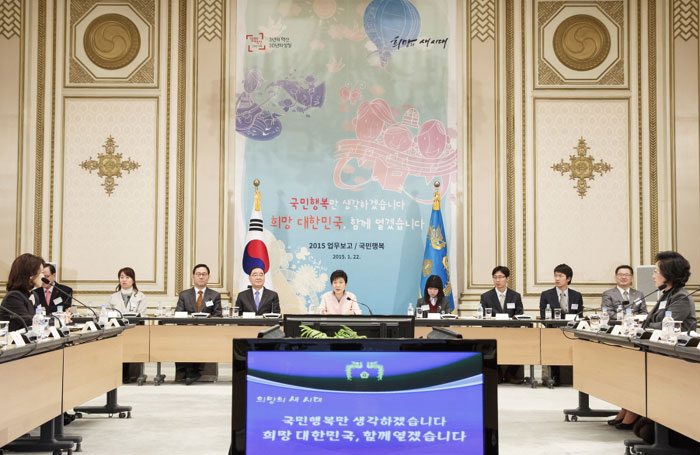
A total of 14 government ministries, including the ministries of Culture, Sports and Tourism, Education and Health & Welfare, announced their plans during a 2015 policy briefing on January 21 at Cheong Wa Dae.
A policy briefing is held on January 21 at Cheong Wa Dae.
Gov’t to pursue happiness for the people through the arts, education, welfare
The Ministry of Culture, Sports and Tourism (MCST) announced policies aimed at helping people be happier and designed to upgrade people's quality of life. The ministry will extend its “Culture Wednesday” program where discounts and benefits are offered at art galleries, theaters, museums and movie theaters on the last Wednesday of every month. It will increase the number of participating organizations, promote related events and expand the number of regions around the country that are involved in the program. It will also offer more opportunities for people to enjoy the arts in their everyday life by running related programs, such as “small art galleries,” “art villages” and the “dream orchestra.” The ministry will also promote humanities-related projects, like Humanities on the Road.
The culture ministry also announced its policies aimed at developing the creative industries specifically through cultural events. The MCST said it would promote Hallyu content, such as video games, cartoons and the fashion industry, which would in turn lead to the production of corporate products. To promote such Hallyu content, it will form a jointly-funded investment fund with China amounting to KRW 200 billion in order to support the creation of joint content between the two countries.
In this regard, President Park Geun-hye said, “We need to lower the barrier of access to culture so that all people can enjoy the creative industries through cultural and artistic programs that are customized for the day-to-day life of the people.”
Policies to promote innovation in the educational sector were also announced at the briefing. The Ministry of Education unveiled its plans to introduce a vocational school system based on Switzerland’s system and to open top tier colleges which will incubate students' technical skills in cooperation with specialized high schools. The education ministry also said it would carry out a project to foster universities that focus on industrial demands in order to narrow the gap between the education at the university level and the actual requirements of the industrial sector.
In regard to innovation in the civics classroom, the education ministry has decided to vitalize the teaching of democratic citizenship at schools. To this aim, the ministry will teach key values, such as liberty, democracy, the constitutional system and about laws and equality, in order to help people build an understanding of democracy and citizenship, as part of being a member of the community, of society and of the country.
The government also announced policies to strengthen the welfare system for all workers. Minister of Employment and Labor Lee Ki-Kweon said, “We will improve the double structure between regular and non-regular workers in the labor market based on the basic agreements of the Trilateral Commission involving labor, corporations and the government. We will also encourage firms to employ more regular workers and help workers continue working until they reach retirement age.”
The Ministry of Employment and Labor (MOEL) said it would extend the introduction of recruitment that focuses on performance and ability, and compensation systems. Most importantly, starting this year it will adopt a new recruitment system in the public sector by expanding the possible number of recruits for an open position.
The Ministry of Gender Equality and Family (MOGEF) announced policies to support the female labor force and working parents. The ministry said it would test-run six support centers for working mothers and fathers, and provide consultation services at night or outreach consultations for families with working parents.
The government revealed measures to reduce medical costs and to foster the health and welfare industries. To lower the burden of medical expenses for four major illnesses and for uncovered expenses, the Ministry of health and Welfare will expand health insurance to cover 200 items or procedures which had been categorized as uncovered items. This will reduce the burden of medical expenses on households worth about KRW 420 billion. This April, the ministry will begin remote medical treatment for emergency patients. The ministry will also extend remote medical service for military units on the front line or at rehabilitation facilities. To improve the quality of childcare, the ministry said it would overhaul the preparation courses for childcare center teachers and reduce the number of children a childcare center looks after.
The briefing also involved policies for a clean and healthy living environment. The Ministry of Environment said it would solve four main environmental issues that are particularly close to people's day-to-day lives, including fine dust, green tide and bad odors. In this regard, the ministry will take action, such as setting up a nationwide warning system that will announce the amount of particulate in the atmosphere, a no-driving system and a system of spraying roadways with water. It will also install facilities to prevent pollutants from flowing into branches of the Nakdonggang River and take measures, such as planting more water-based plants, in order to improve the water quality and to reduce the occurrence of green tide algal blooms.
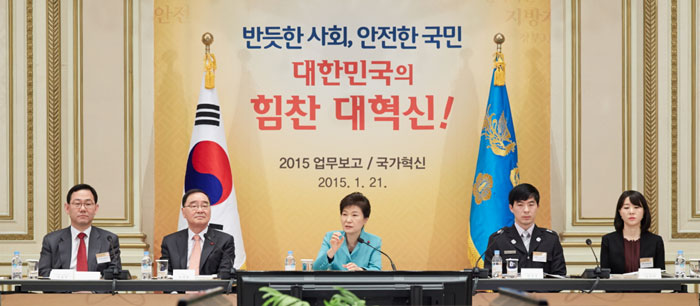
President Park Geun-hye emphasizes a national understanding of law and order and the importance of constitutional values during a policy briefing on January 20.
Gov’t to speed up action to promote innovation, structural reform
In regard to structural reform at the local government level, the Ministry of Government Administration & Home Affairs (MOGAHA) announced plans to reshape local governments by merging similar local bodies, while putting the convenience of residents as the top priority. The ministry will introduce so-called “daedongs,” large local community centers, by grouping two or three local community offices together. This will take place at three regions across the country, including Sigeung-si (city) in Gyeonggi-do (Gyeonggi Province). It will also designate towns with more than 70,000 people as so-called “responsible towns” so that these towns can carry out some functions which were previously conducted at higher levels of the district offices. By reforming local centers, the daedongs or responsible towns will be able to carry out tailored, one-stop services concerning welfare or safety issues, helping residents more promptly. The facilities vacated due to these consolidations will be reused as various welfare facilities.
Concerning reform of the public sector, the MOGAHA said it would reduce the debt ratio of 26 large public corporations by 10 percentage points each year. It will also conduct a review of all government organizations and merge or close some which have similar or the same functions.
Regarding structural reform, the Anti-Corruption & Civil Rights Commission said it would actively protect the rights of all citizens by improving incorrect policies and unfair legislation, which weakens society's trust of government. To strengthen public communications, the commission will also build a so-called “one-stop communications system” by integrating the online petition channels currently run by government ministries, such as “Sinmungo” or the e-People of the Korean Government system, the regulatory reform petition portal and Bokjiro, the portal for public welfare.
Finally, the government also announced policies to bolster the safety of the nation. The Ministry of Public Safety and Security announced that it would bolster its preliminarily response system in order to effectively deal with disasters and accidents. The ministry said it would build a rescue system that can mobilize within half an hour or an hour. To this aim, it will establish more 119 special rescue teams in the Seoul metropolitan area and in Gyeongsang-do (North and South Gyeongsang Provinces), as well as in the Chungcheong, Gangwon and Jeolla-do provincial areas. The ministry will add more special marine rescue teams currently dispatched in the South Sea, and make sure there is coverage in the East and Yellow Seas, as well.
In regard to food safety, an information portal will be run which will provide information about food safety by integrating food safety information of 159 items which are currently covered by 12 separate government ministries, such as the Ministry of Agriculture, Food & Rural Affairs, Education and Oceans & Fisheries.
By Yoon Sojung
Korea.net Staff Writer
Photos: Cheong Wa Dae
arete@korea.kr