Korea and Brazil signed a series of agreements on cooperation related to the creative economy agenda on April 24, after a bilateral summit between President Park Geun-hye and Brazilian President Dilma Rousseff, during President Park's official visit to the Latin American nation.
The two leaders acknowledged the importance of creativity, innovation, science and technology in the memoranda of understanding (MOUs) and President Park agreed to share strategies and policies related to Korea's creative economy agenda. Regarding the creative economy initiative, the two sides decided to collaborate on supporting innovative start-up companies and promoting the commercialization of technologies and joint research projects, in order to develop as knowledge-based societies. They also agreed to promote cooperation between the businesses and institutions of both countries. In addition, the two sides agreed to cooperate on developing smart devices including robots and smartphone app education projects.

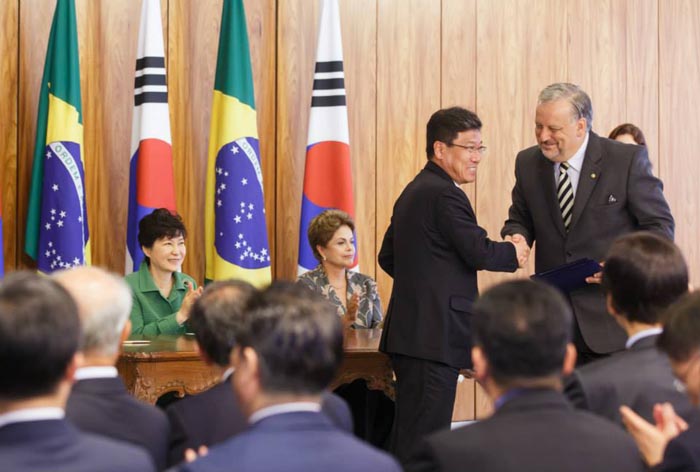
After the two governments signed the MOUs, separate MOUs were signed by the Daegu Creative Economy Innovation Center, Samsung Electronics and the Brazilian Association of Science Parks and Business Incubators (Anprotec), which will carry out the bilateral agreements, on sharing models of creative economy innovation centers and support for Brazilian young entrepreneurs and start-up companies.
As part of implementing the MOU, the Daegu Creative Economy Innovation Center intends to help startup companies grow in size and attain stable sources of return in a short period of time. Samsung Electronics and its research center in Brazil will provide support in training, research and development and commercialization for promising Brazilian startup companies. The company intends to invest USD 5 million in those areas over the next five years.
The K-Move Center, which is designed to help Korean youths live and work abroad, will be established in Brazil, the first in Latin America. The two nations will also cooperate on developing telemedicine technologies and medical service ships for providing healthcare to people living in the Amazon.
The two nations signed a total of 25 MOUs to share their economic policies including Korea's Three-Year Plan for Economic Innovation and the "Bigger Brazil" (Brasil Maior) plan, and help bilateral economic cooperation broaden, diversify and become more sophisticated. The Bigger Brazil plan refers to the South American nation's drastic economic reform measure under the motto, "Innovate to compete, compete to grow," which was initiated in 2011 to promote economic growth and strengthen the country's industrial competitiveness.
According to Cheong Wa Dae, the Korean government's accomplishments include establishing a basis for Korean youths to live and work in Latin America, jointly developing technologies for telemedicine, exporting the creative economy model to Latin America, cooperating on information and communications technology (ICT), and promoting bilateral trade including electronic commerce.
By Wi Tack-whan, Limb Jae-un
Korea.net Staff Writers
Photos: Cheong Wa Dae
whan23@korea.kr
The two leaders acknowledged the importance of creativity, innovation, science and technology in the memoranda of understanding (MOUs) and President Park agreed to share strategies and policies related to Korea's creative economy agenda. Regarding the creative economy initiative, the two sides decided to collaborate on supporting innovative start-up companies and promoting the commercialization of technologies and joint research projects, in order to develop as knowledge-based societies. They also agreed to promote cooperation between the businesses and institutions of both countries. In addition, the two sides agreed to cooperate on developing smart devices including robots and smartphone app education projects.
President Park Geun-hye (left) and Brazilian President Dilma Rousseff shake hands after a bilateral summit on April 24 in which they agreed to share strategies and policies related to the creative economy agenda and diversify and deepen bilateral economic cooperation.
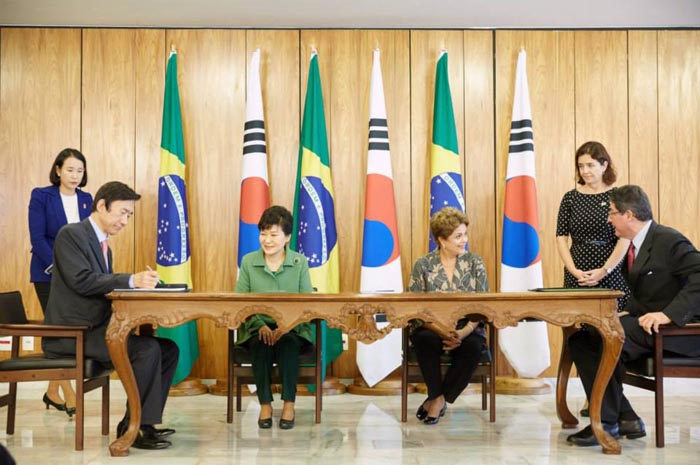
After the two governments signed the MOUs, separate MOUs were signed by the Daegu Creative Economy Innovation Center, Samsung Electronics and the Brazilian Association of Science Parks and Business Incubators (Anprotec), which will carry out the bilateral agreements, on sharing models of creative economy innovation centers and support for Brazilian young entrepreneurs and start-up companies.
As part of implementing the MOU, the Daegu Creative Economy Innovation Center intends to help startup companies grow in size and attain stable sources of return in a short period of time. Samsung Electronics and its research center in Brazil will provide support in training, research and development and commercialization for promising Brazilian startup companies. The company intends to invest USD 5 million in those areas over the next five years.
President Park Geun-hye (rear row, left) and Brazilian President Dilma Rousseff supervise the signing of an MOU after their bilateral summit. A total of 25 MOUs were signed to further diversify and deepen bilateral economic cooperation.
The K-Move Center, which is designed to help Korean youths live and work abroad, will be established in Brazil, the first in Latin America. The two nations will also cooperate on developing telemedicine technologies and medical service ships for providing healthcare to people living in the Amazon.
The two nations signed a total of 25 MOUs to share their economic policies including Korea's Three-Year Plan for Economic Innovation and the "Bigger Brazil" (Brasil Maior) plan, and help bilateral economic cooperation broaden, diversify and become more sophisticated. The Bigger Brazil plan refers to the South American nation's drastic economic reform measure under the motto, "Innovate to compete, compete to grow," which was initiated in 2011 to promote economic growth and strengthen the country's industrial competitiveness.
According to Cheong Wa Dae, the Korean government's accomplishments include establishing a basis for Korean youths to live and work in Latin America, jointly developing technologies for telemedicine, exporting the creative economy model to Latin America, cooperating on information and communications technology (ICT), and promoting bilateral trade including electronic commerce.
By Wi Tack-whan, Limb Jae-un
Korea.net Staff Writers
Photos: Cheong Wa Dae
whan23@korea.kr