These are all elements of the successful results that the Park Geun-hye administration has achieved since its launch three years ago. Along with its four administrative priorities, the government has been carrying out related projects, such as its Three-Year Economic Innovation Plan, financial reform and overall regulatory reform.
Thanks to these efforts, Korea’s gross domestic product (GDP) has continued to gradually increase, from being ranked as the world’s 15th in 2012, to 14th in 2013 and 13th in 2014. This has also led to the highest sovereign credit rating ever seen by the country. The international credit rating agency Standard and Poor’s Rating Services upgraded Korea’s sovereign credit rating to AA-, from A+, in September last year. Another credit appraiser, Moody’s, also raised Korea’s credit rating to Aa2, from the previous Aa3. This is the highest ever rating that the nation has received from the international credit agency. Only seven countries among the G20, including Korea, the U.S., Germany, Canada, Australia, the U.K. and, lastly, France, have received a rating of Aa2.
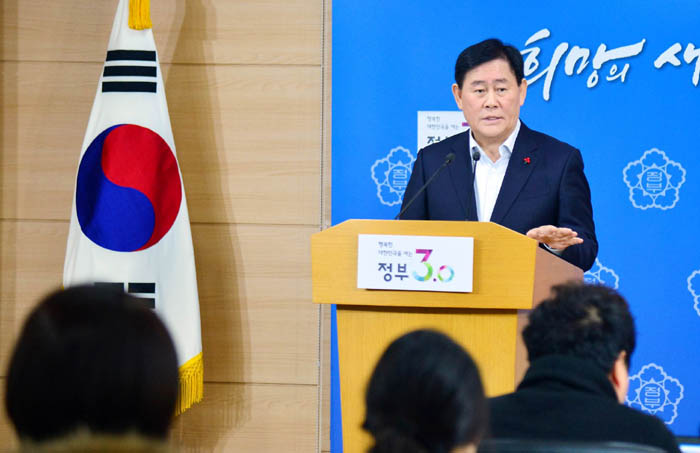
The international credit rating agency Moody’s upgraded Korea’s credit rating to Aa2 last December. This is the highest sovereign credit rating Korea has ever received. Former Deputy Prime Minister and Minister of Strategy and Finance Choi Kyunghwan holds a press conference in regard to Moody’s upgrade of Korea’s sovereign rating in December last year.
Moody’s predicted that Korea’s economic growth over the next five years will be faster than that in other advanced economies. It also foresees the country’s per capita income continuing to converge with those of developed economies in Europe.
Moody’s noted that the Korean government has maintained a prudent fiscal stance, resulting in an average fiscal surplus of 1.1 percent of GDP between 2010 and 2014. It also expects Korea to continue to post fiscal surpluses of about 0.5 percent of GDP, and that general government debt will remain stable at around 40 percent of GDP. It also pointed out that the nation’s total external debt has logged a drop, to less than 30 percent from 50 percent.
The ratings agency also predicted that the government’s structural reforms in four areas -- public services, labor, finance and education -- will be successful, further promoting economic growth and fiscal resilience.
Korea’s economic resilience has also been recognized by international organizations such as the Organisation for Economic Co-operation and Development (OECD) and the International Monetary Fund (IMF). The OECD chose Korea as one of eight countries, including Australia, New Zealand, Norway, and Switzerland, that needs no significant consolidation thanks to its fiscal soundness. The OECD said that Korea’s public finances are reasonably healthy, and that Korea is planning to use its available fiscal space for pro-growth policies. In June last year, Korea also received a high rating, second to the top, from the IMF with regard to fiscal soundness and overall fiscal shape.
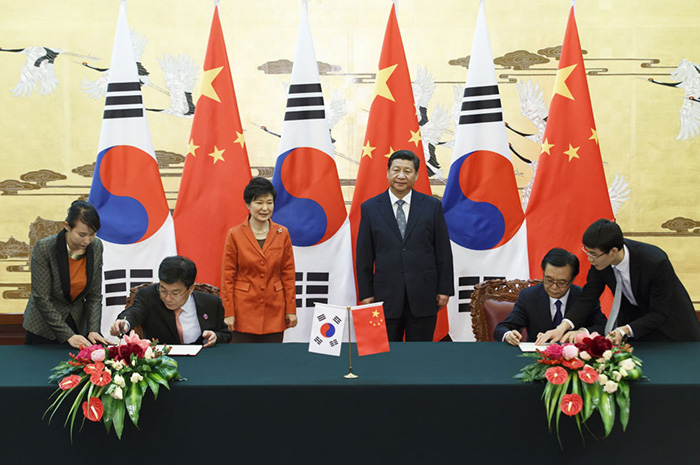
On the occasion of the Korea-China summit between President Park Geun-hye and President Xi Jinping in November 2014, the two governments sign the Korea-China FTA.
The Park Geun-hye administration presents its "creative economy vision" as a new paradigm for economic development that will overcome structural issues in the Korean economy, such as low growth and youth unemployment. In order to realize this vision, the government started by opening a Creative Economy Town in September 2013. It has also opened a total of 17 Centers for a Creative Economy and Innovation in cities and provinces across the country, such as Incheon, Daegu and Daejeon, so that each of the centers can play a role in supporting venture startups and small and medium-sized enterprises (SMEs).
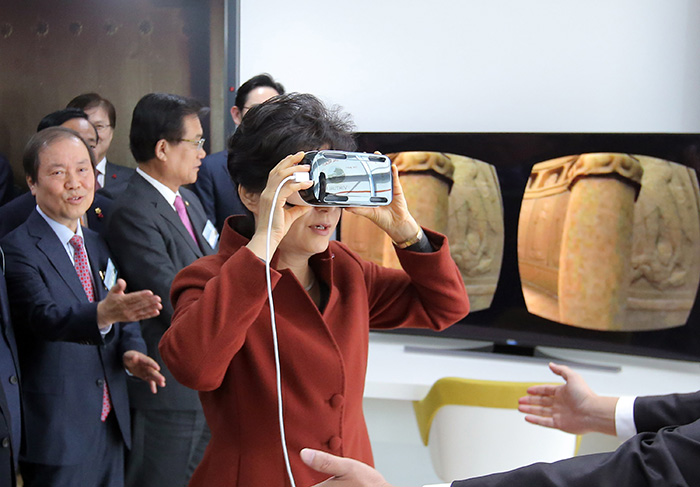
President Park Geun-hye inspects an image of the Seokguram Grotto through a set of virtual reality goggles at the Gyeongbuk Center for a Creative Economy and Innovation, newly-opened in Gumi City in December 2014.
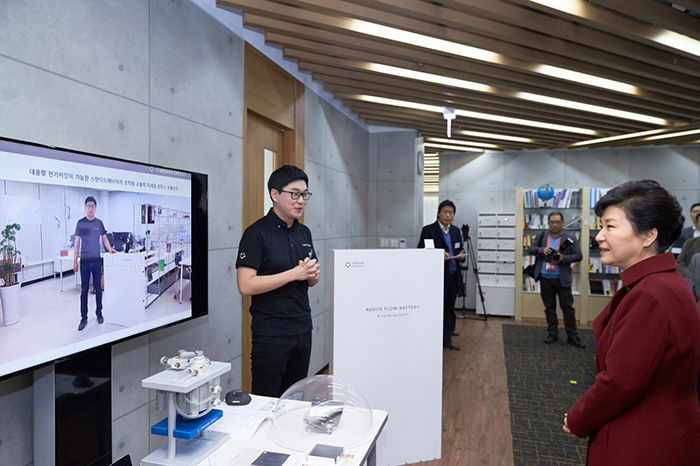
President Park Geun-hye listens to an explanation from one of the startup companies that operate at the Daejeon Center for a Creative Economy and Innovation.
As of the end of 2015, a total of 578 firms are participating in the centers’ startup incubation programs. These centers also provided support for up to 541 SMEs. These efforts have led to an accumulated volume of investment worth KRW 126.7 billion and created sales worth KRW 33.7 billion.
Successful results are also being made thanks to the government’s support for innovation at SMEs. UNESCO selected a Korean venture firm, TEGway, which developed a wearable power generator by using human body temperature, as one of the top ten IT innovations that are expected to change the world at the 2015 Netexplo Awards.
The International Telecommunication Union (ITU) Telecom World 2015 selected Korean firm IRIENCE as one of the three recipients of the Entrepreneurship Award for the company’s DOT smart watch for visually disabled people that uses a special iris recognition device.
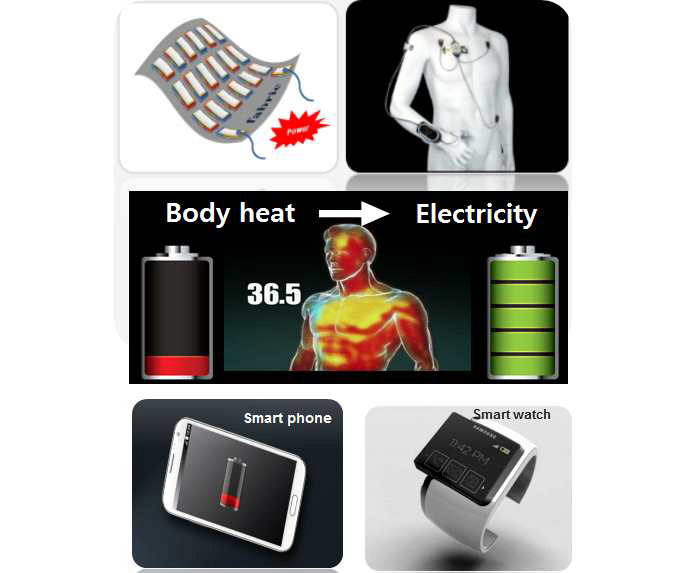
UNESCO selected TEGway’s wearable power generator as one of the top ten IT innovations that are expected to change the world, at the 2015 Netexplo Awards.
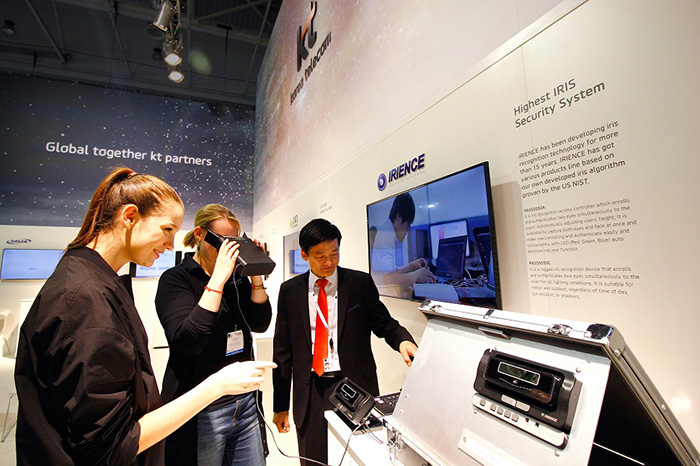
Visitors to the ITU Telecom World 2015 try a special iris recognition device made by IRIENCE. The firm was selected as one of the three recipients of the Entrepreneurship Award at the ITU's Telecom World 2015.
The world is also keeping an eye on Korea’s models for its Centers for a Creative Economy and Innovation. Korea’s creative economy centers have now been exported to Saudi Arabia and Brazil on the occasions of President Park’s visits to the Middle East and to Latin America. While there, the countries signed memoranda of understanding that cover cooperation on their creative economy visions. Saudi Arabia signed an MOU covering management cooperation at the Daejeon Center for a Creative Economy and Innovation, and plans to open its first such center within the year. Brazil has been conducting exchanges between venture startups as well as people-to-people exchanges between Korea and Brazil since signing an MOU that covers working-level cooperation at the Daegu Center for a Creative Economy and Innovation in September last year. Korea has also been carrying out various exchanges and cooperation in this regard with other countries, such as France, China, Honduras, Bulgaria and New Zealand, all with MOUs.
Influential figures around the globe have praised Korea’s model for its creative economy innovation centers. When OECD Secretary General Angel Gurria visited the Daejeon Center for a Creative Economy and Innovation, he said that the center was “one of the world’s most successful state-led economic policies to spur innovation,” while calling it a very good model that can help high-tech venture firms. Google CEO Eric Schmidt told Minister of Science, ICT and Future Planning Choi Yang-hee that it is amazing that Korea’s model for its creative economy and innovation centers has become an exemplary model around the world within a short time.
By Yoon Sojung
Korea.net Staff Writer
Photos: Cheong Wa Dae, Ministry of Strategy and Finance, Ministry of Science, ICT and Future Planning, KT, Yonhap News
arete@korea.kr
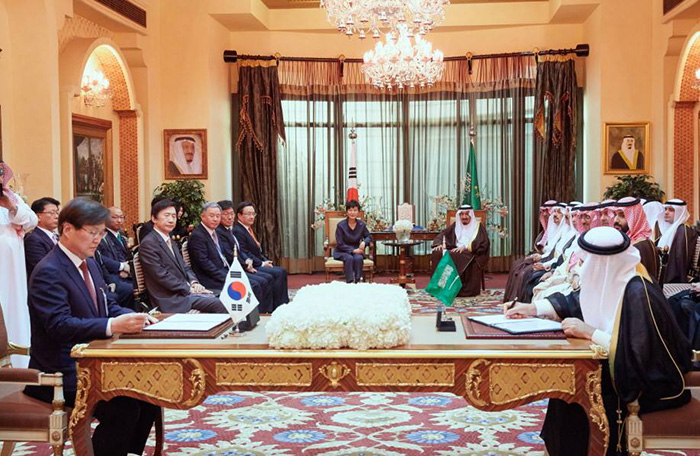
The governments of Korea and Saudi Arabia sign an MOU to cooperate on the creative industries on the occasion of the Korea-Saudi Arabia summit between President Park Geun-hye and Salman bin Abdulaziz Al Saud, the king of Saudi Arabia, in March last year.
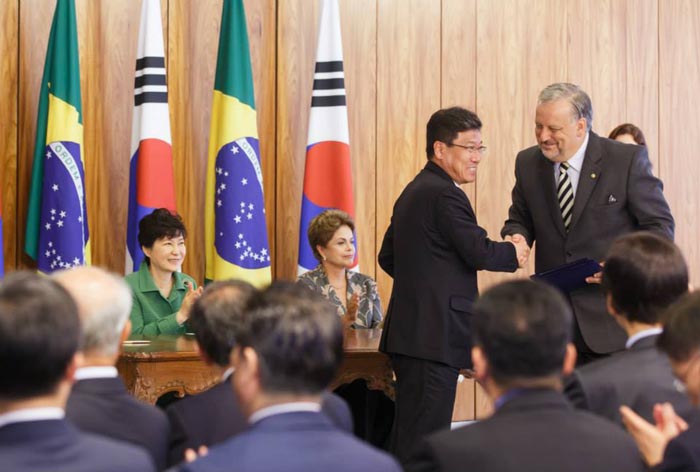
The governments of Korea and Brazil sign a total of 25 MOUs, including an MOU covering the creative industries, during the Korea-Brazil summit in April last year between President Park Geun-hye and Brazilian President Dilma Rousseff.