The government of the Republic of Korea has decided to increase the number of targets for financial sanctions involving North Korea. It will bolster sanctions on any shipping, exports or imports related to the North. The government announced its unilateral sanctions against North Korea on March 8.
Under these newest sanctions, the government will tighten sanctions against North Korea in the financial sector. It will impose a ban on financial dealings and on foreign exchange transactions between any Republic of Korea citizen and then 40 individuals who are responsible for North Korea’s development of weapons of mass destruction (WMD), and 30 specific North Korean and foreign entities that support Pyongyang. It will also freeze assets in South Korea that are owned by the targeted individuals or entities.
Regarding the shipping ban, the government said that it “will strengthen to a large extent a shipping ban related to North Korea.” According to the announcement, it will ban the entrance of any ship that has stopped at a North Korean port within the past 180 days. It will also continue to prohibit ships from third countries to use sea routes that cover North and South Korea. The government said it “will further prohibit any foreign-flag vessel or flag-of-convenience ship owned, in fact, by North Korea from entering South Korea.”
Seoul will also toughen controls on exports and imports involving Pyongyang. The government said it will “thoroughly implement existing sanctions against North Korea by strengthening on-site suspension and controls on inter-Korean trade so that Seoul can prevent any suspicious North Korean supplies from being illegally brought to the South via a third country.”
In regard to Pyongyang’s development of WMDs, Seoul said it will “reinforce export guidelines by devising tailored guidelines and a list of items to be scrutinized that will be distributed to other countries, and play an initiating role in leading other countries to implement the U.N. Security Council’s resolutions in controlling exports and imports.”
The latest sanctions include a ban on visiting North Korean restaurants. The government advised its citizens not to use North Korean restaurants, or other types of profit-making facilities owned by the North, when overseas, as they are serving a cash-earning tools for the regime.
Minister for Government Policy Coordination Lee Sukjoon said, “Along with the U.N. Security Council’s resolutions, Seoul’s latest sanctions against Pyongyang will greatly contribute to raising awareness of any dealings related to North Korea’s development of WMDs with either North Korean or third-country individuals or organizations. They will also contribute to preventing any kind of suspicious items related to the North from being brought to South Korea.”
“The government will continue to closely work with the intentional community to sanction and press North Korea in order to create conditions where there is nothing for it to do but to change,” Lee added.
By Yoon Sojung
Korea.net Staff Writer
Photo: Yonhap News
arete@korea.kr
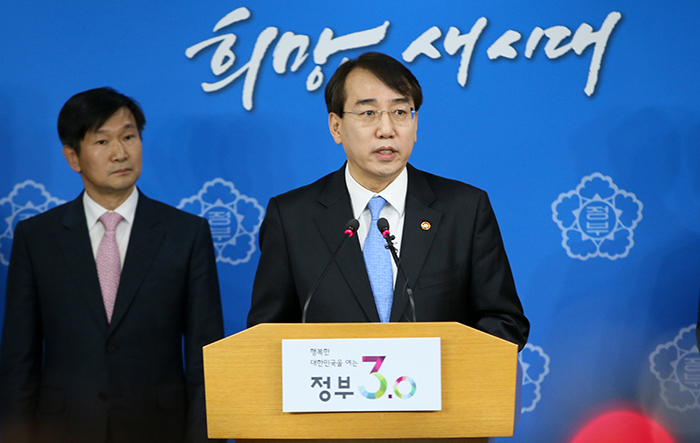
Minister for Government Policy Coordination Lee Sukjoon announces Seoul's unilateral sanctions against North Korea at the Government Complex-Seoul on Mar. 8. The latest sanctions include bans on financial dealings, shipping and trade related to the North.
Under these newest sanctions, the government will tighten sanctions against North Korea in the financial sector. It will impose a ban on financial dealings and on foreign exchange transactions between any Republic of Korea citizen and then 40 individuals who are responsible for North Korea’s development of weapons of mass destruction (WMD), and 30 specific North Korean and foreign entities that support Pyongyang. It will also freeze assets in South Korea that are owned by the targeted individuals or entities.
Regarding the shipping ban, the government said that it “will strengthen to a large extent a shipping ban related to North Korea.” According to the announcement, it will ban the entrance of any ship that has stopped at a North Korean port within the past 180 days. It will also continue to prohibit ships from third countries to use sea routes that cover North and South Korea. The government said it “will further prohibit any foreign-flag vessel or flag-of-convenience ship owned, in fact, by North Korea from entering South Korea.”
Seoul will also toughen controls on exports and imports involving Pyongyang. The government said it will “thoroughly implement existing sanctions against North Korea by strengthening on-site suspension and controls on inter-Korean trade so that Seoul can prevent any suspicious North Korean supplies from being illegally brought to the South via a third country.”
In regard to Pyongyang’s development of WMDs, Seoul said it will “reinforce export guidelines by devising tailored guidelines and a list of items to be scrutinized that will be distributed to other countries, and play an initiating role in leading other countries to implement the U.N. Security Council’s resolutions in controlling exports and imports.”
The latest sanctions include a ban on visiting North Korean restaurants. The government advised its citizens not to use North Korean restaurants, or other types of profit-making facilities owned by the North, when overseas, as they are serving a cash-earning tools for the regime.
Minister for Government Policy Coordination Lee Sukjoon said, “Along with the U.N. Security Council’s resolutions, Seoul’s latest sanctions against Pyongyang will greatly contribute to raising awareness of any dealings related to North Korea’s development of WMDs with either North Korean or third-country individuals or organizations. They will also contribute to preventing any kind of suspicious items related to the North from being brought to South Korea.”
“The government will continue to closely work with the intentional community to sanction and press North Korea in order to create conditions where there is nothing for it to do but to change,” Lee added.
By Yoon Sojung
Korea.net Staff Writer
Photo: Yonhap News
arete@korea.kr