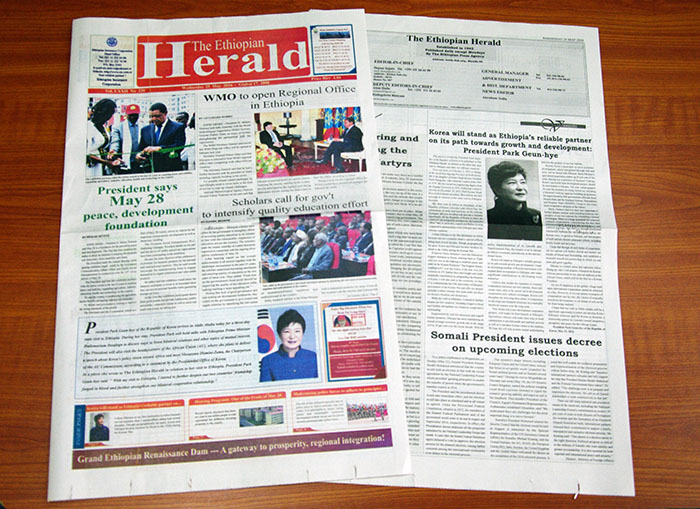
The Ethiopian Herald publishes a contribution from President Park Geun-hye on May 25. In her open letter to the newspaper, the president stressed that the bilateral partnership between Korea and Ethiopia should be expanded.
"Korea will stand as Ethiopia's reliable partner on its path towards growth and development," said President Park Geun-hye who is on a state visit to Ethiopia.
In her contribution to the state-run Ethiopian Herald, published on May 25, the president said that she intends "to further deepen our two countries' friendship forged in blood and further strengthen our bilateral cooperative relationship."
The president began her letter with her reason for choosing Ethiopia as her first destination in Africa. She said that the two countries "share a special affinity dating back several decades. Though geographically far apart, Korea and Ethiopia became brothers by blood in the 1950s during the Korean War."
Quoting Emperor Haile Selassie I who said, "Fight until you win or die fighting to establish peace and order on the Korean Peninsula," she expressed her gratitude to the Ethiopian Kagnew Battalion that was sent by the emperor during the Korean War and that "made remarkable contributions to safeguarding the Republic of Korea."
"Ethiopia has been maintaining an annual average economic growth rate in the range of 8 to 10 percent over the recent decade," the president said, and the country's "active implementation of its Growth and Transformation Plan" will see Ethiopia "set to emerge as Africa's economic powerhouse in the not-too-distant future." She added that she hopes that, "An increasing number of Korean businesses will expand their investments in Ethiopia, and make significant contributions to developing local industries."
The president then listed three "pillars of cooperation" to develop the two countries' bilateral relationship: Korea Aid, the government's newest overseas aid program; Korea's knowhow on how to develop an economy, particularly the New Community Movement, or the Saemaul Undong, a set of economic and agricultural development policies from the 1970s and 1980s; and, lastly, an expansion of cross-cultural exchanges.
President Park then explained these three "pillars." Concerning the new Korea Aid development cooperation projects that will begin in Ethiopia, she said that, "Specialized vehicles will make their way to local communities to provide health and nutrition services, as well as introduce Korean culture to the residents. This will help promote mutual understanding between the peoples of our two nations." Noting that Ethiopia's agricultural population makes up 85 percent of the total, she expressed her hope that, "Sharing our experience of Saemaul Undong, Korea's successful rural development project, should be most helpful to Ethiopia."
During her visit, the president "will propose a blueprint for Korean-African partnership in her special address at the African Union," a first for a Korean head of state. She added that her visit this time will be a "significant opportunity to renew and develop Korea-Ethiopia relations and for Korea to become a trustworthy partner in a journey toward integration, prosperity and peace for the African Union."
By Chang Iou-chung
Korea.net Staff Writer
icchang@korea.kr