In her speech at AU headquarters, the president said, "Korea will be a mutually beneficial partner and a trustworthy friend," unveiling her government's diplomatic plan for all African countries. Saying that, “Korea will share its various developmental experiences, learned through our own trials and errors over the past half century,” she spoke about the New Community Movement, or Saemaul Undong, and Korea Aid, her government's new developmental aid program with its "trucks equipped with health care and food relief services that will make their way into many regions to deliver their services."
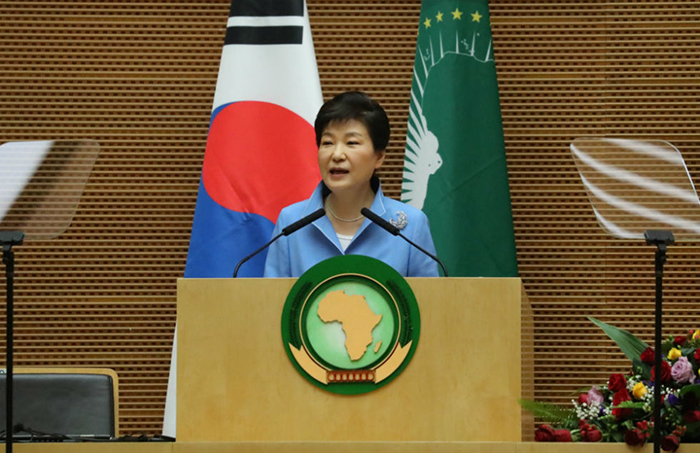
President Park Geun-hye speaks at the headquarters of the African Union on May 27. In her speech, the president unveiled her government's inclusive Korea-Africa aid and cooperation plan.
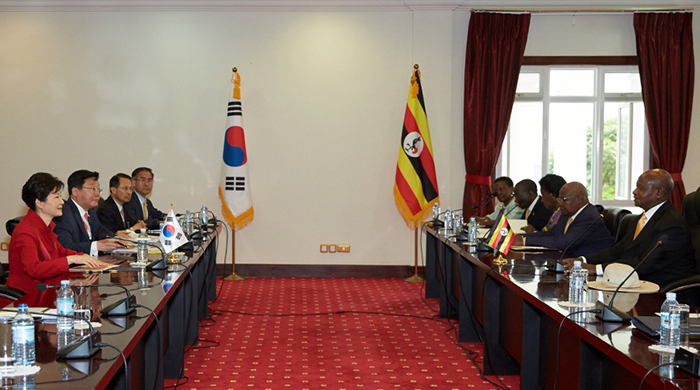
President Park Geun-hye and Ugandan President Yoweri Museveni hold summit talks at State House in Entebbe, Uganda, on May 29. The two leaders agreed to bolster cooperation on the economy, development and defense.
Ugandan President Yoweri Museveni, as well, explained his government's disagreement with the North's nuclear weapons projects during summit talks with President Park. The Ugandan government's decision to halt military and security cooperation with the North Korean government, to implement United Nations Security Council resolutions and to support the Korean Peninsula's denuclearization, were all treated as important news items by the local press, as up until then the government had maintained diplomatic ties with the North. English-language newspapers, such as the New Vision and the Daily Monitor, treated the news as their lead stories, publishing the news on their front pages along with news about the leaders' summit talks.
AU Chairperson Nkosazana Dlamini Zuma assured President Park of her organization's disapproval for the development of nuclear weapons and its support for denuclearization on the Korean Peninsula when they met on May 27 at AU headquarters. The AU is firmly against the development of nuclear weapons by countries that have never had nuclear weapons and supports denuclearization around the globe, the chairperson said.
One day ahead of her meetings at AU headquarters, during summit talks in Addis Ababa, Ethiopian Prime Minister Hailemariam Desalegn promised President Park that his government would implement U.N. resolutions against the North and that all African nations support the halt of North Korea's nuclear weapons development program.
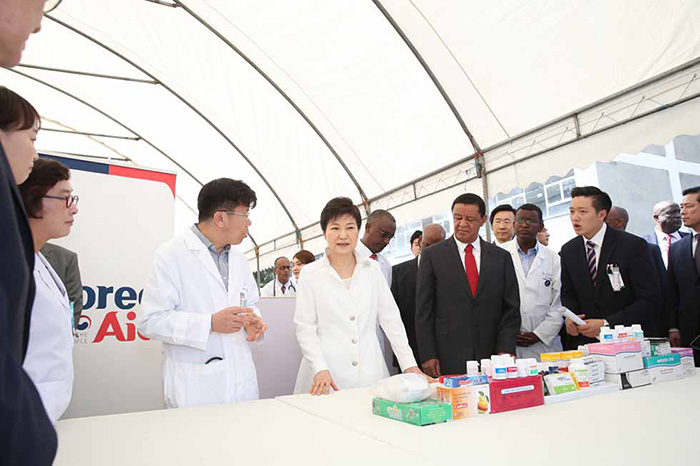
President Park Geun-hye (center) and Ethiopian President Mulatu Teshome speak with Korean medical staff during the launch ceremony for Korea Aid at Addis Ababa University on May 28.
International media, as well, reported on African countries that support denuclearization on the Korean Peninsula. The New York Times released details concerning the Ugandan government's decision to cut all military ties with North Korea and to comply with U.N. sanctions against the North in its article "Uganda Halts Military Cooperation with North Korea" published on May 30. "Uganda has agreed to cut all military and police ties with North Korea, depriving the North of a crucial base for arms and other exports in Africa," the newspaper said.
The Japanese daily Sankei Shimbun said that President Park "succeeded in taking a better position in the tensional South-North relations by sitting down with the leaders of pro-North Korean countries, such as Ethiopia and Uganda" in its article entitled "President Park blocks North Korea by her state trips to African countries, striking North's military cooperation," published on June 1.
By Yoon Sojung, Chang Iou-chung
Korea.net Staff Writers
Photos: Cheong Wa Dae
arete@korea.kr
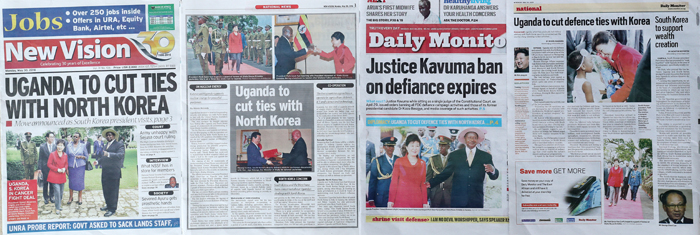
The front pages of major Ugandan newspapers report their government's decision to halt military and police cooperation with North Korea on May 29.
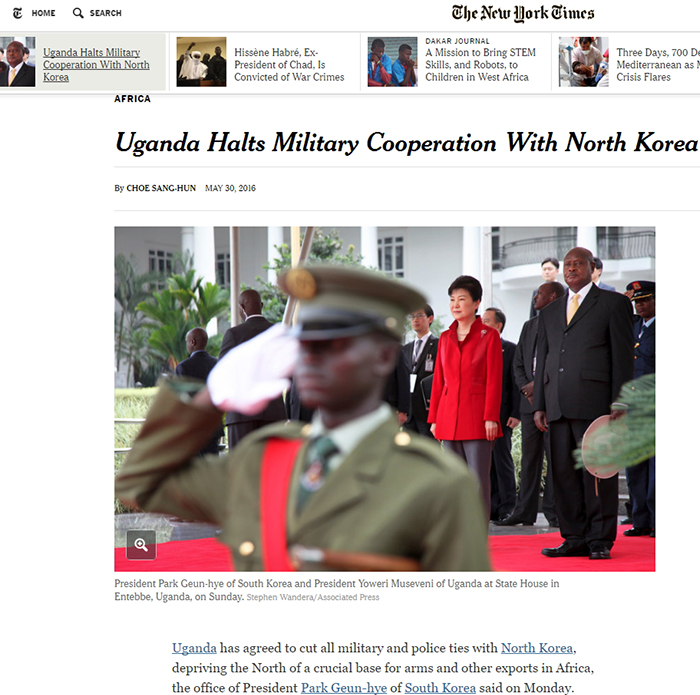
The New York Times reports on the Korea-Uganda summit on its website.