
President Moon Jae-in after his inauguration in 2017 promoted the Small and Medium Business Administration to ministry status, creating the Ministry of SMEs and Startups to nurture future industries. He is pictured here on March 6, 2019, giving a speech at a briefing session on venture capital strategies in Seoul.
By Lee Hana
Photos = Yonhap News
In his 2020 New Year's address, President Moon Jae-in said, "Despite the delayed passage of bills on innovative growth last year, the amount of new investment in business ventures broke the KRW 4 trillion mark, and five new unicorns were created."
"The release of innovative products and services in the market was accelerated thanks to some 200 special exemptions approved via the regulatory sandbox and the designation of 14 special regulation-free zones in provinces and cities."
With the third anniversary of the president's term falling on May 10, these results are a good indication of his administration's direction and policy for achieving innovative growth.
Last year's figures also show how effective the administration's strategies have been for building "an economy pursuing mutual prosperity," especially the plan to promote innovative growth and startups led by small and medium enterprises (SMEs). Through these strategies, the venture capital ecosystem has undergone a transformation that brings with it new opportunities.
First, the Small and Medium Business Administration in 2017 was promoted to ministry status, becoming the Ministry of SMEs and Startups. The new ministry got right to work, revitalizing startups led by the industry's best tech professionals and waiving joint guarantees to expand the infrastructure for entrepreneurs wanting a second chance.
Last year, the ministry injected KRW 4.2 trillion in policy funds to assist some 20,000 startups in the setup, growth and do-over stages. Another plan seeks to provide up to KRW 12 trillion in funds by 2022 to boost promising startups.
The administration also introduced Korea's own regulatory sandbox for four sectors in the real economy: information and communications technologies (ICT), industry convergence, financial innovation and specialized regional development. This allowed these sectors to test new services, products and business models, with the appropriate regulations introduced later.
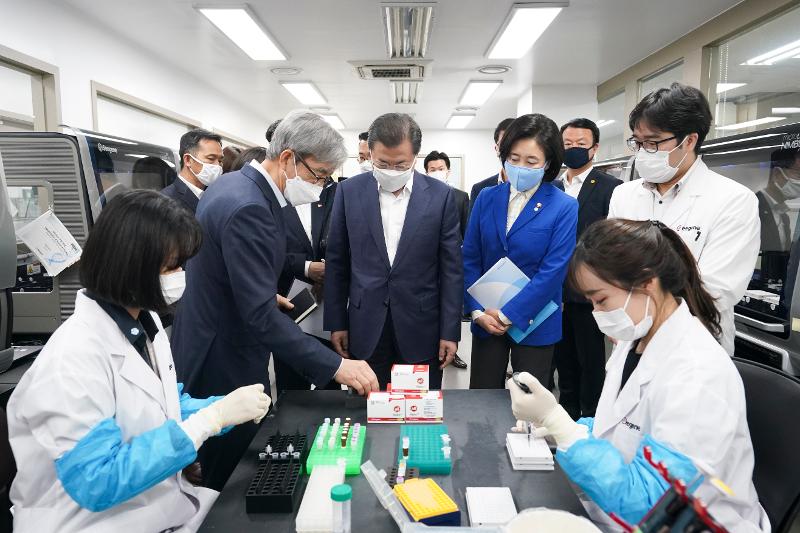
The Ministry of SMEs and Startups on April 9 announced the K-unicorn Project, whose goal is turning Korea into one of the world's top four powerhouses in venture capital. Pictured is President Moon at a Seoul lab of Seegene, one of the producers of Korea's COVID-19 diagnostic reagents and kits.
Innovative growth policy has helped spur investment in venture capital, increase the number of new corporations and given rise to new unicorn companies.
Last year, 108,874 new corporations were registered, a 6.7% rise from the previous year. The number of unicorn companies grew to 11, up from just two in 2014. As of Feb. 17, Korea ranked sixth on the global unicorn rankings behind the U.S., China, the U.K., India and Germany.
To incubate more unicorns, the ministry on April 9 announced the K-unicorn Project, whose goal is turning Korea into one of the world's top four powerhouses in venture capital.
This project is designed to provide support to more innovative startups in the initial stage, given that most existing unicorns were born in the ICT and platform industries. To promote large-scale investment, the ministry has raised a KRW 1 trillion fund to stimulate growth, created an investment guarantee leverage program and expanded guarantees for preliminary unicorn companies, or startups with a valuation of KRW 100 billion or higher. It is also working to allow non-listed venture firms to issue dual-class stocks.
With such measures in place, the ministry announced that it hopes to see 20 unicorn companies in the market by 2021, a year ahead of schedule, and launch 500 preliminary unicorns by 2022.
"Recently, over 120 countries sought Korean-made COVID-19 test kits, which goes to show how a crisis can create new opportunities for our nation's innovative startups and venture companies," said Minister of SMEs and Startups Park Young-sun.
"To ensure that promising companies scale up to become unicorns, the government will work with the private sector to vigorously pursue the K-unicorn Project and make Korea one of the world's top four powerhouses in venture capital."
hlee10@korea.kr